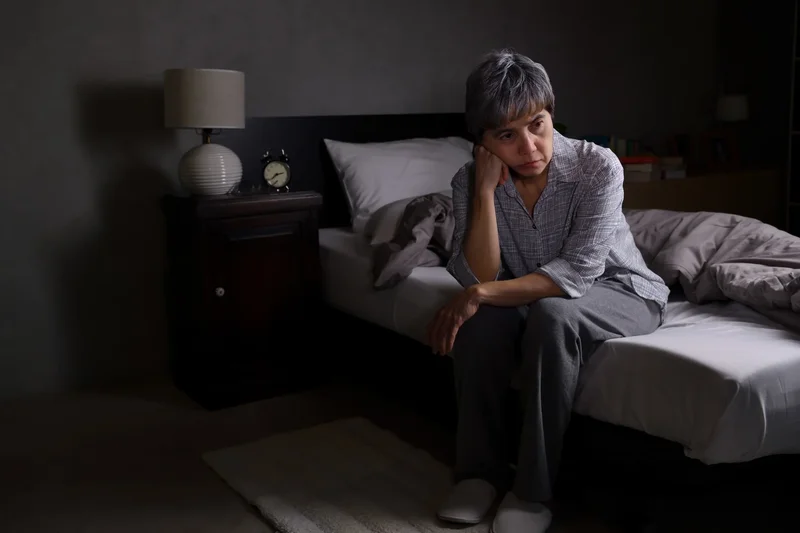
Objective sleep tracking reveals how shifts in nighttime rest, daytime napping, and circadian rhythms may provide early warning signs of declining health in very old women.
Study: Multidimensional sleep-wake changes and risk of all-cause and cardiovascular disease mortality in oldest-old women. Image Credit: amenic181 / Shutterstock
In a recent study published in the journal Communications Medicine, researchers examined five-year changes in sleep-wake patterns and their associations with cardiovascular disease (CVD) and all-cause mortality risks in the oldest-old women, i.e., those in their 80s and 90s.
Circadian rhythms and sleep patterns undergo significant changes with age. These changes include increased sleep fragmentation, reduced circadian rhythmicity, longer sleep onset latency, and poor sleep efficiency, among others. They are well documented from middle age through the sixth and seventh decades of life, but poorly defined thereafter.
Studies have identified a higher risk of all-cause or CVD mortality with poor sleep quality, long or short sleep duration, long daytime napping, and weaker rest-activity rhythms (RARs) in older people. Nonetheless, little is known about how long-term changes in sleep-wake patterns relate to mortality risk in older populations.
About the study
In the present study, researchers evaluated changes over 5 years in circadian RAR and 24-hour sleep patterns, and their associations with CVD and all-cause mortality risks. They included participants from the Study of Osteoporotic Fractures, which recruited community-dwelling White women aged ≥ 65 years in 1986-88.
Specifically, participants with actigraphy data at the first two sleep visits in 2002-04 and 2006-08, respectively, who were subsequently followed for mortality were included. At both visits, participants wore wrist actigraphs for at least three consecutive days. The present study examined nine sleep-wake metrics across circadian RAR, nighttime sleep, and nap domains.
Nighttime sleep parameters included sleep efficiency, wake after sleep onset (WASO), and total sleep time (TST). Circadian RAR parameters were amplitude, robustness, acrophase, and mesor, a measure of average activity level. Nap parameters were nap duration and frequency. The primary outcomes were CVD mortality and all-cause mortality. Participants’ vital status was obtained every four to six months, and the cause of death was confirmed using death certificates.
Questionnaires were used to collect data on age, education, functional impairments, exercise, self-rated health, medical conditions, and self-reported sleep apnea. In addition, the Modified Mini-Mental State Examination (3MS) and Geriatric Depression Scale were administered. The researchers used hierarchical clustering on principal components (HCPC) analysis to explore profiles of sleep-wake changes, and Cox proportional hazards models to evaluate their associations with outcomes.
Findings
Overall, 704 White women with a mean age of 82.5 years at the first sleep visit (2002-04) were included. Several changes in circadian RAR and sleep patterns emerged over time. On average, participants had small changes in sleep efficiency, WASO, and TST, but nap duration and frequency increased substantially. Meanwhile, amplitude, robustness, and mesor declined considerably, reflecting worsening RAR.
Three profiles of longitudinal changes in circadian RAR, nighttime sleep, and napping parameters were identified: stable sleep (SS), increasing sleepiness (IS), and declining nighttime sleep (DNS). Around 44% of participants showed the SS profile, i.e., minimal changes or improvements across parameters. Another 35.7% of participants had the DNS profile, experiencing reductions in the circadian RAR domain, worsening sleep duration and quality, and modest increases in napping.
About 20.7% of participants showed the IS profile, characterized by considerable increases in nighttime sleep duration and efficiency, along with increases in daytime nap duration and frequency, and reductions in circadian RAR parameters. IS participants were slightly older and had worse 3MS performance compared to those with a DNS or SS profile. During a median follow-up of 2.1 years after the second sleep visit, 90 deaths were recorded, including 35 CVD deaths.
Participants with an IS or DNS profile had approximately twice the hazard of all-cause mortality as the SS group. In age-adjusted analyses, neither profile was significantly associated with CVD mortality. After full adjustment, however, DNS was associated with CVD mortality (HR 2.60, 95% CI: 1.03-6.57), whereas IS was not. Further, participants with significant reductions in amplitude or robustness and larger increases in nap duration had a greater risk of all-cause mortality than those in the improving or stable group, after adjustment for age. However, the amplitude and robustness associations were attenuated and no longer statistically significant after full adjustment.
Subjects with increased nap frequency or decreased TST had more than twice the risk of CVD mortality in the fully adjusted analyses. After correction for multiple testing, the DNS profile and increased nap duration remained significantly associated with all-cause mortality. In stratified analyses, large increases in TST were associated with a threefold increase in all-cause mortality risk only in those with long baseline TST. Large decreases were associated with significantly elevated risks of all-cause and CVD mortality among those with long baseline TST, although the corresponding interaction tests were not significant. Therefore, the study did not establish that these associations differed between participants with long and short baseline sleep.
Conclusions
In summary, the oldest-old women with increasing 24-hour sleepiness or declining nighttime sleep had approximately twice the hazard of all-cause mortality compared to those with stable sleep patterns. Large increases in nap duration were associated with more than twice the hazards of CVD and all-cause mortality. However, the observational study cannot establish causality, and changing sleep patterns may reflect underlying illness rather than directly contribute to mortality. The short follow-up, small number of CVD deaths, reliance on self-reported sleep apnea, and inclusion of only White community-dwelling women also limit interpretation and generalizability. These results suggest that long-term changes in circadian rhythms and 24-hour sleep in the oldest-old may not simply reflect normal aging but instead serve as markers of increased mortality risk.
Journal reference:
- Leng Y, Milton S, Yaffe K, et al. (2026). Multidimensional sleep-wake changes and risk of all-cause and cardiovascular disease mortality in oldest-old women. Communications Medicine. DOI:10.1038/s43856-026-01789-y. https://www.nature.com/articles/s43856-026-01789-y