A crack house. We all have a mental image of one, on the poorest fringes of town in its meanest street; squalid and derelict, like the dissolute and lost souls who frequent it.
But this drug den was different. Misty River Hotel was a six-storey Georgian house near Kensington Palace in London’s most exclusive borough.
Sandwiched between embassies, from a distance it looked as grand as its neighbours.
But the nearer you got, the more the illusion was shattered: paint was peeling from its portico; its facade was flaking. Walking in jolted the senses. The debauched chaos was unmatched – but it was the stench that hit you most: ‘Heroin and p***; smells that always come together,’ says chef Alasdair Gill.
Gill, 33, frittered a lost decade as an habitue of the now defunct ‘hotel’ – while holding on, with an ever more tenuous grip, to a series of jobs in top London restaurants (one even had a Michelin star) – all the while in thrall to a spiralling drug and alcohol addiction.
‘Misty River was the perfect hideaway. A hotel, right? It belonged to a totally broken, junkie family, hiding in plain sight. I saw royalty, degenerates, lords, guys who’d survived the 80s punk scene, all come and go.’
In the basement, dealer Matt dispensed coke, ketamine, pills and ‘enough acid to travel for months without leaving the room’. Up in the attic, his mother Elfie dealt in the hard stuff: pipes, needles, smack. ‘I had a problem with pretty much every one of them at some point,’ Gill tells me.
But what began as a ‘Disneyland’ of tantalising excitement ended in squalor: days that morphed into nights spent on strangers’ floors, in doorways or on pavements, ‘splattered with blood, urine and cider – the best-case scenario being that they all came from me’.
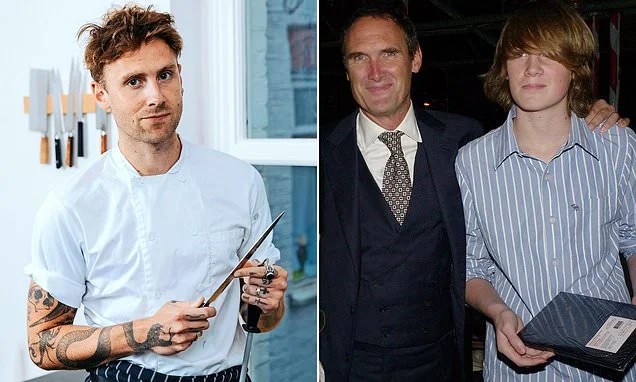
Alasdair Gill, chef and son of the late restaurant critic AA Gill and former Tory politician Amber Rudd spent years in active addiction
Gill has been sober for six years now. He is sweet-natured and tousle-haired with earnest eyes, elaborate tattoos and a polite, almost diffident manner. It is hard to imagine him hoovering ketamine and coke from the edge of his chef’s knives each morning to kick-start his system into life while lying to his loved ones about the scale of his addiction.
Now in a happy relationship with Danish actress and model Maja Simonsen – they have a six-month-old son Arlo – he has just written a corker of a memoir.
Knives And Spoons: A Chef’s Story Of Kitchens, Addictions And Mayhem is a blistering account of the years he spent freebasing crack cocaine and swallowing dodgy Xanax laced with fentanyl, while ‘aggressively drinking, smoking or inhaling just about every other drug known to man’.
All the while – and this is the minor miracle – he also cooked with a flair that belied his tortured physical and mental disintegration, in a multitude of London kitchens from the louche Spuntino in Soho to grand brasserie The Delaunay in Covent Garden.
If his name sounds familiar, it is – because he is the son of the late Adrian, ‘AA’ Gill, the dazzling, often acid-penned restaurant critic, who died in 2016 of cancer, aged 62, and was also a recovering alcoholic and drug user. (He always used his initials, AA, in tribute to Alcoholics Anonymous, to which he owed his sobriety.)
Gill Junior has inherited from his dad, not only his addictive personality but also his dyslexia, his wry humour, his passion for food – and his ability to write soaring, transcendent prose: all this despite his parlous academic record and expulsion from two schools for taking drugs.
I ask how it all started: ‘I don’t remember my first drink or drug but I definitely remember not understanding why anyone at school would sit in the library and do their homework when they could be out getting drunk.’
Gill’s mum is the redoubtable Amber Rudd, 62, the former Tory politician who served as Home Secretary and Secretary of State for Work and Pensions between 2016 and 2019 while Alasdair’s addiction was at its height. He has a sister, journalist Flora, 35.
Rudd was married to Alasdair’s dad for just five years before they divorced in 1995, and he married journalist Nicola Formby, with whom he had twins Isaac and Edith, now 19.
Did Alasdair’s clearly loving family have any idea of the epic scale of his addiction? The answer is ambivalent: probably yes – and in some respects no.
Alasdair Gill seen with his father AA Gill and sister Flora. 'Dad knew there was absolutely nothing he could do except keep the door open for me,' he says
When I first mention the H word – I ask sternly if he was taking heroin – he smiles and says: ‘You sound like my mum.’
So did they have the conversation? ‘No, there was none of that. If I was in a really bad way from taking heroin – you’re either sick or high – I just wouldn’t show my face.
‘I was also really good at lying, at covering my tracks and convincing everyone I was fine. I didn’t want to get caught. Ever.’
But surely his mother must have clocked that when Alasdair, in her absence, invited junkies to her home in Hammersmith, west London, for parties, her spoons were blackened from cooking drugs? Apparently not.
But she did notice – he laughs – a set of abandoned dentures, left by an addict rendered toothless from years of smoking toxic chemicals. ‘Mum did ask: “Who’s been here?” when she saw the false teeth. She’s liberal with a great sense of humour – but she had no idea they belonged to an old junkie.
Honestly, she was busy running the country and when I used her London house to sleep in she was often in her constituency.’ Rudd represented Hastings and Rye from 2010 to 2019. ‘She was divorced when we were just little children in her 30s and was really driven to make something of herself for all of us. She was very busy; a remarkable woman.’
Later, it was Rudd who took the practical steps to help her son on his path to rehabilitation but, meanwhile, what of his dad? How did he, with his first-hand knowledge of addiction, deal with his son’s descent into the abyss?
I get the sense that Alasdair couldn’t pull the wool over his father’s eyes because he’d been there himself.
‘Yes, I think that’s true,’ he agrees. ‘Often sober addicts are calmer than people who know nothing about addiction. Dad knew there was absolutely nothing he could do except keep the door open for me. You can’t jump-start an addict into sobriety. I’ve never heard of anyone becoming sober because someone else wanted them to be.
‘I understand why some parents freak out and their minds turn straight to devastation and death but they just can’t force their agenda on their children.
‘Mum and Dad were there for me in so many ways. I just chose not to take their help for so long.’
When AA Gill died, his son had hit a nadir: his life was chaotic; he was, ‘unmanageable, unhinged, unreliable’. He was working at Spuntino, sharing pipes with crackheads on the street, barely hiding his affiliation with them from his colleagues.
Then he noticed his ancient Nokia mobile, mislaid for days, buzzing urgently. Dozens of missed calls. Flora was summoning him to Charing Cross Hospital where their dad lay dying.
There, Adrian’s last tender request was that his son ‘watch over him’ while he slept. It is a measure of Alasdair’s love for his father that he did not leave his bedside until he took his last breath, sleeping on the floor beside him.
He tells me, without irony: ‘I only left him twice: once to meet my dealer in A&E and once when Dad had an (online) AA meeting.’
Alasdair's mother is the redoubtable Amber Rudd, 62, who served as Home Secretary and Secretary of State for Work and Pensions between 2016 and 2019
Gill Snr never missed those meetings, even as death loomed. And when he died, his son succumbed to racking sobs: ‘My chest felt like it was splitting open.’ But even profound sadness failed to jolt him into sobriety: he did not get clean for another four years. In fact, his continued descent was both tragic and at times farcical.
After a three-day bender, he and a fellow addict cooked lunch for a party of stockbrokers. They mislaid their stash of ketamine, only to discover it – in full view of their clients – liberally dusting the tuna dish they’d prepared.
Then Alasdair was found comatose in his manager’s office, with one hand in a bag of powder, the other in a plate of meatballs.
‘I desperately wanted to seem like I was fine and I thought I was good at it. The only thing worse than being in physical and emotional torment was everyone knowing about it,’ he says.
I ask when he hit rock bottom but it seems that when he thought he’d reached it, some event of even more appalling depravity would trump it. He passed out in the middle of service. He fought the urge to vomit with more ketamine and coke and blacked out again.
His mum, catching a rare glimpse of him, knew he needed help. ‘She asked if I’d like to go to a culinary school in Ireland. Because I thought London was toxic – as an addict you think going somewhere else will solve your problems – I agreed.’
In Ireland he was top of the class; he felt encouraged and restored by his tutor’s praise. But returning to London, he relapsed: ‘I was back on the one-way descent. I didn’t want to live any more but I was too cowardly to end it.’ Then came the real wake-up call: even the people he despised started to pity him.
‘I thought I was above the crackheads, the junkies, the dealers but even they started to think of me as below them: this crazy guy desperate for more drugs. Finally my dealer, who’d spent time in prison for stabbing his business partner, said I needed help.’
It was then that his mum – ‘a woman built from the sort of steel scaffolding they don’t make any more, a support I’d ignored and fled from. Like Dad, she’d been there for me for so many years but I chose not to take her help’ – got through to him with one question: ‘Are you OK?’
It opened the floodgates. At last he admitted he wasn’t. Far from it: ‘I hadn’t been for years and I didn’t want to be here any more.’
His mum sent him to a private doctor in Harley Street who gave her clinical diagnosis: ‘She talked about genetics and said that having an alcoholic father meant I had a 50/50 chance of being an addict, too.
‘Then she gave me the news: early stage cirrhosis had turned my liver into parfait. I had scarring on my bladder, heart irregularities, cracked lungs. But my liver was the headliner. Then she said, “You’ll be dead by Christmas if you don’t seek help immediately.”’
Alasdair was ready for rehab – but he did not realise how gruelling it would be. It was then that his dad returned to him in an unexpected way.
A fellow addict in rehab, discovering a copy of AA Gill’s memoir, Pour Me, gave it to Alasdair. ‘I’d never read a word of what Dad had written before,’ he says. ‘Why would I? He’d always been there, living, talking; filling the room with his wit. Although I’d known he was an alcoholic, I’d never seen him drunk, never knew how far he’d fallen.
‘But reading his book I realised how he’d been through everything I was going through: the hallucinations, the shakes; the despair. I hadn’t even thought we were that similar.’
The pity is, I say, that he never got to see you clean. ‘Yes but there are so many flips to that coin. I grew this whole new relationship with him after he died from the connection we shared.
‘He left something for me in his book; one last bit of guidance. He helped me from beyond the grave. Reading his book was like reading my own story; we’d even blacked out in the same pubs. It was a “holy s**t” moment to read that.
‘It’s been brilliant having his writing. I feel his presence. It’s as if he showed up to save my life.’
So here he is today: writing, as his dad did, running his own business as a private chef; a father himself, living in his own home with Maja and baby Arlo.
‘Responsibilities,’ he says. ‘I’d been avoiding them all my life but now I have them, they anchor me. I’m doing really well. Life is so much better without drugs.
‘It’s the difference between being in a cage and an endless horizon. You don’t get rid of the cage but you’re no longer confined by it. It’s important to understand that because the second you don’t is when you slip.
‘And I can’t relapse now because I’ve built too much.’
Knives and Spoons, by Alasdair Gill (£20, Macmillan) is out now