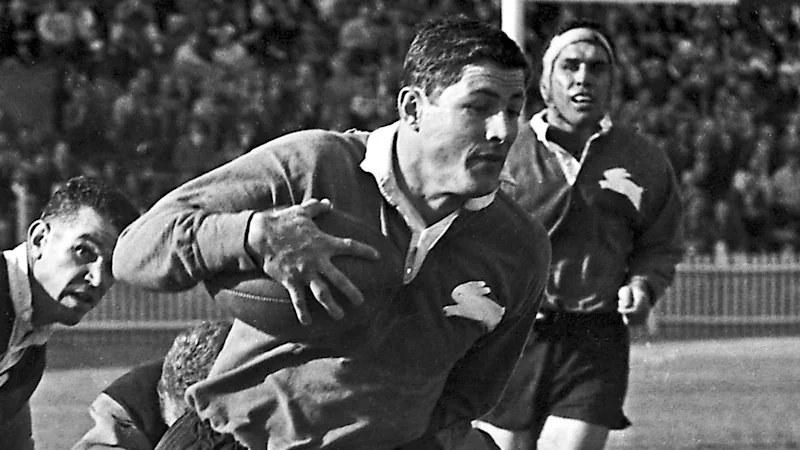
Mike Cleary got the shock of his life when he woke up on Wednesday and heard his name on radio. Now 86, Cleary figured the days of being in the news as a dual international footballer, and later as a Member of the NSW Parliament, had ended decades ago.
“My wife said to me: ‘What did you do? What’s all this comparing to you?’” Cleary said. “I said, ‘I don’t know’. But then I saw the news and I saw the race. It’s been a long time. I had forgot all that.”
The race was Lachlan Kennedy’s historic silver medal run in the 100m at the Commonwealth Games in Glasgow, in which the Queenslander set a new national record of 9.85 seconds.
It was the first time an Australian man had won a medal in the blue-riband sprint in 64 years – a drought stretching back to 1962, when Cleary won bronze in the 100-yard dash at the Commonwealth Games in Perth.
Like Kennedy, Cleary was 22 at the time and also feted as Australia’s fastest man. But that’s where the comparisons end for two stars of very different eras.
In 1962, Cleary was juggling athletics with a footy career, and after having already played for the Wallabies, the Sydneysider had recently switched codes and was also playing league for the South Sydney Rabbitohs. The pacy winger went on to play 139 games for the Bunnies, winning three premierships, and he also played eight Tests for the Kangaroos.
Cleary was inducted into the Sport Australia Hall of Fame in 1999, as one of only four icons who represented Australia in three different sports at a senior level, along with Snowy Baker, Dick Thornett and Wal Mackney. In one 16-month period, Cleary competed for Australia in rugby union, athletics and rugby league.
“They were different times then, we just did everything,” Cleary said. “And I was working, too.”
Cleary took issue with one part of the reporting on Wednesday, which declared Kennedy was the first man to stand on the podium in the 100m since Cleary in 1962. Strictly speaking, it should have been “since Gary Holdsworth in 1962”.
“I actually didn’t get on the podium,” Cleary said. “They gave the medal to the other Aussie in the race for a few days.”
Some background is required. Cleary was a schoolboy athlete at Waverley College, running world-class times for the 100 yards (91.4 metres) as a teenager in the late 1950s.
While playing rugby for Randwick, Cleary also set his sights on running at the Rome Olympics in 1960, and while he was fast enough, glandular fever kept him out of the trials. He beat the Aussie sprinters at a farewell race, but it was too late for selection.
Cleary went on to play six Tests for the Wallabies in 1961, and South Sydney made an offer for the speedster to switch codes in 1962.
“I said, ‘No, I can’t turn professional because I want to go to the Commonwealth Games’, given I had missed the Olympics,” Cleary recalled. “They said, ‘Well, you can play for nothing if you want to.’ So I played for nothing.
“I had to sign statutory declarations – they were very strict with the amateur rules then. In ’62 when I was playing for Souths, I won a Seiko watch, which was 25 quid. And I couldn’t accept it.”
Juggling work and league training, Cleary also did sprint sessions at Maroubra with a coach from the Bondi Surf Club. He won selection to run for Australia in the 100 yards, 220 yards and relay in Perth, and paid £20 for a new pair of custom spikes made of “beautiful kangaroo leather”.
The long “inch and a half” spikes worked perfectly when Cleary raced on cinders in Geraldton ahead of the Games. He ran a hand-timed 9.3 seconds in Geraldton. No one in the world had run faster.
In these Commonwealth Games, however, Australian management forgot to tell athletes the track would have a new synthetic “Tartan” surface.
“No one told me to go down to the local garage and file the spikes down or something,” he said. “We ran heats and so on, and by the time of the final they were crap and bent and useless.”
Kenya’s Seraphino Antao won gold and Tom Robinson of the Bahamas claimed silver, but in a photo finish, judges gave the bronze to Holdsworth. Five days later, Cleary was on the starting blocks of the 220 yards when they were told to stand up.
“So up we get, and the announcement says, ‘Ladies and gentlemen, the judges have reviewed the photo finish in the 100 and it was Cleary third’,” he said. “Then it was, ‘Get on your mark’. Well, I was in pieces, I came in second last.”
The next day Cleary was having lunch in the dining hall with Dawn Fraser and gold medallist boxer Tony Madigan.
“[Games official] Arthur Tunstall came in and said, ‘Here’s your medal son, good job,’ and that was that,” Cleary recalled with a laugh.
Even with times that could have potentially won an Olympic medal in the 100m two years later in Tokyo, Cleary says he never thought seriously about pushing on with sprinting.
“I just changed my thoughts to football,” he said. “I gave it all away. I thought I missed Rome but I got the Empire Games, I’ve done everything I wanted to do. I just accepted it [missing the Olympics] at the time.”
Cleary ran professionally a few more times – including a match race win against fellow league speedster Ken Irvine in 1964 – but he mostly focused on footy.
After retiring following a year at Easts in 1971, Cleary was urged by entertainer and Souths supporter Don Lane to have a crack at politics, and he went on to serve as Member for Coogee for 17 years.
He was Minister for Sport, Recreation and Tourism in the Wran Labor Government in the 1980s. He also did a stint as a broadcaster, commentating on rugby league and even wrestling.
Cleary keeps up to date with Australian athletics, and was particularly wowed when Gout Gout broke the 200m record of Peter Norman, set in 1968.
“Because I remember being wowed by Norman at the time, too, with his times” he said.
Cleary appreciates the discipline and single-sport commitment required by today’s runners, and hopes
Kennedy pushes on down the path Cleary didn’t take and wins an historic Olympic medal in the 100m in 2028.
“He’s fantastic. I am just full of admiration for what they can do these days,” Cleary said. “They’re so, so fast.”