Solar installers are warning of a looming worker shortage, if low-cost loans or subsidies are brought in without any support or training for the wider electrical industry.
Many political parties have announced policies to boost rooftop solar uptake ahead of this year's election, and the Ministry for Regulation today recommended streamling the regulatory process for installing solar.
Some installers have seen demand explode this year already and said the industry was now near capacity, even without additional incentives.
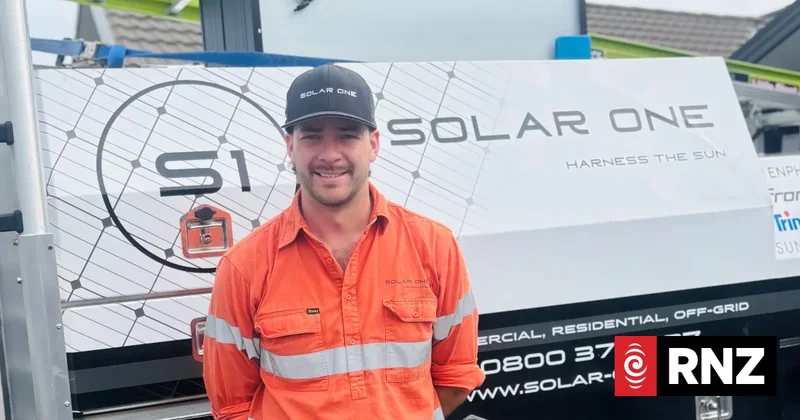
New Plymouth electrician Brad Lynch has run solar installation company Solar One for the last seven years, starting out as one man and a van.
That had rapidly changed in the last two years, he said.
"Last year we were three to four staff and we've scaled up to seven staff this year and we're hiring again to keep up with demand."
Interest had surged after the current Middle East conflict began, he said.
"Everyone wanted electric vehicles, gas prices went up and solar was the talk of the town. We saw a 300 percent increase in inquiries overnight with that war kicking off."
With some form of financial support or incentive for households looking inevitable post-election, he was anticipating yet another jump in demand.
"We're planning for about a 40 to 50 percent increase in work as these subsidies roll out, so we're looking to scale to between 10 and 15 people over the next 12 months to make sure that we're set up for these schemes to roll out," Lynch said.
Each new staff member was already a qualified electrician, but still took about six months to get up to speed with solar, he said.
Workforce needs to double - at least
Solar Energy Association of New Zealand spokesperson Gareth Williams agreed that interest had "really just taken off quite suddenly" after the Middle East conflict began.
"Even though that doesn't directly relate to solar, it's got people thinking about their costs, and then there was another round of quite significant electricity price increases in April."
Many of the organisation's members had reported similar increases in business to Brad Lynch, which was putting pressure on their turnaround times, Williams said.
"In some cases, there are several weeks' lead time before they can even go and visit the site to look at the job to give the customer a quote."
SEANZ estimated there were between 1500 and 1800 solar installers working in New Zealand.
A quarter of those were electricians, who had to be involved in every solar installation job due to the high voltages involved.
The remainder were workers under the electrician's supervision - "the people who get on the roof and put up the panels", William said.
Based on what had happened in Australia, but adjusting for less-aggressive subsidies, SEANZ expected a 250 percent increase in uptake over the next five years.
"Which roughly means, based on our calculations, probably about another 2500 installers, a combination of electricians and mechanical installers."
That did not include additional administrative and sales staff, system designers, and project managers, he said.
Getting enough people was only the first step, Mr Williams said.
"Are they the right people? Are they following good work practices and doing good-quality installs?"
That did not happen universally in Australia at the beginning of its solar surge 15 years ago, he said.
"There were a lot of issues."
Demand from electricians for upskilling growing
In a statement, Master Electricians said demand for solar was clearly building.
New apprenticeships alone would not address near-term demand and the main focus should be on upskilling existing electricians, chief executive Alexandra Vranyac-Wheeler said.
"Bringing an existing electrician up to speed on solar takes months. A new apprentice takes years to reach the same point."
There needed to be a funded plan to lift training capacity across the board, she said. "We're ready to work with the government on what that looks like."
Since last year, electricians have needed a solar-specific endorsement, which they could get by completing a three-day course, or providing evidence of significant experience.
"We're seeing high demand in solar-specific upskilling through our streamlined Trade Master training courses, and that tells us this is one of the fastest-growing parts of the trade right now," Ms Vranyac-Wheeler said.
Brad Lynch said the current endorsement system was "a bit clunky" and he wanted industry bodies to work together with the government to introduce proper certification.
That needed to happen now, not after the election when policies were being rolled out, he said.
"My idea would be a six-week boot camp for electricians that aren't in solar yet to get up to speed and competent and up-to-date with all the standards, so that we are prepared for a subsidy rollout - because at the moment, when that demand goes up, I don't think we are ready as an industry for that kind of thing."
Australia now ran similar "boot camps" that New Zealand could model its own system on, he said.
"If we don't have the staff or the workforce to match demand, there are going to be corners that are going to be short-cutted and there are going to be end-users that are going to be disappointed."
Among the solar policies announced ahead of the election, Labour has committed to putting aside $4 million dollars for workforce development.
That would include apprenticeships, retraining and microcredentials.
Alternative pathways needed for other tradies - solar advocate
Solar advocate Mike Casey, from Rewiring Aotearoa, said he would like to see a fast-tracked pathway for people who were already qualified in other trades.
"What's going on for the 40-year-old gasfitter that's going to need to be retrained? Right now, they have to do a three-year apprenticeship on apprenticeship wages in order to become an electrician," he said.
"Is there an opportunity for a quicker course that you can do in three months or six months, for example, where you can't sign off your own work ... but you can start laying cables and doing your own wiring and just have to have someone else approve it?"
The burgeoning demand for solar was also a chance to address a mismatch between the numbers of training opportunities available and young people searching for work, Casey said.
"The mums of New Zealand are telling me that there's not enough apprenticeships for their kids and the solar installers of New Zealand are telling me there's not enough trained people."
The Energy Efficiency and Conservation Authority said it was currently consulting on an industry-led solar installer accreditation programme.
Most of the ministry's recommendations today, which the government was yet to respond to, aimed at simplifying the steps and rules required for an small-to-medium installation.
However, the review recommended removing the need for an independent electrical inspector to sign off on every job, provided the electrician doing the work was an accredited installer.
The recommendation would allow installations to be signed off more quickly, the review said.
However, it would also likely address concerns raised by those who spoke to RNZ prior to the announcement, identifying inspectors as another area of workforce shortage because of the need for them to also hold a specific solar endorsement.