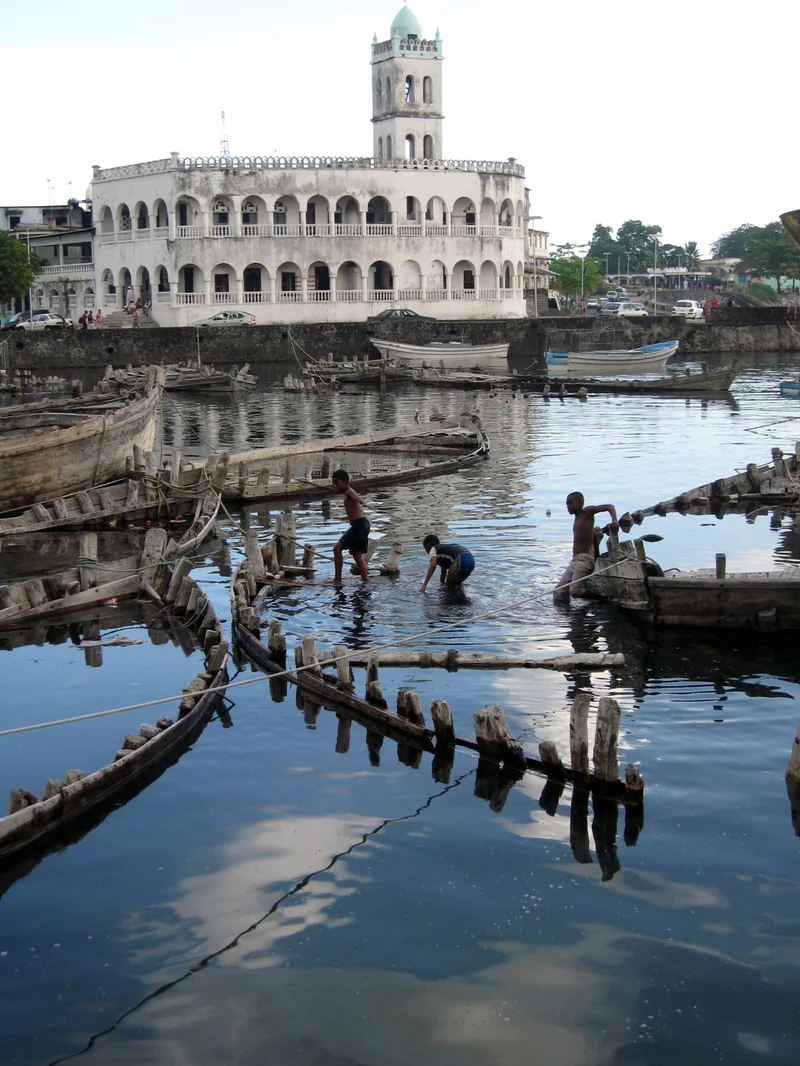
Comoros Wins Its First UNESCO Listing for Six Medinas
COMOROS · CULTURE
What the Comoros UNESCO World Heritage listing covers
The property is serial rather than single. Four of the six medinas are on Grande Comore — Moroni, Iconi, Itsandra and Ntsudjini — and two on Anjouan, at Mutsamudu and Domoni.
Together they cover 30.47 hectares with a buffer zone of 131.68 hectares, inscribed under criteria three and four. UNESCO’s citation describes towns that grew from urban nuclei of at least the 11th century into city-states by the 14th and 15th.
What the committee singled out was social as much as architectural. The citation notes a hierarchy built on matrilineal and matrilocal custom, age-group systems and patrilineal Islamic tradition that is still in use.
The decision came on Saturday 25 July in Busan, where the committee inscribed 25 new sites in all. The register now holds 1,273 properties across 173 countries.
Six towns, six centuries of Indian Ocean trade
The best-known of the six is the capital’s. Moroni’s 14th-century medina is built around the Old Friday Mosque, its green-topped minaret facing a harbour where wooden dhows still tie up, behind paved alleys and multi-storey houses with heavy carved doors.
Iconi, south of Moroni, goes back to the 12th century and holds the ruins of the palace of the sultans of Bambao. It also holds the tomb of Prince Said Ibrahim, son of Said Ali, the last sultan of Grande Comore.
Domoni on Anjouan was once a capital of the sultanates and keeps palaces and mosques from the 14th century. Mutsamudu’s narrow lanes and wooden doors date largely from the 17th.
The islands sit about 300 kilometres off the African coast, at a junction of routes linking East Africa, the Arabian peninsula, Persia, India and Madagascar. The fabric shows it, in zawiyas and fortifications built as much against Malagasy raids as for prayer.
A listing is a bill, not a cheque
The most useful line in the local coverage is the plainest. Inscription does not carry an automatic right to a sum of money; anything that arrives does so project by project, against criteria.
The country’s culture minister, Said Mohamed Ali Said, put it carefully. “This listing is not a finish line but a starting point,” he said, adding that the heritage is fragile and in places in real danger.
The threats named by officials are ordinary rather than dramatic. Uncontrolled building and what one heritage official called modernisation have altered the medinas, and salt air and time have done the rest.
UNESCO’s own nomination assessment is candid that the oldest structures are highly vulnerable, with several cases in serious disrepair. That is the position the listing now obliges the state to improve.
Who actually paid for the nomination
The file did not appear quickly. It rests on roughly twenty years of work by the Comorian heritage collective and the national documentation and research centre, alongside France’s national heritage institute, the École de Chaillot, the Compagnons du Devoir and the ALIPH foundation.
The diplomatic backing came from three capitals with interests in the region: France, Saudi Arabia and Oman. UNESCO’s wider heritage-and-development programme for African island states is financed by Saudi Arabia.
That is worth noticing rather than dismissing. Cultural patronage is one of the cheaper instruments of influence in the western Indian Ocean, and the Comoros sits on a shipping lane between the Mozambique Channel and the Gulf.
For upkeep, the World Bank’s 2023 country economic memorandum found that investment in the islands’ tourism sites is financed mainly through projects backed by the Bank, the African Development Bank and the French development agency. It also found no budget line wholly dedicated to restoring them.
What it could mean for visitors and investors
The immediate effect is visibility. Officials and local associations expect the listing to draw researchers, partners and cultural tourists, and to support crafts, guesthouses and restaurants around the six sites.
The scale to expect is modest, and the baseline is genuinely unclear. Published arrival figures for the Comoros vary so widely between sources that no reliable number can be quoted, which is itself a measure of how thin the sector’s data is.
The economic picture is steadier than the tourism one. The IMF completed the fifth review of a four-year, US$43 million programme in February, releasing US$4.87 million, and projects growth of 4.1 percent this year after 3.8 percent in 2025.
The islands run on remittances and three crops. Money sent home by a large diaspora is worth somewhere between a fifth and a quarter of national income on World Bank data, and export earnings rest on vanilla, cloves and ylang-ylang rather than on visitors.
The currency is unusually predictable for a small island economy. The Comorian franc is pegged to the euro under a monetary agreement with France, which removes the exchange-rate risk that complicates most frontier tourism plays.
President Azali Assoumani, who attended the session, announced a national centre for the conservation of arts and culture. Whether it is funded is the question that decides what the listing is worth.
What to watch
The first marker is a management plan with a budget attached, since none has been published. Without one, inscription documents the problem rather than solving it.
The second is the wider session, which was not uniformly good news for the continent. South Sudan’s Boma-Badingilo migratory landscape was inscribed on an emergency basis and placed on the danger list the same week, while São Tomé and Príncipe won its own first listing for the plantation estates known as roças.
The third is whether Comorian institutions rather than foreign donors end up holding the files. That is the difference between a heritage economy and a heritage grant.
Frequently Asked Questions
What did UNESCO list in the Comoros?
It inscribed “The Medinas of the Historic Sultanates of the Comoros”, covering six towns: Moroni, Iconi, Itsandra and Ntsudjini on Grande Comore, and Mutsamudu and Domoni on Anjouan.
When was the Comoros listing decided?
On Saturday 25 July 2026, at the 48th session of the World Heritage Committee held in Busan, South Korea.
Is this the first World Heritage site in the Comoros?
Yes. The archipelago had no inscribed property before this, and the session reduced the number of countries with no listed site from 26 to 23.
Does a World Heritage listing come with funding?
No. Inscription carries no automatic payment, and restoration money in the Comoros is raised project by project, mainly through the World Bank, the African Development Bank and the French development agency.
How old are the Comorian medinas?
UNESCO dates their urban nuclei to at least the 11th century, with the towns developing into city-states in the 14th and 15th centuries and becoming seats of the islands’ sultanates.