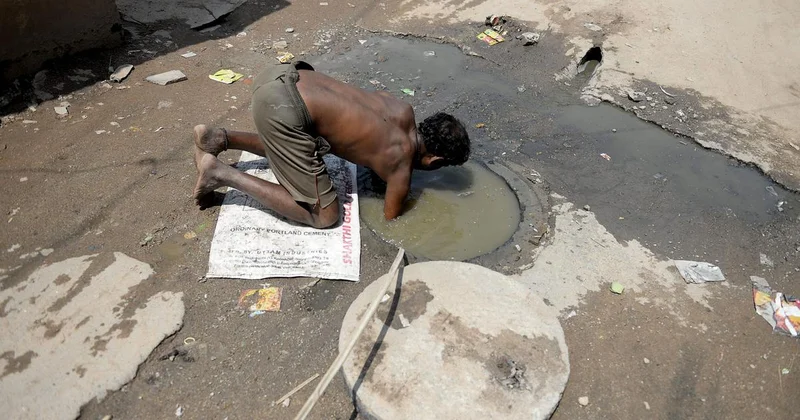
Forty-seven sanitation workers died while cleaning sewers and septic tanks under hazardous conditions in the country in 2025, the Union government said on Wednesday.
Uttar Pradesh recorded the highest number of deaths at 10, followed by Haryana with seven and Tamil Nadu with six, he Ministry of Social Justice and Empowerment said in response to an MP’s question.
Manual scavenging, which is the practice of removing human excreta by hand from sewer lines or septic tanks, is banned under the 2013 Prohibition of Employment as Manual Scavengers and their Rehabilitation Act. However, the practice remains prevalent in several parts of the country.
The government said that 89,915 sewer and septic tank workers have been validated under the National Action for Mechanised Sanitation Ecosystem scheme. It was launched in July 2023 to eliminate hazardous manual cleaning through mechanisation and achieve zero sanitation worker deaths.
Responding to a question on the effectiveness of existing laws, the minister said that the scheme was evaluated in 2025. He added that it provides sanitation workers with safety equipment, occupational training, health insurance and financial support to promote mechanisation of the process.
The government said that states and Union Territories have been asked to ensure implementation of the 2013 law. It also noted that the Union housing and urban affairs ministry had issued standard operating procedures for cleaning sewers and septic tanks.
In July 2023, the Union social justice ministry’s Central Monitoring Committee claimed that the practice of manual scavenging had been eliminated. The ministry had made the claim i despite noting that only 520 of the 766 districts across the country are free of manual scavenging.
Written by Anamika Pathak. Edited by Tanya Shrivastava.
We welcome your comments at letters@scroll.in.