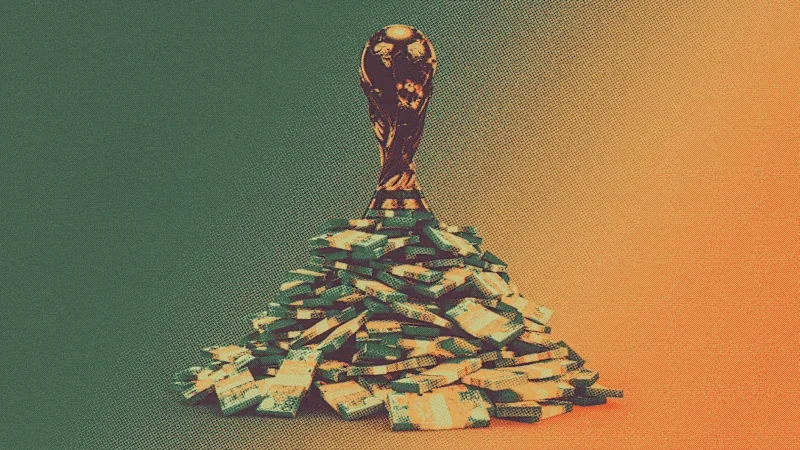
For decades, Australian soccer has lived a hand-to-mouth existence, cursed by the enormous gap between the grand ambitions of its constituents and its capacity to bring them to life.
Now, suddenly, there is a man at the door with a big smile and a novelty cheque.
FIFA president Gianni Infantino is offering $40 million in bonus funding to Football Australia to back his plan for a $US20 billion ($28.7 billion) company to run the World Cup with private investors. And even better, he’s saying there are no strings attached, if you could just sign here, please, and don’t worry about the fine print.
How many of your problems would be solved by a cash injection of that significance?
For Football Australia, it would amount to one of the biggest single financial windfalls in the history of the sport in this country: increased distributions from FIFA of a little more than $28 million for the next World Cup cycle, up from $11.5 million (figures are in Australian dollars), through to 2030, plus access to an additional one-off payment of up to $28 million.
It’s not enough to make the AFL and NRL – with their multibillion-dollar broadcast deals – sweat about the established order of Australian sport, but it would help FA address more than a few pressing issues.
This is, after all, a code that is in commercial turmoil at domestic level, and an organisation that just laid off 20 per cent of its workforce before announcing a record $15.3 million loss, which topped the previous record of $8.5 million the year before.
This is the same FA that, within hours of the Socceroos’ elimination from the World Cup, had its executives standing in front of cameras, cap in hand, begging for more support from a seemingly disinterested Australian government.
Infantino is slipping them a golden bargaining chip: a thick wad of cash that FA could take to the negotiating table as a co-contribution for the long-mooted national home of soccer in Sydney. That’s how the other codes get things built. As FIFA has suggested, it could be the pledge that unlocks the entire project – or it could enable FA to revisit so many other ideas that, for so long, have felt beyond reach.
It is the same amount of money that is being offered to all of FIFA’s 211 member associations for their support, and for the majority of them, Australia included, it would materially change the outlook for the game.
But at what cost?
Why, exactly, is this smiling man at the door anyway? And what to make of these very obvious and pronounced strings attached to the novelty cheque he is holding? Didn’t he say there weren’t any?
These are the questions FA powerbrokers are asking themselves as they consider one of the most consequential proposals ever put before them by FIFA: their vote in exchange for a huge wedge of tomorrow’s money, delivered today.
“As this is the first time we have been made aware of the initiative, we are now working to understand the proposal in full,” an FA spokesperson said in a statement on Thursday.
“We have requested further information from FIFA to properly assess the strategic, commercial and governance implications of such a significant step. We will only be able to form a position after receiving this information and engaging in further dialogue with our peer member associations and our confederation.”
Their cautious response is understandable, although anything short of a full-throated rejection by FA was going to be unsatisfying for many fans who immediately aligned themselves with the populist opposition stemming out of Europe when the news broke on Wednesday (AEST).
Infantino wants to establish a company, FIFA Forward Enterprise (FFE), to run FIFA’s competitions, including the World Cup and Club World Cup for men and women. He then would like to sell a 20 per cent stake in that company to a group of private investors – led by Joshua Kushner, the brother of Donald Trump’s son-in-law Jared – to raise up to $6 billion, which will be carved up 211 ways.
If a majority of FIFA’s 211 members say yes, it will happen.
Like everyone else in football, FA had no idea that any of this was coming, and officials are now scrambling to try and understand what it all means – fully aware that no matter which way they go, they will be criticised.
There is nothing inherently wrong with the involvement of private equity in sport, or even the proposed structure, which is how many sporting bodies have set up their commercial rights, including some of those that are protesting the loudest against FIFA’s proposal.
For some, it works. For others, it doesn’t. What matters is who ultimately holds the power, whose interests are prioritised, and how commercial demands shape decisions over time – and on those fronts, detail is sorely lacking.
Given the prized status of the World Cup in the hearts and minds of billions of people, FIFA and its member associations must tread extra carefully.
FIFA insists it will retain complete control and authority over all sporting and regulatory decisions, and essentially yield zero power. But nothing comes for free, and if private equity is involved, those investors will require a return on their investment at some point, somehow – and that fact may dictate how FIFA (or FFE) operates, or force them to act in a way that they otherwise would not, to everyone else’s detriment.
The commercial logic points in only one direction: more.
More inventory. More teams (64, probably) and more games. More World Cup co-hosts, sharing the load between them. More hydration breaks. More extended half-times to fit in cringy concerts. More premium experiences. More expensive tickets. More expensive everything. And probably more of everything, if FIFA also exhumes its hare-brained idea to stage the World Cup every two years instead of four, which cannot be discounted.
More pressure to optimise the tournament as an asset rather than preserve it as a cultural event.
How can the private investors make their money back in a way that doesn’t kill the golden goose? That’s the key question, thus far unanswered, aside from FIFA’s own assurances, whatever they are worth.
Unlike the big, cashed-up countries in Europe, Australia cannot afford to take a purely philosophical stance. For FA, there is far too much money at stake, and no realistic hope of changing the direction of travel with a protest vote. They will cast only one of 211 ballots, and for most of those countries, the benefits of saying yes are immediate and tangible, while the risks remain distant and theoretical. That’s why Infantino thinks this will get up.
But FA’s directors, the men and women who will decide Australia’s stance on this, now have two obligations that sit in tension: to strengthen the game they inherited, and to protect the game they will leave behind. They have a fiduciary duty to FA, which means there needs to be a very good reason to say no to $40 million. But they also have a duty to protect the long-term interests of FA and of soccer at large. They are not the same.
The devil, as always, will be in the detail – hidden within the fine print, right at the bottom of Infantino’s novelty cheque, underneath the big number intended to seduce them.