Starting next week, Nebraskans on Medicaid will be at risk of losing their health coverage unless the state can verify that they work, volunteer, or attend school for 80 hours per month. Come January, millions of other low-income Americans will face the same cliff.
While some working-age people are exempt, including those with young children and those deemed “medically frail,” new rules about who can opt out have led to widespread confusion. For patients with complex medical conditions, the looming requirements may create another barrier to health.
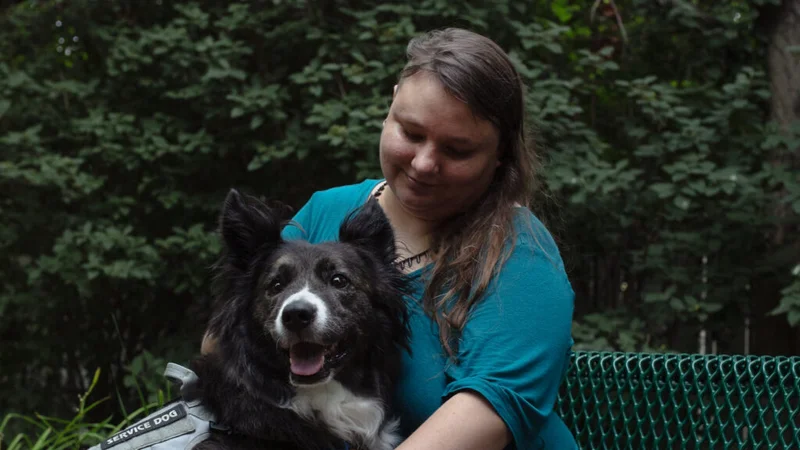
Work requirements, introduced months early in Nebraska, have caused Crystal Schroer, 31, intense concern this spring. They have a litany of chronic illnesses, including depression, ADHD, and a panic disorder that became so severe during the Covid-19 pandemic, Schroer could barely go grocery shopping alone.
That changed once they got Tarot, a 50-pound Australian shepherd-border collie trained in “sensory grounding” techniques. Yet even as the dog reopened the world, Schroer struggled to find stable employment in rural Kearney, Neb.
“There’s not a lot I can apply to that I think she would be safe at,” they said.
In a few days, the state will begin checking enrollees’ status and cutting off coverage to people who don’t meet the new rules.
The changes are slated to go into effect in many other states come Jan. 1. Arkansas, Montana, and Iowa also plan to launch their programs before that deadline.
Work requirements were created to help pay for President Trump’s tax cut law, passed a year ago. Republicans argue that they will encourage people to find work, though many adults covered by Medicaid already hold a job, or have other obligations, such as caring for a dependent.
Democratic attorneys general have challenged the rule in court, saying rules published by the Centers for Medicare and Medicaid Services in June differ from guidance states had been receiving in the months prior. Their case went before a district judge on Tuesday and could determine the future of the medical frailty exemption in over two dozen states.
Now, states, legal advocates, and people with chronic illnesses are scrambling to figure out what health conditions let patients evade the requirements, and how people should prove the severity of their disease.
States had previously hoped they could automatically consider someone with a serious or complex condition to be medically frail, Jennifer Hananoki, senior counsel at the law firm Holland & Knight, told STAT. “A patient who has terminal cancer, a patient who has advanced end-stage renal disease and is going to a dialysis facility three days a week, those types of scenarios.”
Instead, beneficiaries now will need to prove that their sickness is so bad it won’t let them work 20 hours per week. The “functional impairments” caused by their disease will need to be well-documented. Enrollees can self-attest for the first year, but as of 2028, their medical frailty exemption has to be backed up by health data, according to the rule.
Experts worry that the litany of unanswered questions surrounding medical frailty will lead to more vulnerable people getting kicked out of the program. Preliminary estimates from the Congressional Budget Office suggest over 7 million people will lose coverage in coming years.
Building a system to vet medical frailty applications in under six months will be a significant challenge for states, researchers said. The CMS policy could also create new bureaucratic hurdles for vulnerable people who are already struggling to manage their health, and it could put patients at risk of losing access to critical treatments, they said.
“For an already overtaxed health care system, with providers with inadequate time, with patients with horrendous challenges. … You don’t even have words for how bad all this is,” said Ada Hamosh, a clinical geneticist who works with rare disease patients and teaches in the Johns Hopkins Department of Genetic Medicine. (She was speaking only for herself.)
More paperwork and self-management
Chronically ill people will tell you: Being sick is hard work. Many are bogged down by the volume of paperwork, outreach, insurance appeals, and follow-ups it takes just to get a diagnosis or proper treatment.
It took Schroer four years and several specialists to come up with an effective care plan. Medicaid has covered all that, including one ADHD medication that costs $400 a month. “We finally just found the combination that works this year,” they said, noting that they went from having a panic attack every other day to once a month.
Nebraska has a nearly 300-page index of diagnoses that could qualify someone as medically frail. Schroer’s conditions are among those. But CMS said in June that those with “complex or serious medical conditions” must still show how their illness affects daily tasks such as eating, bathing, and walking. States can also change the list of conditions, or risk being investigated by federal officials if they are too lenient, per the rule.
Information such as diagnostic codes, clinical encounter data, prescriptions, and hospitalizations can all be used to corroborate someone’s claim of medical frailty. But the ultimate burden will probably fall to Medicaid patients and their doctors, given the data limitations, researchers told STAT.
If doctors end up needing to fill out medical frailty exemption forms every year or six months, as the CMS rule suggests, “It’s going to break the system,” said Benjamin Sommers, a primary care provider and professor of medicine at Harvard University. “There’s just no way.”
Who is sick enough?
The new rules raise uncomfortable questions about who the government considers sick enough to get health benefits. Since the expansion of Medicaid, the main requirement to be in the program was having a low income. Medical frailty is far thornier.
Among the conditions the government “would not typically expect” to create a barrier to work or community engagement include well-controlled HIV/AIDS, asthma, hypertension, anemia, generalized pain, prediabetes, type 1 or type 2 diabetes, obesity, psoriasis, headaches, and ADHD, the rule says.
However, doctors and patients know that many diseases and disorders might be well-controlled one week and out of whack the next. Some can change overnight — asthma exacerbated by poor air quality, like during wildfires, or autoimmune conditions that flare on hot days.
“I sometimes have worsening arthritis symptoms with storms,” said Lorraine Boissoneault, who wrote a book, “Body Weather,” about how chronic illness and weather are closely tied.
“You might not be able to shower at some points in time, and then other times you can. You might be able to do some work occasionally and then, other times, you can’t. That’s been the case for me, even when I’m in a bad flare,” she said. Boissoneault has psoriatic arthritis, celiac disease, endometriosis, Graves’ disease, and Hashimoto’s disease. She is on her husband’s insurance but says if she were single she would probably be on Medicaid.
Many others are still in the midst of their “diagnostic odyssey,” trying to find the right specialists who can figure out what’s wrong. Clinicians told STAT that some people, including the 1 in 10 Americans with a rare disease, may never get a clear ICD code. What will happen to them under new Medicaid rules? Their health care coverage may be at risk, at a time when many patients can’t afford such interruptions.
States can choose to adopt short-term “hardship exemptions,” which allow Medicaid patients to miss work during hospitalizations or while seeking care outside of their community. However, states can choose not to allow such exemptions.
“[Our] biggest concern right now is that eligible patients with serious and complex conditions could lose their health care coverage because the system is too hard to navigate,” said Carolyn Sheridan, associate director of state policy at the National Organization for Rare Disorders.
States must establish a system for people to ask for a medical frailty exemption even if they fall outside the list of accepted diagnoses, but it’s unclear how that process will work, or how flexible it will be.
A negative track record
In previous state efforts to adopt work requirements for Medicaid coverage, as in Arkansas, people who should have been exempt were nevertheless kicked off the rolls, sometimes en masse.
Researchers and advocates fear the same will happen on a national scale come the new year.
A recent study of low-income adults on Medicaid found that roughly half of them would be at risk of disenrollment despite serious health impairments. Those at risk of losing coverage were more likely to have self-reported poor health, including mental health, researchers found.
“The narrower that criteria or those definitions are, the more concerned I am that we may risk disenrolling people who should absolutely stay on Medicaid,” said Darshali Vyas, a pulmonary and critical care fellow at Mass General and Beth Israel Deaconess Medical Center who co-authored the study. “These are people who have high health needs.”
Federal officials have a vastly different take, describing the requirements more like a bootstrap to be pulled.
Work and community service can help people with serious and chronic health conditions “escape isolation and dependency, build confidence, achieve self sufficiency and prosperity, and improve health,” the interim final rule says.
The more people join the workforce and leave Medicaid, the smaller that line item becomes, aiding the Trump administration in its quest to minimize federal spending.
Schroer’s story aligns with the administration’s vision, in some ways. They got an offer for a full-time job doing administrative work at a university just days before when Nebraska said it will start kicking people who don’t meet work criteria off of Medicaid. Still, it took over a year of searching for Schroer to find the gig. The administration’s view is misguided, they said.
“People that I know in the disabled community would rather be working or doing something that brings in at least a little bit of income,” they said. “We want to go to movies. We want to be able to buy our action figures, or our Starbucks, or our little treats, and not have to worry about that.”
Data suggest work requirements are not an effective way of getting people jobs: At the state level, “It does not increase employment and leads to rapid and broad-scaled coverage loss,” Vyas told STAT.
Part of the problem is that many people who will need to follow the Medicaid work requirements might not know it. Sarah Maresh, director of Nebraska Appleseed’s health care access program, said she has heard of people calling state caseworkers with basic questions and getting incorrect information. Call center wait times have stretched as long as an hour and a half, she said.
Some Nebraskans haven’t even been able to figure out whether they are part of the Medicaid expansion population.
“There’s no way for them to look it up on their portal. They can’t look at their Medicaid card to find that out,” Maresh said. “We’re hearing from a lot of people who are already really confused about it.”
After Arkansas imposed requirements in 2018, one-third of people affected said they did not know about the new policy. Over half of those who had heard about the change didn’t know it applied to them, one study found. The courts blocked the policy a year later, but these pitfalls would prove hard for other states to overcome.
New Hampshire tried its own version of work requirements in 2019 but paused implementation once it realized how many people who were eligible for Medicaid would lose coverage. A federal judge later blocked the program.
Sommers, the Boston doctor and health economist, said, “It turns out, probably even more important than outreach is: How much can the state do on its own, with the data they already have?”
STAT’s coverage of chronic health issues is supported by a grant from Bloomberg Philanthropies. Our financial supporters are not involved in any decisions about our journalism.