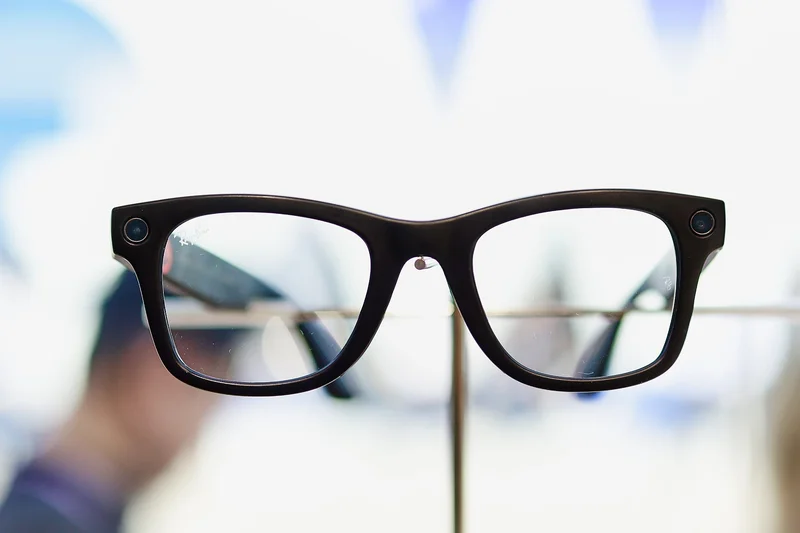
“To hell with those glasses. Don’t buy them. They’re not sexy,” Lorde said during her appearance at the Mad Cool music festival in Madrid. She was not talking about just any glasses, but Meta Glasses, which are equipped with cameras and microphones and can record video or take photographs.
“It’s getting harder and harder to know what’s real. Now you can’t tell whether someone is wearing sunglasses or that crap,” the singer added.
Ever since so-called smart glasses went on sale, in several versions, some developed in partnership with brands such as Oakley and Ray-Ban, there have been concerns about privacy. To address those fears, the devices were designed so that a small LED light illuminates and a shutter sound plays whenever the user records a video or takes a picture.
“It’s our way of ensuring that we protect other people’s privacy. It also protects the user’s privacy, because they can switch off the glasses in environments where they don’t feel comfortable,” Ankit Brahmbhatt, Meta’s head of product, told EL PAÍS. Facebook even published a guide to responsible use urging owners to let others know when they’re being recorded and “be respectful of people nearby.”
But any technology can be misused, and bad actors exist. Manfluencers — male content creators operating within the internet’s so-called manosphere who monetize misogynistic content — have posted videos of themselves approaching women they hope to pick up, effectively turning harassment into a form of livestreamed content.
The women are unaware they are being recorded and therefore have not consented to the videos being shared online. Stephanie Wescott, a feminist scholar, author and lecturer in Education, Culture and Society at Australia’s Monash University, told CNN that smart glasses can be an ideal tool for misogynistic content creators because they send a clear message about power.
According to Wescott, men can “be watching, recording and therefore controlling women’s images in public spaces without their knowledge and therefore, that the public spaces belong to men.”
The rise of a type of content filmed with Meta glasses, often focused on women, service-sector workers and homeless people, highlights how smart glasses can reinforce existing inequalities and enable new forms of surveillance directed largely at women. Given that women are the primary targets of online abuse, the devices pose a direct threat to their safety and open the door to new forms of harassment and exploitation.
Fabio Assolini, a cybersecurity expert, says the legality of such recordings depends on the context, the country and how the footage is used. “The fact that a device can technically record does not mean any use is legal,” he says. “In general, capturing images, audio or personal data of other people may be subject to privacy and data protection rules, especially when the recording is done without the knowledge of those affected, is shared publicly or is used for purposes other than those permitted.”
The real concern, he argues, lies in what happens to the information once it has been collected: where it is stored, who has access to it and whether it can be used to identify, profile or harm the people being recorded.
Despite the controversy, Meta has sought to broaden the appeal of its smart glasses among women by partnering with Kylie Jenner on a co-designed model. Yet, as journalist Andi Zeisler argues, even though Meta recruited a celebrity to make smart glasses seem safe for women, this strategy has not worked.
“If Meta really wanted to appeal to women, there are plenty of ways to do that,” she wrote on the website Salon. “But it can’t change the message inherent in the technology: that your consent doesn’t matter, that other humans don’t deserve a baseline expectation of privacy. Even the most beautiful face can’t hide the profit motive of that malignance.”
Content creator Matt Bernstein has come out strongly against the collaboration. “Meta glasses have evaporated any defenses you might have from being photographed or recorded in secrecy. Who does this appeal to? Who would this benefit? Obviously, creepy men,” he says. “You can’t have a hit product without women. [...] So who better to hire to manufacture consent among women for predator goggles than the single most famous woman on the internet, who also happens to be a morally bankrupt, ruthless capitalist, who would sell her audience just about anything if the price is right.”
According to Meta’s website, the glasses, which retail from $399, can record video clips of up to three minutes and include an LED indicator to alert others when the camera is active. In response to users physically covering the LED light, Meta has introduced an update that disables recording whenever the indicator is obscured.
Last year, a man complained on social media after a woman smashed his smart glasses on the subway, fed up with being recorded. He appeared to expect public sympathy, but the overwhelming majority of commenters sided with the woman.
In September 2025, a video went viral in which a woman recounted the moment she realized that the woman waxing her bikini line at a New York beauty salon was wearing Meta smart glasses.
@niessaxoxo_ What should I do? #europeanwaxcenter #brazilianwax #metaglasses
♬ original sound - aniessanavarro
“New phobia just dropped cause I can’t believe one day I’ll be in the same space as someone wearing Meta glasses and I won’t know I’m being recorded or what that person will do with the footage,” one user commented on X.
The fear is not unfounded. In May last year, a man was arrested in Barcelona for using smart glasses to record hundreds of young women without their consent.
María Aperador, a criminologist specializing in cybersecurity, explains on her social media channels how people can tell when they are being recorded. “When someone starts recording with these glasses, a small light flashes rapidly. Thanks to that, we can know they are recording,” she says.
What is impossible to know, she warns, is whether the wearer is simply recording a public space or secretly monitoring someone from a distance. “That’s why they can be so worrying,” she warns.
Opposition to the controversial devices has even spawned merchandise. T-shirts are already being sold with messages against the use of recordings made with the glasses. “I do not consent to the company Meta and their subsidiary companies using, storing and recording my appearance, voice and location with their smartglasses,” reads one design.
Assolini says the main risks include non-consensual recording, the inadvertent capture of sensitive information, the use of artificial intelligence to analyze recorded images, and the possibility that stored data could be compromised by cybercriminals.
“It’s important that these devices incorporate privacy and security by design, including user controls, data encryption, security updates and transparent mechanisms that allow people to know when they are being recorded,” he says.
“Currently, if you are recorded without your consent and that video is ridiculed, sexualized or you even receive sexual harassment, it is very likely that you will be the only one left unprotected,” Cecilia Bizzotto, a sociologist and official spokesperson for JOYclub in Spain, tells EL PAÍS. “The people who record women without their consent face no consequences and may even profit from their videos going viral, while those who report them have virtually no avenues for recourse in these situations.”
Glasshole, a derogatory term combining glasses and asshole, was coined to describe early users of Google Glass, the smart-glasses project that flopped a decade ago. The term implied that wearers were jerks who recorded people in public without their consent. Today, some people refer to Meta’s devices as “pervert glasses.”
“I’m not saying these are glasses for creeps, but I can’t help but feel like one while wearing them,” Boone Ashworth wrote in his review of Meta’s second-generation smart glasses for * Wired*.
And it’s not just men feeling this discomfort: “I wore Meta’s smartglasses for a month – and it left me feeling like a creep,” Elle Hunt wrote in her review for The Guardian.
Last year, Meta sold more than seven million glasses worldwide.