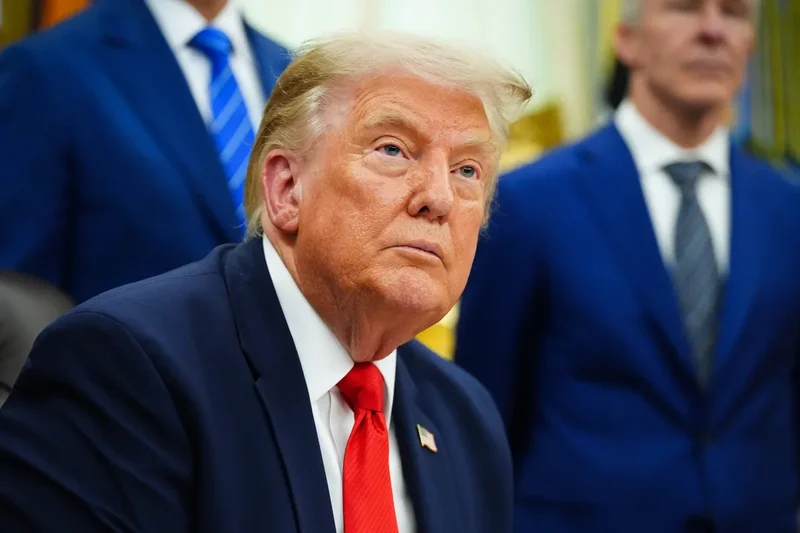
President Donald Trump is “exasperated” by the lack of progress in ending the Iran conflict and the lack of consensus on strategy among his top military advisers, according to a report.
An unnamed ally of the president has told NBC News: “The president is exasperated. I don’t think he believed it was going to be this difficult to get the Iranians to agree to a deal.
“There was not a real strategy for how long or what they should do to get to the endpoint… He did not intend this to be a long, drawn-out war.”
A U.S. official, who also spoke on the condition of anonymity, said that the root of Trump’s frustrations lay in the lack of agreement about how to proceed with a war that began with joint U.S.-Israeli airstrikes on February 28 that killed Ayatollah Ali Khamenei but quickly brought retaliation, the closure of the Strait of Hormuz and, ultimately, stalemate.
“After all this time, there is no unity,” the official said. “We have had a series of tactical victories but are facing a strategic defeat without clear policy guidance or a decision about where this is going.”
The source told NBC that Trump had “erupted” during a meeting with his top national security team last week and had even yelled expletives at those present.
White House Press Secretary Karoline Leavitt has denied that the incident took place, however, responding: “This is false. The president has a great team whom he trusts, and everyone on the team knows he’s the final decision-maker.”
The president “is not going to stand by as they break the [memorandum of understanding], kill our soldiers and fire at our ships in the strait,” Leavitt added. “So until that behavior changes, his behavior will not change. He’s locked and loaded to keep punishing Iran.”
Chief Pentagon spokesperson Sean Parnell likewise said the Department of Defense was “locked and loaded, ready to execute the president’s directives at a moment’s notice.”
Defense Secretary Pete Hegseth, CENTCOM Commander Admiral Brad Cooper and Chairman of the Joint Chiefs of Staff Dan Caine “stand completely aligned and are united in mission, strategy, and resolve regarding overseas operations involving Iran,” Parnell added.
The Independent has reached out to the White House and the Pentagon for further comment.
Trump promised during his 2024 presidential campaign that he would not lead the U.S. into any further “forever war” commitments overseas, only to follow his Operation Midnight Hammer strikes on Iran’s nuclear facilities last summer with another conflict that he once described as a “short-term excursion” but which is about to enter its sixth month.
Despite the president’s repeated insistence that Tehran is “desperate” to make a deal to end the hostilities, it has proven itself a tough negotiator and has not shied away from launching fresh attacks of its own.
Meanwhile, on the domestic front, many of Trump’s fellow Republicans are keen to draw a line under an unpopular war in good time for November’s midterms.
They remain fearful that its impact on gas prices could count against GOP candidates at the ballot box, who could bear the brunt of a protest vote that threatens to sweep the Democrats back to power in Congress.
The president has remained characteristically bullish, however, telling Fox News Wednesday: “We are going to beat the fing s out of them… We’ll be hitting them hard. They are going to get a beating.”
He also expressed perplexity about Iran’s attitude towards diplomacy following the failure of the MOU signed in Versailles in June, commenting: “For some reason, we can be in the midst of a beautiful discussion, and they’ll come out and say ‘we’re not talking.’”
According to NBC, the difference of opinion within Trump’s camp can be broadly divided into two factions: Hegseth and Israeli Prime Minister Benjamin Netanyahu back the use of greater military force against Iran – although the latter is not thought to have raised prospect with the president when they met in Washington this week – while Vice President JD Vance and Caine question what that would achieve.
The chairman of the joint chiefs, for one, is said to have advised Trump against allowing the continued depletion of U.S. munitions stockpiles through prolonged strikes.