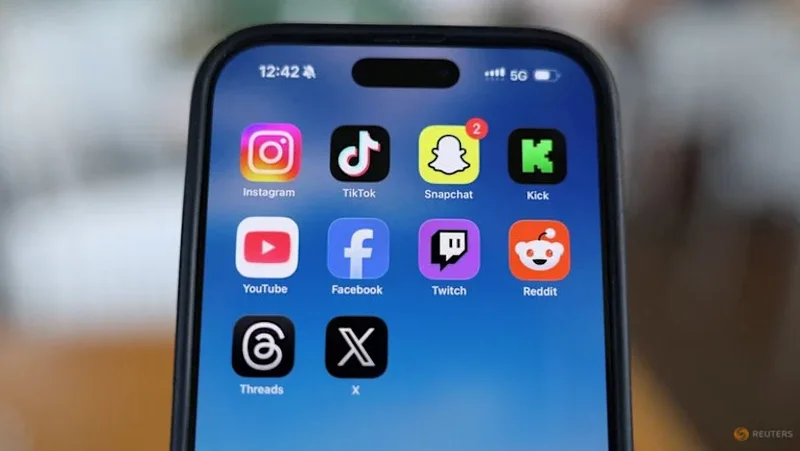
Singapore expert panel recommends targeting harmful social media features instead of imposing age bans
The government-appointed panel also called for a precautionary approach to regulating social media, stronger age checks, and greater support for parents and young users.
SINGAPORE: Social media platforms should be made safer for young people by addressing potentially harmful design features rather than imposing blanket age-based restrictions, an expert panel has recommended.
The Ministry of Health (MOH), which convened the panel in September 2025 to examine the impact of social media use on young people's mental health, announced on Thursday (Jul 30) that it had submitted its report to the government.
In its report, the panel "considered the evidence on the potential negative impact of problematic social media use on young people’s mental health, weighed against the possible benefits that social media may bring", said MOH.
"On balance, the panel is of the view that the cost of inaction is too high."
It recommended "a precautionary and proactive approach" to regulating social media use among young users, MOH said.
The panel noted: "Definitive causal links between problematic social media use and adverse mental health outcomes have not yet been established, and conclusive causal evidence may take years to emerge.
"However, the evidence of association is clear and sufficient to act on - many jurisdictions have already done so in some form, recognising that waiting for certainty is not a responsible option."
The Saw Swee Hock School of Public Health was commissioned to review the international evidence base. This informed the expert panel's deliberations and underpinned the recommendations it set out, MOH said.
The panel is co-chaired by Institute of Mental Health chief Dr Lim Choon Guan and Associate Professor Lee Jungup at the National University of Singapore's department of social work.
        Related:


  ## ADDRESS RISKS, RATHER THAN A BLANKET BAN
The panel acknowledged that countries including Australia, France, the United Kingdom, Malaysia and Indonesia have moved to raise the minimum age for access to social media.
Most of these moves seek to ban users under the age of 16 from accessing platforms such as Instagram, Facebook and TikTok. France's proposed legislation targets users under the age of 15.
"The panel acknowledges the intent behind such measures, but is concerned that blanket age-based restrictions do not distinguish between harmful and beneficial uses of social media, and risk being counterproductive should young people easily circumvent age restrictions," said MOH.
"A more durable and proportionate response" is preferred to make social media safer by design for young people, rather than simply deferring the onset of its use, it added.
The recommendation is broadly in line with the government's recent approach.
Earlier this month, Digital Development and Information Minister Josephine Teo said at a forum on child online safety that restricting social media access was "not the starting point" and "not the preferred outcome".
In May, Minister of State for Digital Development and Information Rahayu Mahzam said in parliament that Singapore's approach was “more demanding, more rigorous” than a blanket ban.
FEATURES OF CONCERN
The panel identified several platform features that may be particularly problematic for young people’s mental health.
These include direct messaging functions, which may expose young people to safety risks, including cyberbullying, harassment, and inappropriate contact from unknown users.
The ability to make anonymous or pseudonymous accounts may further reduce accountability and make harmful online behaviour more difficult to detect and address, the panel said.
Infinite scroll or autoplay functions that constantly serve up content to users may also contribute to problematic or addictive patterns of social media use, it said.
By removing natural stopping points, the platforms encourage users to remain engaged for prolonged periods beyond what they originally intended.
"For young users, this can displace physical activity, in-person socialising and other activities essential for healthy development," the panel said.
The panel also highlighted other features, like algorithmically curated feeds, which may amplify exposure to distressing or harmful content, even when a user's initial interest was benign.
Quantified social feedback mechanisms like visible "like" counts and follower metrics also encourage social comparison and validation-seeking behaviours, with potential negative effects on self-esteem and emotional wellbeing, said the panel.
They "may accelerate the onset of internalising symptoms among vulnerable young people".
FINDINGS
The panel said adolescence is a critical developmental period during which young people are more sensitive to social feedback and influences while still developing emotionally and cognitively.
This may leave them less equipped to manage the online social pressures, critically evaluate online content, or recognise manipulative platform design, it said.
As mental health conditions often emerge during adolescence, the negative effects of social media use could have lasting consequences.
The panel also distinguished between excessive and problematic social media use, saying problematic use - characterised by persistent, compulsive or addiction-like behaviour - is more consistently associated with poorer well-being than time spent on social media alone.
In Singapore, one in three young people aged 15 to 17 spent more than three hours on social media daily, while one in six aged 10 to 24 showed signs of problematic social media use.
"These figures suggest that a significant proportion of young Singaporeans are engaging with social media in ways that may place their mental health at risk," said MOH.
The panel noted research findings that show that excessive or problematic social media use can result in issues like anxiety, depression, lower life satisfaction and well-being, body image concerns and problematic eating behaviours.
"Problematic social media use and poor mental health may be mutually reinforcing, with each worsening over time," it said.
Young people experiencing anxiety or depression may turn to social media for comfort or connection.
Instead, problematic social media use may deepen over time and displace healthier forms of support and regulation, creating a vicious cycle.
"Heavy social media use can also disrupt sleep, affecting emotional regulation and mental health," the panel said.
"Beyond clinical symptoms, problematic social media use has been consistently associated with lower life satisfaction and lower levels of mental well-being, with the negative effects on life satisfaction found to be strongest during early adolescence."
Frequent exposure to the idealised portrayals of lifestyles and appearances that are common on social media may encourage comparison, contributing to body image concerns, depressive symptoms and problematic eating behaviours among some young users.
OTHER RECOMMENDATIONS
Besides targeting harmful platform features, the panel recommended strengthening age assurance measures to more accurately identify users' ages.
The government should also empower young people to navigate the online environment in safe and healthy ways, and support their parents in guiding them to do so, said the panel.
The panel further recommended a whole-of-society approach involving families, schools, healthcare providers, community partners, platform operators and the government to better safeguard young people's well-being online.
MOH said the panel's findings and recommendations would help inform ongoing efforts to strengthen support for young people's mental health and promote safer digital experiences for young people.
CURRENT MEASURES
The panel noted that Singapore has already introduced a range of measures to promote safer use of social media, including a code of practice that requires certain social media services to minimise exposure to harmful online content for Singapore users, particularly children.
The Infocomm Media Development Authority also assesses the effectiveness of these safety measures.
The panel noted that some social media platforms have started introducing features that support safer use among young users, such as differentiated accounts with stronger parental controls for younger users.
Others have created resources alongside community partners to help parents guide their children in fostering healthy digital habits.
"These efforts provide an important foundation, and the government will continue to do more to protect users, especially children, online," said MOH.