China's next chapter in South Africa: From building projects to putting down roots
For years, China's presence in South Africa was defined by major infrastructure projects and booming trade. Now, more Chinese companies are shifting to establishing a lasting presence as both countries navigate changing economic realities.
JOHANNESBURG: Across South Africa, China's presence is etched into the landscape – in vast solar farms, heavy mining equipment and factories.
For decades, Chinese companies have come to Africa's largest economy to build roads, power plants and other infrastructure, while buying the minerals that fuelled China's rapid industrialisation.
China has been the region’s largest trading partner for the past 15 years. What began as trade gradually expanded into investment, construction and financing through projects such as the Belt and Road Initiative.
But a new chapter is beginning.
As growth slows at home, some Chinese firms are shifting from building projects to establishing a longer-term presence.
That transition is already visible in South Africa's renewable energy sector.
A SEA OF MIRRORS IN THE DESERT
The Northern Cape is South Africa's largest province, but also its least populated.
It is one of the sunniest parts of the country – making it an ideal location for renewable energy.
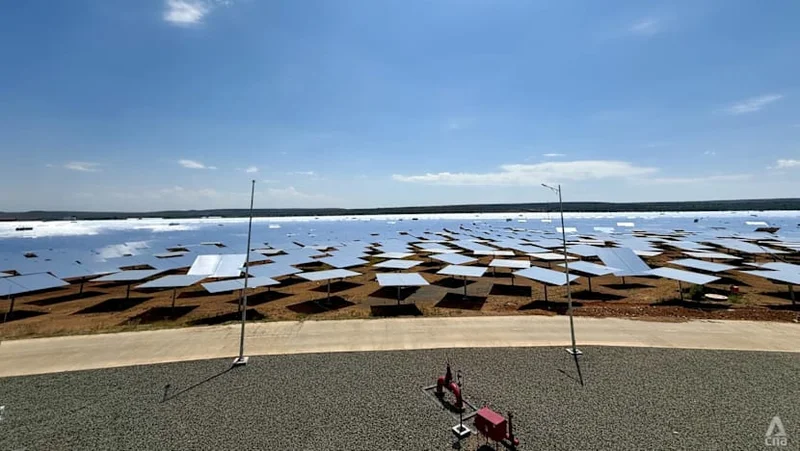
Rising from the desert is Redstone, one of South Africa's largest renewable energy projects.
From a distance, the plant looks almost like a shimmering lake. Up close, more than 40,000 mirrors stretch across the landscape, moving together as they follow the sun.
The mirrors reflect sunlight onto a central tower, where molten salt stores the heat before releasing it to generate electricity.
The 100-megawatt concentrated solar power plant, which entered commercial operation in 2025, can supply electricity to more than 200,000 homes.
Unlike conventional solar farms, it can continue generating power after sunset, helping ease electricity shortages in the country.
The facility was built by SEPCOIII, a subsidiary of China's state-owned POWERCHINA.
Like many of China's flagship projects across Africa, Redstone represents a model that has defined Chinese engagement on the continent for years – large, state-backed infrastructure built by Chinese engineering firms.
For its deputy project director Wang Zhiyou, 40, South Africa is simply the latest stop in a career spent overseas.
The engineer from China's Shandong province has previously worked in Saudi Arabia. For the last three years, he has called the Northern Cape home.
Compared with his previous posting, he says life in South Africa has been easier.
"In Saudi Arabia, the summers are extremely hot. Given the amount of work we do on site every day, everyone has to endure those harsh conditions. Here (in South Africa), the temperature overall, including winter, is very comfortable.”
As Chinese companies expanded overseas, so too did the careers of many engineers like Wang. For him, working abroad has become routine.
"We bring our own chefs, service staff and logistics support. The company handles this quite well, so everyone is fine when it comes to food. We can have Chinese food."
IMPACT ON THE COMMUNITY
Projects such as Redstone reshape more than the landscape. They also change the communities around them.
South African Fabracius Jacobs grew up less than 30km away. The 32-year-old now works as a human resources and community liaison officer at Redstone.
“In 2009, things started changing,” he recalled.
“When the mines came, they started discovering that there's iron ore and manganese in our place. And as time developed, a lot of solar (farms) also started popping up.”
"Initially, because (people) didn't have knowledge about the projects ... they would be against it,” he said.
Today, Jacobs acts as a bridge between the Chinese contractor and nearby communities, helping navigate language barriers, cultural differences and expectations.
Communication, he said, was one of the biggest early challenges. But translation apps, bilingual signs and cultural workshops helped both sides better understand each other.
He also received training in grievance resolution, helping mediate disputes internally, or between local communities and the company.
Such challenges rarely feature in official announcements.
Instead, Chinese state media has highlighted the 2,500 jobs created by the project – 650 of them taken up by the local community. More than 400 local engineers and technicians also received training.
That matters in South Africa, where youth unemployment stood at 45.8 per cent in the first quarter of 2026.
For POWERCHINA, Redstone is more than a successful engineering project.
According to the company, Africa already contributes about a third of its overseas revenue, and it aims to expand further across the continent.
But even as large infrastructure projects continue, China’s approach in South Africa is evolving.
MANUFACTURERS SETTING UP BASE
In the northern Limpopo province, one of the country's richest mining regions, vast deposits of chrome, platinum group metals and iron ore have long drawn Chinese buyers.
Chrome, an essential ingredient in stainless steel, is one of South Africa's key mineral exports.
Today, China is also supplying the machinery used to extract those minerals.
Chinese heavy equipment maker SANY is one example. Founded in 1994, it has grown into one of China's largest manufacturers of construction and mining equipment, with machinery sold in more than 180 countries and regions.
Africa was its fastest-growing overseas market last year, with revenue rising by more than 55 per cent.
At Mantengu Mining's Langpan mine, SANY's machines have become central to its operations.
Mike Miller, who was Mantengu's CEO when CNA visited the company in February, said it chose the Chinese manufacturer for both cost and reliability.
"SANY's equipment is highly cost efficient. It's very, very competitive. It runs at very low operating costs,” he said.
But cost was only part of the equation.
"We've got a full-time (SANY) team on site, and we are able to bring any machines that are down for any mechanical or technical failure back into production very quickly," Miller said.
SANY's next step is to make South Africa a manufacturing base as well.
At the time of CNA's visit, SANY's new industrial park in Johannesburg was still under construction.
Once completed, it will become the company's manufacturing and assembly hub for Southern Africa – designed to assemble up to 1,000 machines a year, while creating local jobs and supplying neighbouring countries.
SANY’s regional service director for Southern Africa, Leon Liu, said there has been a significant change from when he first arrived in South Africa in 2010.
"Looking at South Africa today, there are far more Chinese companies here than when I first arrived," he said.
"You now see Chinese companies involved in mining, road and bridge construction, as well as renewable energy. Local people are also much more willing to work with Chinese companies than before."
The company’s strategy has also evolved alongside China's changing relationship with South Africa. Last year, overseas markets accounted for almost two-thirds of its revenue.
"In the early days, we mainly focused on trade," Liu said. "We manufactured our equipment in China and brought it to South Africa."
"Now, our goal is to assemble and manufacture locally."
CHINESE INVESTMENT WELCOME
SANY's strategy reflects a broader transition taking place across Chinese industry.
A prolonged downturn in China's property sector, weaker domestic demand and rising trade tensions have encouraged more manufacturers to look overseas for growth.
For South Africa, the challenge is not simply attracting Chinese manufacturers, but ensuring their investments strengthen local industries.
"The South African government is very receptive to Chinese investment," said Darren Davids, an analyst at the Economist Intelligence Unit.
"However, local businesses are growing increasingly anxious about competitive displacement."
Instead of restricting imports through protective tariffs, the government has sought to attract more Chinese investment into local manufacturing, he said.
That strategy is already taking shape.
Chinese carmaker Chery opened its first manufacturing plant in South Africa in early July, taking over a former Nissan factory and pledging to create nearly 3,000 jobs.
For Trade, Industry and Competition Minister Parks Tau, that is the kind of investment South Africa wants to see.
The country hopes to process more of its minerals at home rather than exporting raw materials overseas, but rising electricity costs have made many smelters uncompetitive.
"The reality is that we've had our smelters in chrome and manganese closing down, and a lot of this product going into the Chinese market," Tau said.
"And we said: can we try and ensure that we get Chinese investors to do these sorts of investments in the country? And China has been open to that discussion."
Success in that approach, he added, would mean more than attracting capital.
"It would include greater industrialisation in South Africa. It would include improving the balance of trade."
“South Africa's economy has been growing at a very low level, and I think this gives us an opportunity to accelerate that level of growth,” he added.
BEYOND THE FACTORIES
For many South Africans, their first encounter with Chinese businesses came in places like China Mall.
Rows of imported goods, family-run shops and small traders became a familiar sight as Chinese entrepreneurs arrived in search of opportunity.
These shopping centres have multiplied over the years, particularly around Johannesburg. Locals now refer to the these clusters as the "new Chinatown".
But Johannesburg's actual Chinatown in Cyrildene tells a different story.
Business owner Chen Xiuzhu remembers arriving from China in 2006 with little knowledge of the country.
"South Africa was completely unfamiliar to me,” she said. "If people spoke English, I could understand them, but when they spoke the local languages, I couldn't. So I just had to learn."
The mother of two had previously worked in a textile factory and a glass factory in China to earn a living, but opened a small supermarket and later a clothing shop after moving to Johannesburg.
"That's where I made my first money. I went back to China and built a house."
But the Chinatown she remembers has changed.
"In the past, Chinatown was much livelier,” she said. "Back then, most Chinese people lived here, so the community was very concentrated. Now they've spread out."
The area's evolution has become increasingly apparent to Chen Shaoguang, director of the Johannesburg Chinatown Management Committee. His role involves helping Chinese businesses navigate South Africa's business environment.
"Especially over the last couple of years, we've seen many companies from China coming here in search of business opportunities," he said.
"State-owned enterprises, private companies, individual entrepreneurs – we receive them all the time."
NEW WAVE OF ENTREPRENEURS
Today’s Chinese entrepreneurs often have a different profile from earlier migrants.
35-year-old Zhou Yixin, who studied overseas and worked in property, moved to South Africa after marrying a local and in 2022 spotted an opportunity created by the country's electricity crisis.
"I was having a casual chat with one of my friends from university and she was looking for investment opportunities outside of China because after COVID, there aren't many opportunities in China," she said.
She resigned from her job, opened a warehouse in Johannesburg and began recruiting staff.
Today, her company connects Chinese solar manufacturers with customers in Africa.
Zhou said many Chinese manufacturers initially believed exporting products and sending sales teams from China would be enough to succeed overseas.
"Now they realise it's more difficult if you don't have that existing relationship with local customers, if you don't understand what they are thinking, if you don't understand the culture, it's extremely difficult," said Zhou.
"You can't just hop onto Uber and go and visit clients ...The market's reaction (was): yes, I can buy from you at a cheaper price, but afterwards I have no support. I'd rather spend more money to buy from a local distributor, which we know they're going to be here long term.”
For another entrepreneur, Liu Nanfei, 31, the story began with her parents.
Born to Chinese parents who immigrated to South Africa post-apartheid, Liu was named after the country itself. In Chinese, "Nanfei" translates directly to "South Africa".
Unlike her parents, who built a business importing Chinese goods, Liu studied and worked in the United States before returning to South Africa in 2024.
Her parents encouraged her to come back as ties between China and South Africa deepened. At the time, it was an unconventional choice for someone who had established a career in the US.
"But this is very common now ... many of my peers who were in Australia or America are choosing to come back to South Africa to join our economy here, or inherit their parents’ business, because we're seeing such promising growth in our country."
Today, she runs a consultancy helping Chinese companies expand into South Africa while supporting South African organisations seeking opportunities in China.
"We're not a public relations company. We're not an events coordination company," said Liu.
"We're a company where we take what you need, and we decide, and we plan, and we strategise what is needed for you to successfully implement yourself in South Africa or in China."
This could include competition analysis, recruitment or finding property.
"My parents built their business on what you could perhaps just call hard skills," said Liu.
"I'm building my business on soft power, and that's relationships and understanding culture."