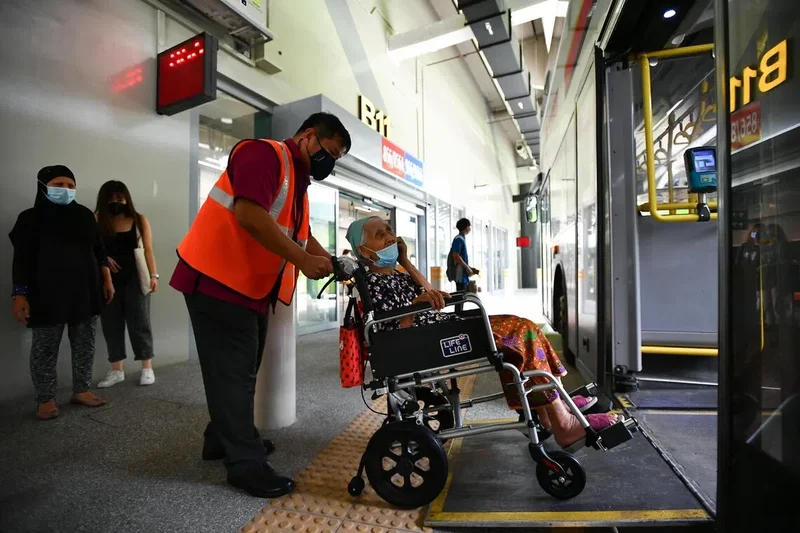
Wheelchair users flag potential loss of dedicated space on buses in ongoing trial
AI generated
SINGAPORE – Wheelchair users are concerned that a small bay set aside for them on buses will be taken up by parents with prams under a proposed initiative that is now undergoing trials.
The six-month Land Transport Authority (LTA) trial run, which began in April, allows families with strollers, and wheelchair and personal mobility aid users to use wheelchair bays on buses on a first-come-first-served basis.
The Disabled People’s Association (DPA) on July 26 took to social media to argue that strollers can be folded, but wheelchairs cannot be folded when in use.
More importantly, wheelchair users need the wheelchair bay to travel on buses – which is the only accessible and affordable way for them to get around, DPA said in its post.
The few wheelchair-accessible vehicles on the road are difficult to book and can be expensive, with prices rising to two to four times the cost of a regular cab ride, it added.
Singer-songwriter and educator Sky Shen, 32, who uses a motorised wheelchair, said: “There is a difference between a need and a want.
“While passengers with strollers may want the convenience of leaving their strollers open, many wheelchair users don’t have a choice, and they need the wheelchair bay to board the bus and travel.”
Now, if a wheelchair user boards the bus and a commuter with a stroller is in the bay, the commuter will need to fold the stroller and carry the child, making space for the wheelchair user, he added.
If the first-come, first-served trial becomes policy, wheelchair users will need to wait for the next bus if the bay is already occupied, said Shen, who has muscular dystrophy, a condition that makes muscles weaker and lose mass over time.
DPA in its post also said buses need to be designed with ample space for both wheelchairs and strollers. DPA was not involved in consultations ahead of the trial, it added.
Shen, speaking to The Straits Times, said he has concerns about LTA studying a shared-priority approach because that meant the ability of wheelchair users to take buses would depend on public preferences, which should not be the case.
Most passengers, he added, have been kind to wheelchair users like himself, but he had concerns that a first-come, first-served rule could result in some commuters feeling “entitled” to the space and refusing to give way.
LTA, responding in a comment to the DPA post, said the trial was introduced after talks with stakeholders like social service agencies, as well as feedback from different commuter groups.
In response to queries, LTA said it has been working with social service agencies, including SG Enable, Handicaps Welfare Association and SPD, over the years to improve accessibility on public transport.
It added that there are plans to keep getting more feedback during the trial period, and find a “balanced way” to move forward together, including engaging other segments of the disability community, like DPA, to better understand their concerns and experiences.
LTA said the trial was prompted by feedback that mothers or fathers travelling alone with more than one child found it difficult to fold a stroller while minding their children.
There may be times when passengers’ needs overlap or require careful balancing, LTA said, and the trial seeks to better understand these experiences, challenges faced by commuters and how different needs can be balanced in a fair and practical manner.
So far, based on trial observations, LTA said there were no conflicts between wheelchair users and families with strollers as commuters have been gracious to those with greater mobility needs.
“We will continue to listen carefully to feedback, engage stakeholders and thoughtfully consider all views received before deciding on the way forward,” LTA added.
The trial is being carried out on about 10 bus services. They are numbers 5 or 5A or 5B, 54, 57, 67, 131 or 131A, 143 or 143M, 166, 851 or 851e, 960 or 960e and 980.
Max Soh, research and policy manager at DPA, said the association shared its concerns with LTA, but it remains unclear what the outcome of the trial will be, and whether the concerns of wheelchair users will be addressed.
He added that it is important for wheelchair users to be involved in both consultation and co-design of the trial.
Soh said: “A more inclusive approach that LTA could have taken would be to test-pilot, research or explore various ways to increase capacities of bus fleets to accommodate both groups.”
Examples include test-piloting more convertible spaces within buses that can accommodate parents with strollers while ensuring access to wheelchair bays for wheelchair users, he added.