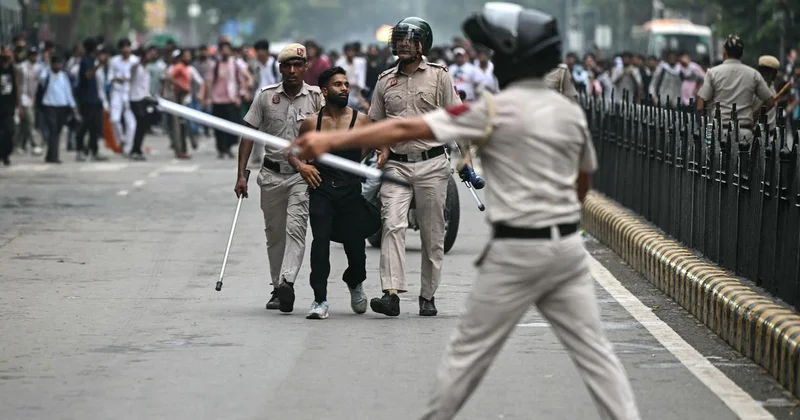
The Supreme Court on Thursday directed the Union government to preserve the ammunition logs of the Rapid Action Force members deployed at Jantar Mantar in Delhi during the youth protests against the alleged mismanagement of competitive examinations, The Indian Express reported.
A bench of Chief Justice Surya Kant and Justices Joymalya Bagchi and V Mohana was hearing petitions seeking a ban on the use of pellet guns to disperse crowds during protests.
Two of the petitioners, Prashant Kumar Singh and Sheikh Irshad Mansoor, said they were injured by pellets fired by security personnel during the protesters’ march to Parliament on July 20. The lead petitioner is former Intelligence Bureau Special Director Yashovardhan Azad.
While hearing the plea, the court verbally observed that the petitioners’ request was “vague” as they had not challenged the police regulations permitting the use of pellet guns for crowd control, Live Law reported.
Police regulations permit the use of pellet guns in exceptional circumstances, Live Law quoted Bagchi as saying. He added that unless those regulations are challenged, the reliefs sought could be barred.
Bagchi said that the court was “not averse to examining” the use of pellet guns during the protest, but added that the petitioners would have to show whether their use was permissible under the “graded approach”.
Appearing for the petitioners, lawyer Vrinda Grover said that the regulations are not readily available in the public domain and requested the court to direct the Union government to place them on record so the petitioners could amend their prayers.
“I could not find any such standing order of the Delhi Police at all,” the legal news outlet quoted her as saying.
Grover also clarified that she was confining her challenge to the alleged use of “metallic pellets” and was not questioning whether pellet guns should form part of the Rapid Action Force’s armoury.
Solicitor General Tushar Mehta said that he would do whatever was necessary to assist the court.
Before adjourning the matter, the bench passed an interim order directing the Delhi government to provide adequate medical treatment to the injured petitioners and other protesters undergoing treatment.
Pellet guns unfit for dispersing civilians, contend petitioners
The petitioners contended before the Supreme Court that projectile action guns are unfit for dispersing peaceful gatherings and that the use of such weapons should be banned when security personnel are dealing with civilians.
They argued that given the “sporadic and unpredictable nature” of the trajectory of pellets once fired, the weapon is an “unreasonable, arbitrary and dangerous tool unfit for deployment against civilian assemblies for the purpose of their dispersal”.
“Although such guns are classified as ‘less lethal’ or ‘non-lethal’ alternatives to general firearms, when fired into a large crowd from close proximity, it has the propensity to cause fatal and grievous injuries, especially to vital organs,” the petitioners said.
Youth protests
The agitation in Delhi began on June 6, when the Cockroach Janta Party political campaign began a protest at Jantar Mantar to demand the resignation of Dharmendra Pradhan, the Union education minister at the time, over the alleged irregularities in the conduct of competitive exams. Pradhan resigned on Saturday.
On July 20, thousands joined the protest two days after the police forcibly took activist Sonam Wangchuk, who had been on a hunger strike for three weeks, to hospital. Their march to Parliament was met with a crackdown by the police. Dozens were injured as the police used lathis, fired tear gas shells and pellet guns against the demonstrators.
The police action turbocharged the agitation, which spread to other parts of the country.
Edited by Neerad Pandharipande.
We welcome your comments at letters@scroll.in.