- See more Daily Mail on Google - save us as a Preferred Source
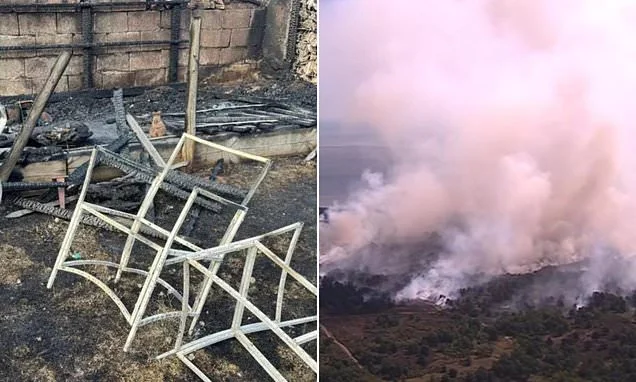
Firefighters have warned that glass objects can spark blazes after a fire started when sunlight reflected through a garden table.
Nottinghamshire Fire and Rescue Service (NFRS) were called to Gunthorpe Road in Gedling at 15:13 on Sunday.
Three crews attended the blaze, which spread to four sheds across four neighbouring properties.
A spokesperson for NFRS said that glass objects could focus the sun's rays onto combustible materials and advised positioning furniture out of prolonged direct sunlight.
A few days ago, NFRS urged residents to help protect their communities after a significant rise in deliberate outdoor fires across the county during the first week of the summer holidays.
Between July 20 and 26, firefighters attended 61 deliberate outdoor fires, compared to 27 incidents during the same period last year.
Areas of particular concern include Bramcote, where firefighters attended five deliberate outdoor fires within 24 hours, and Rayton Lane in Worksop, which saw four incidents over the six days.
A spokesperson for NFRS said: 'These fires can spread quickly, particularly in the warm and dry conditions Nottinghamshire has recently experienced, and can threaten lives, homes, businesses, wildlife and the environment.
Nottinghamshire Fire and Rescue Service (NFRS) were called to Gunthorpe Road in Gedling on Sunday
Three crews attended the blaze, which spread to four sheds across four neighbouring properties
'They also place additional pressure on emergency services, diverting resources away from other emergencies where people may urgently need help.
'The increase we have seen in just the first few days of the summer holidays is concerning.
'We have attended more than double the number of deliberate outdoor fires compared to the same period last year.
'Many people associate deliberate fires with anti-social behaviour, and we are asking parents and carers to speak to young people about the dangers and consequences of setting fires outdoors.
'We are working closely with colleagues from Nottinghamshire Police throughout the holidays to prevent these from happening, utilising joint assets such as the drone.
'However, not all deliberate fires are started with malicious intent. Some incidents can begin when people light campfires or disposable barbecues without considering how easily they can spread or the risks they pose to others.
'What may start as a small fire can quickly spread, especially in grassland and woodland areas, putting people, property, wildlife and the environment at risk. We are asking everyone to think carefully about their actions and help us prevent these incidents from happening this summer.'
This comes after hundreds of holidaymakers were evacuated as firefighters battled large wildfires in Suffolk and London.
A major incident was declared after a 'large-scale, wind-driven' blaze broke out on Dunwich Heath on the Suffolk coast at around 5.30pm yesterday.
Around 70 firefighters were still tackling the blaze this morning, which has now spread to an area the size of 14 football pitches.
Suffolk Fire and Rescue Service described the situation as 'dynamic' and said it was working hard to protect seaside holiday homes - with 200 caravans evacuated overnight.
Around 48 people, including families with babies and dogs, are currently taking shelter at Westleton Village Hall after being rushed out of their homes at 11.30pm.
Suffolk Fire and Rescue has declared the blaze a major incident 'due to the size and complexity'
Aerial photo shows a fire ravaging an area the size of 14 football pitches in Suffolk
Meanwhile, around 120 firefighters tackled two large grass fires in east London yesterday. Around 30 acres of grassland were destroyed in a blaze in Romford, while ten acres were also damaged by flames in Rainham.
Britain is on high alert for 'exceptionally severe' wildfires after more than 200 were recorded in the past two weeks.
Blazes have swept across parched landscapes including in Nethy Bridge in the Scottish Highlands and Blaenavon in South Wales. Crop fields in Essex and the area around Dovestone Reservoir near Oldham have also gone up in flames.
Almost half of England has been placed in drought. Some areas have not seen rain in 43 days and temperatures soared again to 34C yesterday.
Analysis suggests the UK is on track for the highest number of deaths caused by heatwaves since current figures began.
The UK Health Security Agency said it 'is likely that 2026 could see the highest number of heat-associated deaths on record', surpassing the number in 2022 when the agency started studying them.
An estimated 753 deaths were associated with the heatwave that ran from May 24-27, with a further 2,124 deaths linked to the heatwave between June 21 and 28.
Fire services in England and Wales have so far responded to 706 wildfires in 2026, with more than 200 recorded in the last two weeks, the National Fire Chiefs Council said.
Eight wildfires are currently burning and 'being monitored' across the UK, with fire chiefs warning that there remains an 'elevated risk' of more igniting.
Britain is on high alert for 'exceptionally severe' wildfires after more than 200 were recorded in the past two weeks. Pictured: The fire in Suffolk
Grass in Blackheath, south-east London, has turned entirely brown due to the increased temperatures
In Scotland, crews said they were making 'significant progress' tackling a wildfire in the Cairngorms that broke out two weeks ago.
A number of homes in the remote region were evacuated as plumes of smoke billowed into the sky, and vast swathes of trees, heather and grasslands have been left charred and blackened.
The Environment Agency made the declaration that more than half of England is officially in drought.
The areas are East Anglia; Hertfordshire and the whole of London; Thames Valley; Hampshire and the Isle of Wight; Devon and Cornwall; the West Midlands and Wessex (covering Dorset, Somerset, Wiltshire, and south Gloucestershire).