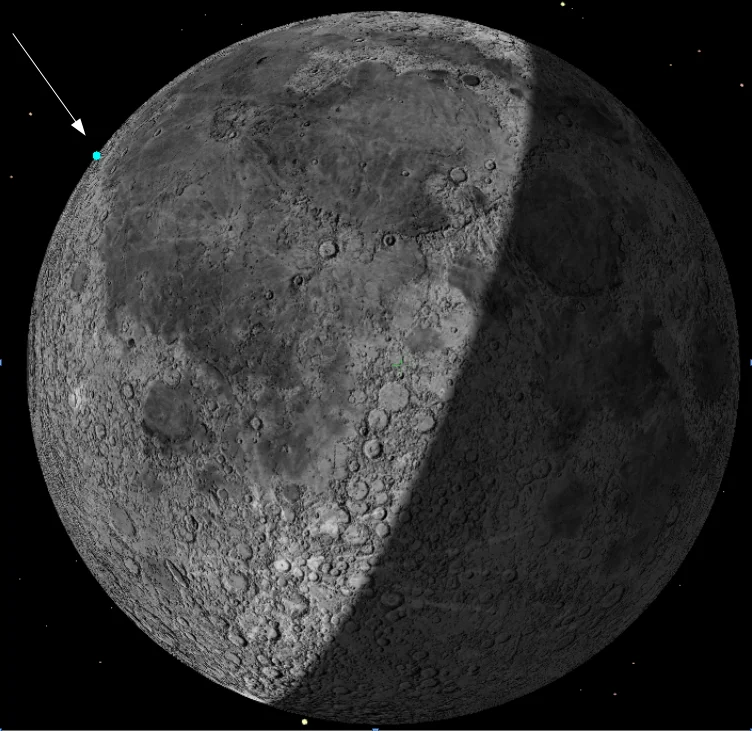
This is the spot where a Falcon 9 upper stage rocket body will collide with the moon on August 5, 2026. The spent rocket will hit the moon at 5,400 mph (8,700 kph). Image via Bill Gray. Used with permission.
Falcon rocket will hit the moon on August 5
In January 2025, a Falcon 9 rocket launched two missions toward the moon: Blue Ghost and Hakuto-R. After the upper stage of the Falcon 9 rocket completed its boosting mission, it became just another piece of space junk. But now – says Bill Gray, a prolific tracker of near-Earth objects – the Falcon 9 is on a collision course with the moon.
Current estimates are that the upper stage will hit the moon at 1:35 a.m. CDT (6:35 UTC) on August 5, 2026. As Gray said:
It doesn’t present any danger to anyone, though it does highlight a certain carelessness about how leftover space hardware (space junk) is disposed of.
And now, on July 17, 2026, a new paper has come out with details on planning observations for the upcoming collision. This event provides scientists and nonscientists alike a perfect opportunity to record a lunar impact in real time. The data collected can help scientists better understand dust dynamics from impacts, the hazards of the resulting debris and more.
Will we be able to see the impact?
The moon will be close to last quarter phase on August 5, 2026. By 1:35 a.m. CDT, those in the Central Time Zone will be able to see the moon, as it will have already risen in the east. Saturn will be nearby. Check Stellarium to see if the moon will be above the horizon at the time of impact if you’re further west. The timing will favor people in the eastern half of the U.S. and Canada, plus much of South America.
So where will the rocket hit? It appears the impact will occur near the edge, or limb, of the moon, close to the Einstein crater.
In the new paper, scientists used Bill Gray’s tracking data to show that the rocket body (39 feet or 12 meters long and 13 feet or 4 meters wide at a weight of around 8,800 pounds or 4,000 kilograms) will gouge a new crater into the surface. The crater won’t be as large as one created by a solid object such as an asteroid, because the rocket body is largely hollow. But still, the new crater should be around 66–98 feet or 20–30 meters wide. We can also expect a huge cloud of dusty lunar soil to launch a few miles into space above the impact site.
Will telescopes in space and from observers in the Americas be able to see all this? It’s possible. The paper said:
Potential observables from this event include the flash at the time of impact (likely lasting less than a second) and the ejecta plume (lasting minutes to tens of minutes). Although some specifics of the impact (such as its precise visual magnitude) remain unclear due to the complexity of the physical processes involved, this event is an ideal opportunity to calibrate measurements of flash brightness and plume dynamics against a known event, should either be detected.
Bill Gray said:
Will the impact be visible from Earth? The impact probably won’t be. The ejecta plume might be. Surprises are possible; it will probably be at least worth taking a look.
Previous lunar impact
After the impact, NASA’s Lunar Reconnaissance Orbiter might be able to get an image of the resulting crater. It’s happened before.
Back in 2022, Bill Gray also predicted a rocket impact with the moon. There was a little confusion about where the rocket came from, but the space junk did indeed hit the moon on March 4, 2022. And it left a mark, too. NASA’s Lunar Reconnaissance Orbiter took an image of the aftermath.
A rocket body struck the moon on March 4, 2022, near Hertzsprung crater. It created a double crater roughly 100 feet (30 meters) wide at its longest. Image via NASA/ Goddard/ Arizona State University.
A speeding object
Gray estimates the space junk will hit the moon at about 1.51 miles (2.43 kilometers) a second. That equates to 5,400 miles (8,700 kilometers) an hour. Because the moon has no real atmosphere, there will be nothing to slow it down.
Tracking the Falcon 9 upper stage
There have been hundreds of Falcon 9 launches. Usually, the spent rocket bodies orbit closely to Earth and eventually reenter our atmosphere. But some have gone on to orbit the sun.
This upper stage rocket has spent most of its time farther out than average, around the distance of the moon. Asteroid surveys pick up objects like this as they scan for dangerous space rocks. As Gray said:
The asteroid surveys would actually prefer not to observe space junk. Time spent observing junk is time not spent finding rocks. But both the rocks and the high-altitude space junk are slowly moving points of light in their images; they aren’t easy to distinguish. So the asteroid surveys find this sort of junk whether they want to or not.
Gray provides software tools for astronomers that help them distinguish between space rocks and space junk. He also computes orbits for high-orbiting objects the military doesn’t track. And he’s been tracking this piece of space junk for months. He’s known since September 2025 that the upper stage was likely on a collision course with the moon. And as he told EarthSky, he wasn’t surprised:
I’ve been checking for such possible impacts for about 20 years, ever since we started having many large bits of junk in orbits that could hit the moon. In a way, the only real surprise is that only two objects have hit the moon.
Rocket will hit the moon despite tiny pushes from sunlight
Over the past months he’s continued to track the object. The reason it can change course a tiny bit is due to the gentle push of sunlight on objects. And that little bit of push is tricky to track. As Gray said:
As an object tumbles, it may catch more or less sunlight, and may reflect some of it sideways.
But, as Gray told EarthSky:
I was reasonably sure a month or two later, but was in no rush to say anything about it. I figured I’d wait until the impact location was well established. So it was something of a gradual process, with no ‘Aha! It’s gonna hit!’ moment.
Not a lot of tracking farther from Earth
Gray told EarthSky:
I am an astronomer working under contract with both asteroid and artificial object observers. I started out doing this for natural objects (asteroids, comets, moons of other planets) about 30 years ago. A few years later, the asteroid surveys started to notice the occasional artificial object and asked me if I could find orbits for them as well.
And as Gray explains on his website, various countries carefully track objects in low-Earth orbit because there are so many pieces of debris with risks of collision with military and science satellites. Farther from Earth, there is less tracking. Or, as Gray said:
Generally speaking, high-altitude junk goes ignored. (Except, it appears, by me.)
Gray works with asteroid hunters. As he said:
My ‘day work’ is for the asteroid-hunting community … Most artificial objects are close to the Earth and move fast enough that there is no risk of mistaking them for an asteroid. But there are about a dozen ‘high-flying’ objects that can move slowly enough to look like a rock, at least briefly. For about 15 or 20 years now, I’ve taken these observations and computed orbits. Then, when the surveys find such objects, they can fairly quickly say ‘Never mind; it’s not a rock; it’s just another nuisance artificial object,’ and go back to looking for actual rocks.
Bottom line: A Falcon 9 rocket will hit the moon on August 5, 2026. Who can see it? And what might you see? Answers here.
Source: Observational planning for the 2026 August 5 Falcon 9 Upper Stage lunar impact
Read more: Satellites swarm the night sky in this new video
Read more: Starlink satellite breaks up, scatters debris
Kelly Kizer Whitt
About the Author:
Kelly Kizer Whitt - EarthSky’s nature and travel vlogger on YouTube - writes and edits some of the most fascinating stories at EarthSky.org. She's been writing about science, with a focus on astronomy, for decades. She began her career at Astronomy Magazine and made regular contributions to other outlets, including AstronomyToday and the Sierra Club. She has nine published books, including a children's picture book, Solar System Forecast, and a young adult dystopian novel, A Different Sky.