Sun news for July 22, 2026. This video shows the M3.6 flare from powerhouse active region AR4493, the day’s leading flare producer. AR4493 fired 23 of the day’s 24 flares, including an M3.6 at 6:35 UTC on July 22 and an M1.7 at 17:27 UTC on July 21. The GOES-19 SUVI instrument captured the eruption in its 131 angstrom wavelength channel, which highlights the hot plasma of solar flares. Image via NOAA.
Sun news July 22: New sunspot region keeps flaring big, 23 flares!
Today’s top story: Newcomer sunspot region AR4493 continued flaring big. During this period, it became the leading flare producer. In fact, it accounted for nearly all the flare activity observed from the Earth-viewed solar disk. That includes two M flares and a list of 22 C flares, for a total of 23 blasts out of the day’s 24 flares. Meanwhile, AR4491 contributed one C flare before decaying. Our hero of the day continued displaying a beta-gamma-delta configuration, the highest possible level of magnetic complexity. That means it surely has more in store! Stay tuned.
Past 24 hours on the sun
(11 UTC July 21 – 11 UTC July 22)
Flare activity: Solar activity stayed at moderate levels over the past day. During this period, the sun sparked a total of 24 flares: 2 M-class (moderate) flares and 22 C-class (common) events.
- Strongest flare: An M3.6 at 6:35 UTC on July 22 from active region AR4493. An R1 (minor) radio blackout accompanied the M flare, affecting an area over India.
- Other M flares: An M1.7 at 17:27 UTC on July 21 from AR4493. It triggered an R1 (minor) radio blackout over the east coast of México.
Sunspot regions: The Earth-viewed side of our sun shows 4 numbered active regions today. Among them is a newcomer emerging from the southeast horizon, now numbered AR4494.
- AR4489 (beta): This region kept its beta configuration. It continued showing signs of decay. It produced no flares during this period.
- AR4493 (beta-gamma-delta): This region shows the strongest complexity on the solar disk and ranks largest in extent. It continued growing and kept flaring all day.
- AR4492 (alpha): This active region ranks second largest in extent. However, it decayed to an alpha configuration. It produced no flares.
- AR4491 (alpha): This region decayed to plage. Still, it contributed one C flare this morning before disappearing.
Blasts from the sun? Observers detected no Earth-directed coronal mass ejections (CMEs) in available coronagraph imagery over the past day.
Past 24 hours in space weather
Solar wind: Solar wind continued at moderate to moderate-high levels. The arrival of fast solar wind from a coronal hole, combined with a co-rotating interaction region (CIR), is driving this rise.
Bt, Bz and magnetic coupling: The interplanetary magnetic field is showing moderate strength. Meanwhile, the Bz component underwent several extended southward deflections during the whole period. A sustained south-oriented Bz component may drive geomagnetic activity. Together, the coronal hole’s fast wind and glancing effects from coronal mass ejections are providing these conditions.
Earth’s magnetic field: Earth’s magnetic field stayed quiet-to-active during this period, with Kp values of just 2–4. No geomagnetic storm registered. Even so, Kp 4 periods were reached. At the moment of this writing, the Kp index sits above level 3.
What’s ahead? Sun–Earth forecast
Flare activity forecast: Forecasters expect low-to-moderate levels, with increased chances of M-class (moderate) flare activity. The main driver of these conditions is AR4493, which shows the largest magnetic complexity, a beta-gamma-delta configuration. In addition, AR4492 and the just-rotating-into-view AR4494 in the northeast disk may contribute.
M-class chances continued at 55% today. Likewise, X-class (strong) flare chances increased from 5% yesterday to 10% today.
Geomagnetic activity forecast:
- July 22: Anticipate unsettled-to-active periods. G1 (minor) geomagnetic storms are possible throughout the day. Fast solar wind from a coronal hole is driving these conditions. Moreover, CMEs that left the sun on July 20 may deliver a glancing blow.
- July 23: Unsettled-to-active conditions may prevail through the day, with continued chances for G1 geomagnetic storming.
- July 24: Conditions may gradually ease later in the day as the stream wanes.
Sun news for July 22, 2026. The sun blasted out two beautiful, eye-catching prominences. Interestingly, the two erupted almost in sync, one on the southwest corner and the other on the northwest corner. Both came from the far side of the sun, arcing over the horizon into view. The GOES-19 SUVI instrument captured them in its 304 angstrom wavelength channel. Image via NOAA.
This image shows sun activity – with the most active regions labeled – as of 0 UTC on July 22, 2026. Original image, without labels, via NASA SDO. Courtesy of NASA/SDO and the AIA, EVE, and HMI science teams, with labeling by EarthSky. Armando Caussade posted today’s sun. Why are east and west on the sun reversed?
Sun news July 21: New sunspot region arrives with a bang
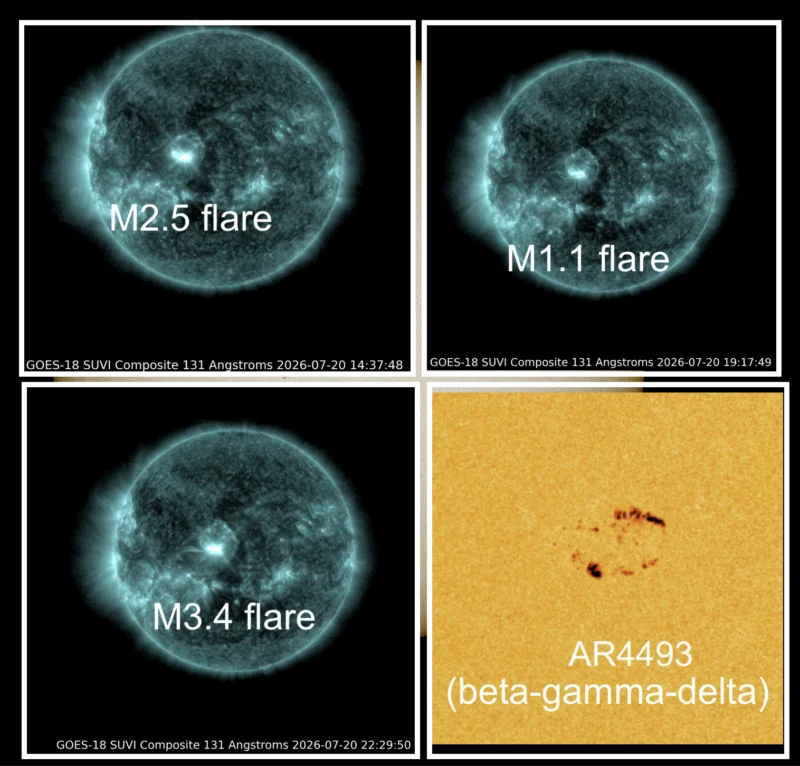
Today’s top story: A lull on the sun has been shattered by a volley of 3 M flares from new sunspot region AR4493. This region emerged from nothing and grew rapidly in the past couple of days, and now displays a beta-gamma-delta configuration, which is the highest possible level of magnetic complexity. That means it could have plenty more big flares in store! Stay tuned.
Past 24 hours on the sun
(11 UTC July 20 – 11 UTC July 21)
Flare activity: Solar activity increased from low to moderate levels over the past day thanks to three M flares. Flare production also registered a notable jump. Yesterday, the sun fired just three C-class (common) flares and one B-class (weak) event. This period, it fired 18 flares: 3 M-class plus another 15 C flares.
- Strongest flare: An M3.4 at 22:25 UTC on July 20 from active region AR4493. An R1 (minor) radio blackout accompanied the M flare, affecting an area over Hawaii.
- Other M flares: An M2.5 at 14:36 UTC on July 20 from AR4493 triggered an R1 (minor) radio blackout over the Atlantic Ocean. Later, an M1.1 at 19:20 UTC on July 20, also from AR4493, produced an R1 (minor) radio blackout over Baja California in Mexico.
Sunspot regions: Currently, the sun shows 4 numbered active regions on the side we see from Earth. Among them is a newcomer, now numbered AR4493.
- AR4489 (beta): This region lost its gamma configuration. It also began to show signs of decay. It produced no flares during this period.
- AR4493 (beta-gamma-delta): The unnumbered region in the east we mentioned yesterday emerged from nothing and continued growing. It now shows the strongest complexity there is.
- AR4492 (beta-gamma): This active region underwent notable growth. In addition, it developed a gamma configuration. It produced one C flare.
- AR4491 (alpha): This region showed some decay. Consequently, it reduced from its beta to an alpha configuration today.
Blasts from the sun? The coronal mass ejections (CMEs) produced during the three M flares of this period remain under modeling and analysis. Forecasters are working to determine if any could reach Earth.
Past 24 hours in space weather
Solar wind: Solar wind conditions averaged at background levels throughout most of the period. However, at 7:30 UTC this morning, speeds increased to moderate levels. The arrival of fast solar wind from a coronal hole, combined with a co-rotating interaction region (CIR), caused this rise.
Bt, Bz and magnetic coupling: The interplanetary magnetic field showed similar behavior. It stayed weak during almost the entire period. Then, at 6:30 UTC this morning, the Bt component started to increase. By the end of the period, it showed strong levels. Meanwhile, the Bz component pointed southward the whole period. A sustained south-oriented Bz component may drive geomagnetic activity. In short, the calm is passing. The coronal hole’s fast wind is arriving.
Earth’s magnetic field: Earth’s magnetic field stayed quiet-to-unsettled during this period, with Kp values of just 1–3. No geomagnetic storm conditions occurred. Auroras remained confined to the highest latitudes around the auroral oval. At the moment of this writing, the Kp index sits at level 3.
What’s ahead? Sun–Earth forecast
Flare activity forecast: Forecasters expect low-to-moderate levels through July 21–22, with increased chances of M-class (moderate) flare activity. The main candidates include AR4493, the most magnetically complex region currently on disk with its beta-gamma-delta configuration, and AR4492, which has developed gamma complexity. Furthermore, new regions are rotating onto the northeast disk.
M-class chances increased to 55% today. Likewise, X-class (strong) flare chances rose to 5% today.
Geomagnetic activity forecast:
- July 21: Anticipate quiet-to-unsettled conditions through most of the day. Late on July 21, a co-rotating interaction region ahead of a coronal hole’s high-speed solar wind stream will likely arrive. This will enhance the solar wind environment. Consequently, unsettled-to-active conditions are expected by late in the day, with a chance for G1 (minor) storm levels near the end of the period.
- July 22: Expect unsettled-to-active periods. G1 (minor) geomagnetic storm conditions may persist throughout the day. If conditions align, aurora may appear over Seattle, Edinburgh, southern Scandinavia and Hobart (Tasmania). Southern Hemisphere observers have the advantage of longer winter nights.
- July 23: Conditions may gradually ease later in the day as the stream wanes.
Sun news for July 21, 2026. These four panels show the fiery debut of new active region AR4493. From left to right and top to bottom: the M2.5 flare at 14:36 UTC, the M1.1 flare at 19:20 UTC, and the M3.4 flare at 22:25 UTC, all on July 20, as captured by the GOES-19 SUVI instrument. The final panel shows the AR4493 sunspot region itself, seen in visible light by NASA SDO’s HMI intensitygram. Images via NOAA and NASA.
Sun news for July 21, 2026. This image shows the large coronal hole, a dark region of lower density in the sun’s outer atmosphere. Its fast solar wind stream is arriving now and could spark G1 (minor) geomagnetic storms and auroras on July 22. The GOES-19 SUVI instrument captured this view. Image via NOAA.
Sun news July 20: Fast solar wind on its way to Earth
A large coronal hole we saw a couple of weeks ago has passed around the far side of the sun and returned to our star’s Earth-facing side. This “hole” in the sun’s outer atmosphere has just crossed the center of the solar disk. That means the fast solar wind streaming from it is on its way to our planet, and should reach our magnetic field late on July 21. As a result, geomagnetic activity could climb to G1 (minor) geomagnetic storm levels by July 22. Stay tuned!
Past 24 hours on the sun
(11 UTC July 19 – 11 UTC July 20)
Flare activity: Solar activity remained low over the past day. Observers recorded three C-class (common) flares and one B-class (weak) event.
- Strongest flare: A C2.1 from an as-yet unnumbered region at 7:39 UTC on July 20.
- Other flares: A C1.9 occurred at 18:48 UTC on July 19, followed by a C1.3 at 18:25 UTC on July 19. Both came from a region just beyond the southeast limb.
- The three numbered regions on the visible disk stayed largely inactive throughout the period. Instead, action on the horizon accounted for most of the flaring.
Sunspot regions: The Earth-facing solar disk displayed three numbered active regions.
- AR4489 (beta-gamma): The most magnetically complex region on the disk. It sits in the south-central area. During the period, it underwent slight development and an increase in magnetic complexity. Even so, it stayed largely inactive in terms of flare production.
- Meanwhile, forecasters noted a new, unnumbered region in the east. It shows continued growth.
- The remaining numbered regions stayed mostly unchanged and quiet. They contributed no significant flare activity.
- Finally, active regions beyond the southeast limb continued to produce C-class flares. This suggests potentially significant activity may rotate into view in the coming days.
Blasts from the sun? Forecasters cataloged four coronal mass ejections (CMEs) during the period. However, none should impact Earth.
Past 24 hours in space weather
Solar wind: Solar wind conditions remained at background levels throughout the period.
Bt, Bz and magnetic coupling: The interplanetary magnetic field stayed weak. The Bz component fluctuated gently between moderately northward and southward, but the southward dips were not sustained enough to drive geomagnetic activity. These are textbook quiet solar wind conditions: the calm before the coronal hole wind arrives.
Earth’s magnetic field: Earth’s magnetic field stayed quiet throughout the entire period, with Kp values of just 0–2. No geomagnetic storm conditions occurred. Auroras remained confined to the highest latitudes around the auroral oval. Moreover, the short summer nights in the Northern Hemisphere further limited any visibility.
Sun news for July 20, 2026. The solar wind is currently calm, but we’re expecting bursts of high-speed wind from a coronal hole. That’s a region where the sun’s magnetic field opens up into space, allowing the super-hot atmosphere to stream more easily from the sun, giving us the fast solar wind. This artist’s animation shows the coronal hole blowing the fast wind toward Earth and its magnetic field (not to scale). Images via NASA/ SVS.
The sun in recent days
This image shows sun activity – with the most active regions labeled – as of 2 UTC on July 21, 2026. Image via NASA/ SDO.
This image shows sun activity – with the most active regions labeled – as of 2 UTC on July 20, 2026. Image via NASA/ SDO.
This image shows sun activity – with the most active regions labeled – as of 1 UTC on July 19, 2026. Image via NASA/ SDO.
Earlier sun images
This image shows sun activity – with the most active regions labeled – as of 2 UTC on July 18, 2026. Image via NASA/ SDO.
Sun images from our community
View at EarthSky Community Photos. \| David Hoskin in Halifax, Nova Scotia, Canada, captured this image of the sun on July 21, 2026. David wrote: “Large Earth-facing sunspot AR4493 harbours energy for the possible release of X-class solar flares.” Thank you, David!
View at EarthSky Community Photos. \| Victor Rogus in Sedona, Arizona, captured this filtered image on July 20, 2026. Victor wrote: “Mostly cloudy skies with rain on the way for Sedona, but this morning through the cloud we see that, new sunspot AR4493 is emerging rapidly from the depths of the sun–and it has taken the shape of a gigantic ring. And that this sunspot has a 100,000-km-wide structure.” Thank you, Victor!
View at EarthSky Community Photos. \| EarthSky’s own Raúl Cortés in Monterrey, Mexico, captured this filtered image on July 20, 2026. Raúl wrote: “Sunspot regions AR4492, AR4493 and AR4489.” Thank you, Raúl!
More sun images from our community
View at EarthSky Community Photos. \| Mario Rana in Hampton, Virginia, captured these filtered images on July 19, 2026. Mario wrote: “The sun in hydrogen-alpha, helium D3 and sodium D2.” Thank you, Mario!
We sometimes feature sun images obtained using hydrogen-alpha filters. Read why.
Bottom line: Sun news July 22, 2026: Powerhouse region AR4493 fired 23 of the day’s 24 flares, including two M flares. With top complexity, it likely has more in store!