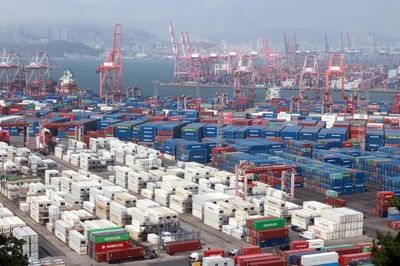
Containers stacked at Busan Port, Wednesday / Yonhap
Long celebrated as Korea's bustling maritime gateway, the southern port city of Busan is launching a new bid to secure a different kind of global arrival: foreign tech talent.
Municipal officials and immigration authorities gathered at the Busan Eurasia Platform on Monday to inaugurate the city’s first Global Startup Immigration Center. The facility is the first of its kind in the nation's southeastern metropolitan corridor, representing a significant victory for local policy experts seeking to decentralize the country’s heavily capital-centric tech economy.
Administered by the Busan Tech-Startup Investment Agency, the center will run the central government's Overall Assistance for Startup Immigration System. The initiative provides foreign nationals with a step-by-step pathway to permanent regional residency through intensive tech incubator workshops, corporate law seminars and intellectual property mentorship.
For aspiring foreign founders in Korea, the center represents a critical regulatory bridge. Navigating the highly coveted D-8-4 technology startup visa requires a point-system qualification structure. The new Busan hub provides participants with a direct avenue to earn these points, offering institutional recommendations and critical oversight for corporate registration.
While Korea established the immigration initiative in 2014 — drawing over 12,000 global participants through late 2025 — the specialized centers remained disproportionately clustered around Seoul. Under a national policy push for equitable regional development, the central government began distributing these administrative assets to coastal hubs. Busan now joins North Jeolla and North Chungcheong provinces as a regional anchor for the program.
"The opening of this immigration center establishes a strong institutional foundation for exceptional foreign startup talent to settle and scale directly within Busan," said Lee Jin-soo, the city's director-general of financial and startup policy. "We will work closely with immigration and venture capital authorities to ensure foreign-led enterprises bring new economic vitality to our local community."
Following the official ribbon-cutting, the center hosted an inaugural lecture by Casimir Agossou, an entrepreneur, author and the founder of Acafo, an artificial intelligence-driven platform designed to help foreign job seekers navigate the employment landscape in Korea. The event drew roughly 50 aspiring global entrepreneurs, trade experts and immigration officials.
The city plans to link the new center with its existing international cooperation networks, overseas venture capital funds and its premier annual Asian startup expo. By converting its maritime logistics infrastructure into an archival and technological launchpad, Busan hopes to build an enduring global hub that proves Korea’s innovation extends far beyond the borders of Seoul.
This article was published with the assistance of generative AI and edited by The Korea Times.