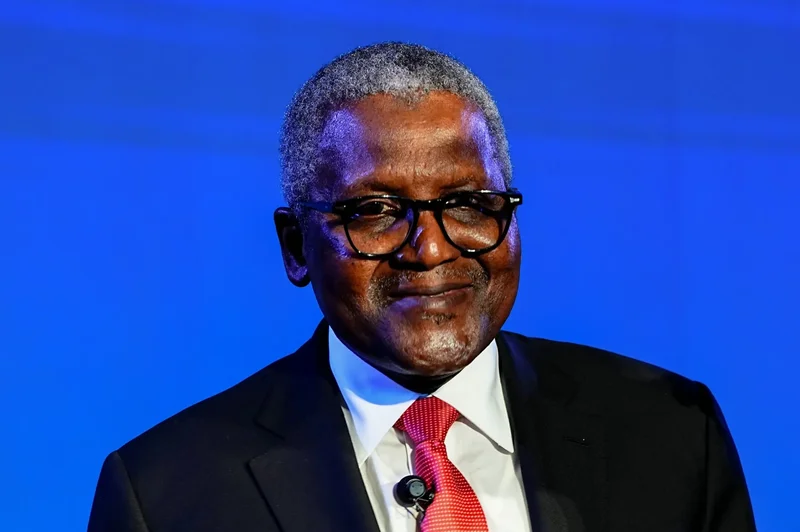
Aliko Dangote wants to be remembered for being more than an industrialist.
“I want to be known not just as Africa’s richest person,” Dangote said in 2025 when he joined Time’s list of the World’s Top 100 Philanthropists, “but also as its biggest philanthropist.”
He plans to leave one-third of his fortune to charity, his daughter Halima Dangote told Bloomberg in an interview published this week. Based on the Nigerian industrialist’s estimated $35.2 billion fortune, that pledge amounts to about $11.7 billion. He’s already secured his family’s buy-in to make it stick.
“He made an announcement and he asked myself, my two sisters, and his mother to sign under that will that he is able to give that 33% to humanity,” Halima, a trustee of the Aliko Dangote Foundation, told Bloomberg. The arrangement, she noted, follows Islamic inheritance rules, which permit a portion of an estate to be set aside for charity.
“Giving back is part and parcel of what we do,” she continued. “Our business is successful because of the giving back.”
Dangote runs Dangote Group, a large African industrial conglomerate focusing on cement, oil refining, and fertilizer. It’s the biggest cement producer on the continent, and Dangote plans to take his massive Nigerian oil refinery public, with a listing targeted for September. So that $11.6 billion estimate is likely conservative, considering the asset that dominates his balance sheet hasn’t yet been priced by the market. One-third of his fortune could be worth considerably more once it lists.
From a small trading business to a continental business empire
Dangote, 69, built his fortune the old-fashioned way, on physical things people haven’t yet figured out how to survive without.
He started with a small trading operation in 1977 and expanded into cement, sugar, salt, and flour before founding Dangote Cement, which now spans 10 African countries. He owns the bulk of the publicly traded company through a holding structure. As previously noted, he’s recently poured more resources into the refinery and a fertilizer plant, moves that have driven his net worth to record levels. He’s held the title of Africa’s richest person for well over a decade.
Dangote also isn’t new to philanthropy. He founded the Aliko Dangote Foundation in 1994, which was endowed with $1.25 billion about a decade ago and has taken in another $700 million since, according to Halima. The foundation focuses on health, education, nutrition, and economic empowerment, including a $100 million program to fight childhood malnutrition. Roughly 70% of its spending goes to Nigeria.
Some of its highest-profile work was partnering with the then-Bill & Melinda Gates Foundation (now just the Gates Foundation) and northern Nigerian state governments on campaigns focused on malnutrition and polio eradication in Nigeria.
A rare pledge—by any measure
Dangote is a rare philanthropist for Africa, but also across the globe. Only a handful of Africans have signed the Giving Pledge, which encourages the ultrawealthy to give away a majority of their fortunes. While one-third of his fortune is undeniably a huge sum, it cuts just short of that.
His approach also differs from a growing cohort of American megadonors who give aggressively while they’re alive—think MacKenzie Scott, who has handed out tens of billions in fast, no-strings gifts. Dangote’s plan is structured as a bequest, locked into a will rather than deployed now.
To be sure, the Giving Pledge was built in a U.S. context and “is not the best measure of philanthropy in Africa,” Katja Schiller Nwator, founder of the Lagos-based Philanthropy Circuit, told Bloomberg. Across the continent, she said, giving tends to flow through families, communities, and faith-based institutions.
Either way, Dangote’s fortune has the power to continue to change communities throughout Africa as his previous work has shown. His daughter says he preaches two rules for anyone who wants to succeed: give to charity, and respect your mother.
“My mother instilled in me the ethos of giving back, which inspired my philanthropy 30 years ago,” he said last year, after landing on TIME’s inaugural list of the world’s most influential philanthropists alongside Michael Bloomberg, Oprah Winfrey, and Warren Buffett.
The Fortune 500 Innovation Forumwill convene Fortune 500 executives, U.S. policy officials, top founders, and thought leaders to help define what’s next for the American economy,
Nov. 16-17 in Detroit. Apply here.