You can find more obituaries from The Globe and Mail here.
To submit a memory about someone we have recently profiled on the Obituaries page, e-mail us at obit@globeandmail.com.
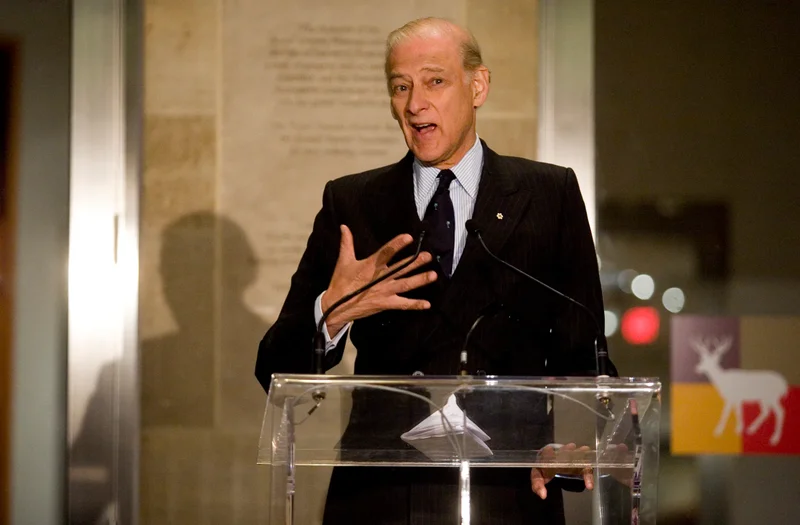
“Tall and elegant” is how multiple profiles have described Christopher Ondaatje over the decades.
He was long-legged and, rather than simply walk, he was known to range gracefully along corridors. But those adjectives could just as easily describe his almost-century-long life.
Tall, because his was a truly towering list of life experiences. Christopher Ondaatje was a self-made millionaire, an Olympic athlete, a best-selling author, a musician, a painter, a swashbuckling explorer and a deeply devoted brother, husband and father.
Elegant, because each of his passions seemed to connect seamlessly together, with none seeming to overpower another.
“He was probably the most active person that I’ve ever known,” David Ondaatje, Christopher’s son and a filmmaker who lives in California, said in an interview from the family home in the Bahamas where Christopher spent his final days. He died on July 20, at the age of 93.
“He was always making something. He always found time to do the things he loved. He was a painter. He was a writer. He was a musician. He was a filmmaker. He made a lot of family movies. For years every Christmas we would get a movie in the mail, a new creation that he had filmed over the summer.”
Born in Sri Lanka in 1933, back when the country was still a British colony called Ceylon, Christopher was part of an Ondaatje lineage stretching back nearly four centuries. According to a 2019 profile in Sri Lanka’s Sunday Observer newspaper, Christopher was a direct descendant of a Brahmin physician named Ondaatje in the court of Tanjore (present day Thanjavur, a city in the south Indian state of Tamil Nadu) who was summoned by the Dutch governor of Ceylon in 1659.
He was sent to boarding school (Blundell’s) in England in the mid-forties, but in 1950 his mother sent a letter saying he would have to leave as the family could no longer afford the fees. The loss of the Ondaatje family fortune was widely attributed to the alcoholism of his father, Mervyn. Christopher’s mother, Doris Gratiaen, divorced her husband around that time and Mervyn died in an accident a short time later.
“Being kicked out of my house and my family in 1947 forced me to become worldly-wise and to be able to think for myself and make decisions very early on,” Christopher told Salon Magazine in May, 2000.
David said that experience also helped Christopher to prioritize family above all else.
“Family was so important to him because his own family broke up when he was very young in Sri Lanka. All four kids were sent to live with different people when their parents divorced. That had a big impact on him: They were all very close when they were young. Then they lost everything.”
Doris brought two of Christopher’s younger siblings, Michael (future author of The English Patient, among other bestselling novels and poetry) and Janet, over to England, where she ran a Notting Hill boarding house. Jillian, his other sister, stayed behind in Sri Lanka.
As the eldest, Christopher quickly set a goal of rebuilding his family’s financial position. He got his first banking job in London at age 17, but quickly decided he would have better fortune abroad.
Christopher arrived in Canada in 1956 with just $13 in his pocket (or about $150 in 2026 dollars). He was initially unimpressed.
“I stood with the other passengers in the shelter of the open shed and gazed miserably at the bleak prospect of Montreal’s Pier 26 — my first view of Canada after eight days of the Atlantic — eight cold, drizzly, sunless days in a second-rate Cunarder,” he previously told The Times.
His only friend in Canada at the time was a trumpet player in a Toronto nightclub, and Christopher’s first Canadian home was a basement laundry room. He would initially earn some money by joining his friend’s band on the guitar.
Christopher eventually found a banking job in what was known as “the cage” of a Toronto stockbroking company. The term was accurate, as his tasks revolved around making records of individual trades in a room enclosed by iron bars (for security) that was more akin to a jail cell than an office.
He quickly broke free of that position, however, and moved to Montreal, where he got into magazine advertising. It was there he met Valda Bulins, the daughter of Latvian refugees who had a degree in chemistry from Dalhousie University. They married in 1959 and would remain together for more than 65 years.
Three years later, Christopher brought his younger brother Michael over from England.
“When he was 18, I pulled him out to Canada to go to university. He immediately latched onto the literary set,” Christopher told Salon. “He’s 10 years younger than me and we didn’t really have a chance to get to know one another in earlier life.”
Michael dedicated his latest book, The Distance of a Shout, published earlier this year, to his older brother. Christopher “persuaded me to join him” in Canada, he wrote, “so giving me the essential gift of a new life.”
“Before leaving England, he had introduced me to the pleasures of books and music, especially jazz. And for years at parties he would bring out his guitar and sing a Hoagy Carmichael song, ‘Huggin’ and Chalkin’’, and when he got to the last verse I would join in with him.”
Shortly after bringing Michael to Canada, Christopher got into bobsledding and was selected to represent Canada at the 1964 Winter Olympics in Austria. While his own sled finished 14th, another Canadian sled won gold.
Back in Canada, Christopher published his first book, a history of the prime ministers of Canada, in 1968. It was a massive success, selling several hundred thousand copies.
He translated that success into a publishing company that he launched in 1970 called Pagurian Press (Pagurian is the scientific name for hermit crab). That same year, he founded Canada’s first independent institutional equity brokerage, Loewen, Ondaatje, McCutcheon & Company.
Pagurian would go public on the Toronto Stock Exchange in 1979, expanding from publishing into corporate finance and investment management.
By 1988, the company was reportedly worth roughly $500-million, or nearly $1.2-billion in 2026 dollars. By age 55, Christopher had achieved his goal of rebuilding the Ondaatje family fortune. But he had had enough of high finance.
Reading The Devil Drives, a biography of Victorian explorer Sir Richard Burton, had an influence on him as significant as getting kicked out of school decades earlier. He promptly sold off all his business interests.
“I was hacking my way through the jungles of finance, and I suddenly realized his was the life I would have preferred to have led,” Christopher told Salon. “I was fed up with the world of finance and greed, and the uncertainty of the economic clouds. I was worried too that I wouldn’t have enough time to do all I wanted with my life. I didn’t want to die with ‘financier’ written on my gravestone.”
After having spent the last four decades of his life collecting, adventuring (he spent years tracing the source of the Nile River) and creating art, David said there is clearly no risk of that.
“The next generation of the family doesn’t really know anything about his financial life. They only know him as a fun, eccentric, wonderful person.”
The sheer elegance of Christopher’s manner was never more evident than in 1999, when David went with his wife and his sister to join the family patriarch on a trip to Africa.
“We all kept diaries. He showed me his diary and I couldn’t believe it: every page was neatly written, every sentence was perfectly formed. Page after page after page and nothing was crossed out. No changes, no corrections. Thoughts were coming out as fully formed sentences,” David said.
The journalist John Fraser, a longtime friend, said Christopher was “generous to a fault,” citing a long list of causes, charities and institutions he supported over the course of his life. Christopher received the Order of Canada in 1993 for his philanthropy and was knighted for it in 2003.
Christopher was also “restless about what the next adventure was going to be,” Mr. Fraser said. Yet no matter how busy he was, David said, Christopher was still a “very present parent.”
“He was very much a part of our lives. We never got the sense that there was anything more important than his family. I’ve tried to make sure my kids feel the same way,” he said.
Christopher would regularly get out his guitar and sing for the family at gatherings. The songs were usually about his family and the places they went together.
He became a prolific painter towards the end of his life, David said, with every member of the immediate family receiving a portrait as a present in recent years.
David said one of his parents’ favourite movies was Out of Africa. After Christopher’s passing, Valda quoted from the eulogy at the end of the film: “He brought us joy.”