Sign in. It’s quick, free and it’s up to you.
An account is an optional way to support the work we do. Find out more.
Politics by Numbers is a new series for The Journal where broadcaster, author and spreadsheet stan Gavan Reilly takes a data deep dive into a political point of the week.
WITHOUT MUCH FANFARE, the curtain is coming down this week on an enormously important era in Irish history. With shareholders today approving a takeover of PTSB, the State will sell its final shareholding in the Irish banking system – the final step of a €64.1 billion process that began in the dismal spring of 2009 with the takeover of Anglo Irish Bank and quickfire injections of cash into AIB and Bank of Ireland.
Tomorrow, meanwhile, Nama is officially dissolved. The ‘bad bank’ set up to warehouse the property-related debts has managed its portfolio and sold off all but a tiny remnant of its loan book.
It’s coincidental that this week also marked the visit of a German Chancellor to Ireland – given how the last two visits have come at what felt like key inflexion points in the country’s modern past.
In 2014, Angela Merkel was officially in Dublin for a congress of EPP member parties, but took the opportunity to visit Government Buildings for a bilateral with Enda Kenny.
It was only two years since her public image as the architect of austerity had become so notorious; Merkel’s name even appeared as a gag on a banner shown by Irish fans at Euro 2012.
By the time of her visit, Ireland had officially ended its bailout – and the Chancellor was fielding questions about retroactively undoing some of the damage.
Ireland had been somewhat unlucky in the timing of its financial woes, prompted partly by Merkel herself. In October 2010 she and Nicolas Sarkozy, the president of France, had declared that any future bailouts of banks would require their creditors to share some of the burden – prompting surges in borrowing costs for banks, and in turn a fatal credit squeeze for Ireland that precipitated the November 2010 bailout.
European leaders later created a central fund which could be used for saving banks in future – opening the question of whether Ireland could effectively sell its stakes in its banks, and get its cash recouped.
The outcome on that day wasn’t quite so clear. Die Bundeskanzlerin’s own English interpreter suggested a “positive” view on Ireland selling its shares to the European fund, though the original German was more guarded (“a positive outlook on a positive outcome”). Either way, the vibes were, well, positive: Enda Kenny was so chipper he encouraged his guest to close the press conference with a ‘go raibh math agat’. Merkel, wanting neither to embarrass herself nor butcher the language, politely declined.
Merkel’s next visit to Dublin five years later came in very different circumstances. No longer was Ireland a basket case or problem child, but still a cornerstone of a different European crisis. It was April 2019, and the United Kingdom was eight days from a no-deal ‘crash out’ Brexit that threw up all sorts of queries about Ireland’s role in defending the integrity of the EU’s single market.
There was broad sympathy for Ireland’s wish to avoid any ‘hard border’ with customs checks or personnel, but nonetheless Brussels was fretting about how to retain free movement of people while denying a back door to imports.
The EU was even advising that it would become illegal to import food for personal use: officially you’d be banned from buying a ham sandwich in Strabane and eating it in Lifford, even if nobody was standing at the River Foyle to take it from you.
On that visit, as Berlin briefed, “the meeting was the message”. Merkel was edging towards retirement, but made a flying visit simply to assure Leo Varadkar that there would not be any pressure from other member states to mount physical border posts. Meeting at Farmleigh with communities from the border region, Merkel recalled the hurt of a divided Germany and did not want the same for Ireland.
“For 34 years I lived behind the Iron Curtain,” she said at a joint press conference. “I know only too well what it means once borders fall.”
The very next day, with obvious refusal in Europe to countenance a border and unable to get parliamentary backing for any compromise, Theresa May sought an extension to the Article 50 process – delaying Brexit itself, necessitating European elections, fuelling the rise of Nigel Farage’s then-Brexit Party and setting a chain of dominoes that continues today.
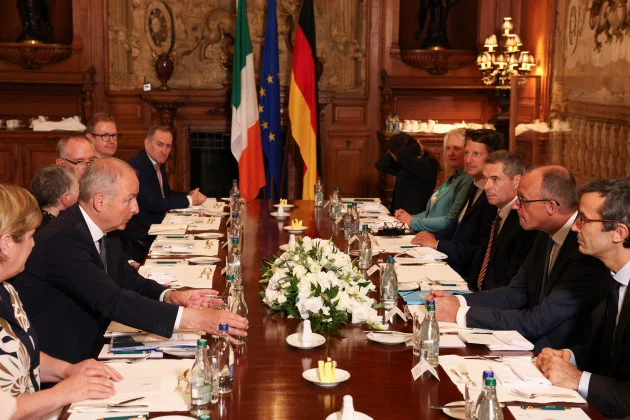
And then to this week, and the four-hour flying visit of Friedrich Merz. The tables now seem to have turned: while Merz’s leadership of Merkel’s CDU has been ravaged by infighting, and his government destabilised by a botched reshuffle, Ireland’s political and fiscal outlooks are broadly stable.
In fact, this week, Germany was coming to make its case: Ireland now holds some of the cards.
Because we hold the rotating presidency of the EU Council, it falls to Ireland to broker a deal on the ‘multiannual financial framework’ – in layman’s terms, the EU’s next budget, running from 2028 to 2034.
Germany cannot countenance the same: it’s under pressure domestically to refine its spending and pare back the civil service, and cannot justify increasing its spending in Brussels while cutting in Berlin. The message might still be one of austerity and performance-related targets, but now Germany is asking of Ireland, rather than enforcing its own views.
Twelve years ago, the idea that a German chancellor would be coming to Ireland and looking to present arguments to us would have seemed fanciful, if not farcical. Yet in the week that Ireland closed two major chapters of its dismal past, that’s precisely what happened in Farmleigh on Tuesday.
Nobody can ever put a cost on what else we could have done with the money that went into Nama and in supporting the banks.
That lost decade of austerity meant a growing population and developing society did not get the public investment it needed; the social cost of that failure is innumerable and ongoing. And, of course, tens of billions were poured into Anglo Irish Bank and Irish Nationwide, two entities that will never trade again.
But politically – through a fixture of some hard work, some good fortune, a baffling British referendum, and a rotating chairmanship – the stories of the three Chancellors’ visits are a story of how Ireland has managed to get back on its own two feet.
Angela Merkel thought we were working. Perhaps we were.
Gavan Reilly is the Political Correspondent for Virgin Media News and the host of Monday with Gavan Reilly, which airs every Monday at 10pm on Virgin Media Play and Virgin Media One.
To embed this post, copy the code below on your site