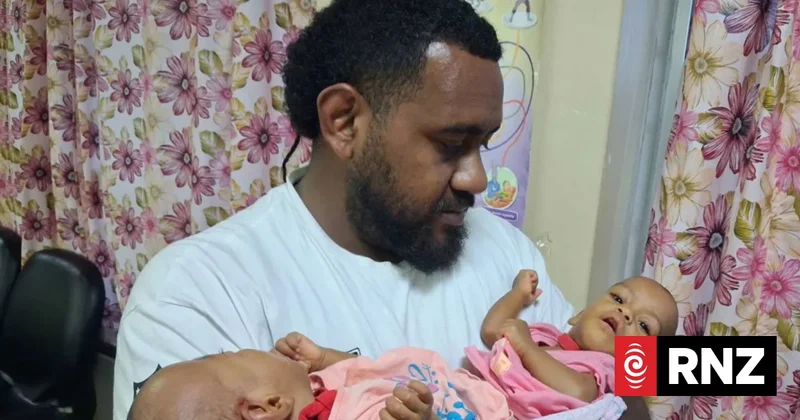
Three countries asked for US$1 million. Then Saudi Arabia stepped in to offer free surgery for Fiji's rare conjoined twins
Three different countries asked for US$1 million upfront before they would surgically separate rare conjoined twins born in Fiji.
The 10-month-old girls - Di Cecea and Jesipeli Kikau - were born prematurely in a set of triplets at the Colonial War Memorial (CWM) Hospital in the capital, Suva.
"The doctors said this is the first case of conjoined twins in Fiji in 20 years," their mother Akenata Vulimaiigiladi said in a video shared by Fiji's Health Ministry.
"When they were born two months premature the doctors said they might only survive for a few days. We are grateful to the nurses, doctors and medical staff here at the hospital for their service," she said.
Help sought
A team of paediatric doctors at CWM spent eight months seeking help from multiple other countries, including neighbours Australia and New Zealand.
"We approached Mexico, the United Kingdom and the United States, but they wanted US$1 million upfront to perform the surgery," one of the team in Suva who looked after the twins, Dr Ilisapeci Tuibeqa, told RNZ Pacific.
She said several countries they approached were only interested in performing the surgery for research purposes.
"We asked Australia if they would offer the family humanitarian support, after (the Sydney Children's Hospital) agreed to operate on the conjoined twin boys from Papua New Guinea. But we were told it was not possible."
"The initial surgical team had asked New Zealand if it would consider performing the surgery but doctors said that they were not able to assist us with that," Dr Tuibeqa said.
"I think they made the decision knowing the complexity of the surgery and the need for a multi-disciplinary team to do the operation."
Riyadh to the rescue
However, the Saudi Arabian government offered to perform the surgery for free on humanitarian grounds, while also paying for the family's airfares and accommodation.
The family flew out of Nadi International Airport on Wednesday night bound for Hong Kong, Doha, the capital of Qatar, then onto Riyadh, the capital of Saudi Arabia.
Fiji's government has paid for a paediatric registrar to accompany the family on the trip and liaise with doctors at the King Salman Hospital in Riyadh, who are performing the surgery.
Dr Tuibeqa said the hospital in Riyadh would review the case again before fixing a date for the operation.
"We've shared imaging and medical reports with them from when they twins were about two or three months old," she explained.
The twins - fused below the sternum - spent the first two months of their lives with their sister, Hossana, at CWM Hospital's neo-natal care unit.
Humanitarian grounds
Dr Tuibeqa said she was "exhausted" but "overjoyed" that the Saudi Arabian government offered to perform the surgery on humanitarian grounds.
The outlook for the twins was positive, given they did not share vital organs, she said.
"They're joined below the sternum, so below the chest diaphragm, they're joined just below that down to the pelvis. They have their own heart and they have their own lungs," Dr Tuibeqa said.
However, she said they do share some organs.
"Between the two of them there's only two kidneys instead of four and there's two ureters, they're sharing a bladder, some parts of the intestine, and a colon, but they have their own stomach."
Dr Tuibeqa said the conjoined twins have had no major health problems so far.
"They got admitted at one stage with Hematochezia, so they had a bit of blood in the stool, then we thought they had an anal fistula, they're sharing one anus as well and one set of female genitalia, but they've got four legs ," she said.
"They've been really well, they've been growing. They've been admitted just once or twice, we've been seeing them in clinic regularly. They seem to be both equally well,"
Hopeful
Dr Tuibeqa said the prognosis for the girls post-surgery is good.
"Twins that have surgical separation below the chest, the outcomes for them are almost always favourable. People can survive on one kidney, you can reconstruct genital parts, one intestine can be given to one and then you can do a colostomy on the other one, so its favourable in that sense."
"Having said that, we've advised the family that anything is possible, they may lose one and save one, but we are all hoping that both of them will be separated successfully,"
This is the second case of conjoined twins in the Pacific region in the past year, after brothers Sawong and Tom Kevin were born in a remote village in Morobe Province in Papua New Guinea last October.
The boys, fused at the lower abdomen, underwent emergency separation surgery at Sydney Children's Hospital last December, however only Sawong survived.
In June 2004, Fiji recorded its first live birth of conjoined twins at Suva's main hospital.
Twin girls of Indian descent were born sharing a heart and liver and were joined along the front of their bodies.
Preparations had been underway to send them to the Royal Melbourne Children's Hospital for separation surgery, however the girls died in Suva of a cardiac complication.