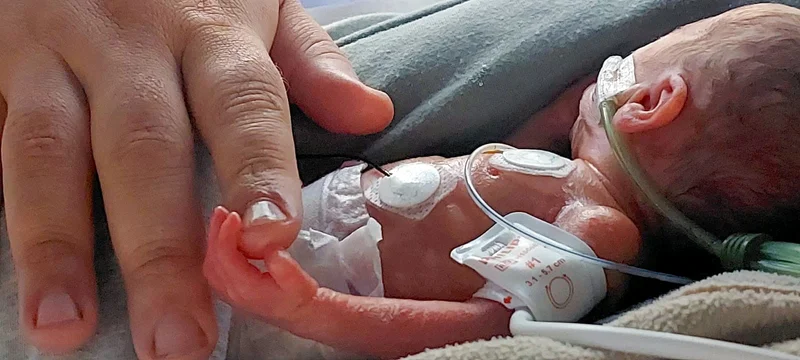
Sitting next to his sonâs incubator at the Life St Georgeâs Hospital, Jordan Theron was overwhelmed by a feeling of utter helplessness.
Looking at his baby boy, he could see the colour drain from his skin as every blood sample drawn for testing sapped his tiny body.
But Jordan has experienced the miracle of watching colour return to his sonâs pale grey skin after receiving his first blood transfusion.
Eli Maverick Theronâs story is just one of many that show how blood donations collected by the South African National Blood Service (SANBS) save lives and give people a second chance.
Struggling to fight back tears, Jordan took to the stage at the annual South African National Blood Service (SANBS) Awards evening in Gqeberha on Wednesday night, recounting his familyâs life-altering experience, with one-year-old Eli sitting in the front row.
Jordan and his wife Helen went to the hospital for a routine 26-week check-up in February 2025, not expecting that their doctorâs visit would turn into an emergency delivery, followed by a three-month hospital stay for their baby.
âWe thought we still had months. We were still planning out the nursery, and the next moment my wife is booked in for an emergency C-section.
âThere was no cord-cutting; we had no time for cuddles. He was taken away, and we were devastated. It was the start of a terrifying journey for our family.â
As he was placed into his incubator, Eli weighed just 740g â roughly the same as a loaf of bread.
âI just remember a feeling of utter helplessness coming over me. As a father, it is my job to protect my son and care for my family, and all I could do was put my hand through the opening in his incubator and hope that he knew I was there by his side,â Jordan said.
In the coming days, hospital staff had to draw blood from Eli almost daily to monitor his health and adjust his treatment.
Jordan recounted that his son was so afraid of needles in his legs that when they would lay him down to change a diaper, and they touched him, his babyâs entire body would flinch for fear of being pricked again.
He recalled his dread when his sonâs entire complexion had gone âgrey and lifelessâ, and fearing the worst.
A request was sent to the SANBS, units of blood were delivered, and the Theron familyâs prayers were answered.
âEli received his first blood transfusion, and I could literally see the colour return to his skin. I knew the journey was far from over, but seeing that gave us so much hope.â
During his hospital stay, Eli received eight whole blood transfusions, and one transfusion of source plasma. His tiny body was so perforated from repeated needles that doctors had to find veins on the top of his head to give him blood.
But the tide had turned, and after 120 days in hospital, Eli went home for the first time.
On 8 February 2026, he celebrated his first birthday. In May, his parents took him to the Nelson Mandela Bay Stadium, where they spent the day as a family, watching the Baby Boks play in the under-20 World Championship.
âMy son is crawling, standing, laughing and playing. We get to hold him and watch him grow up. And the person who saved his life might be in this room tonight. Thank you,â Jordan said to the hall full of blood donors.
The event brought together donors from the SANBS Port Elizabeth East District, who were awarded a certificate and medal for reaching milestone donations, categorised in 25 donation intervals.
Two special awards were handed to donors who achieved a remarkable 450 donations.
âMy way of giving backâ
Retiree Michael Rowly said he donated blood for the first time when he was 16, and said it was his way of giving back to the community.
âIâm not a wealthy man, so I cannot make any monetary contributions to charity. But when I hear these stories of lives being saved and changed, I like to think that I have made a difference in someoneâs life.
âAn hour of my time could give someone years of life. Thatâs special.â
Alongside Rowly, Jack Shepherd said he was grateful because the award meant that he had enjoyed good health, putting him in a position to make regular donations.
âSitting here, listening to these stories about lives being saved by the contribution of blood donors is a humbling experience. My health has stood the test of time while others have not been so lucky, and I hope my contributions helped them.â
Donors who give whole blood can visit their donor centres every 56 days. Donors who give either platelets or source plasma can donate more frequently, but need to make their donations at specified donor centres.
Platelets and source plasma are used for more specialised treatments, such as for patients with immune deficiencies or blood clotting disorders.
Each donation can potentially be used to treat three patients.
While the PE East District boasted a good turnout of donors, reaching some of their annual targets for platelets and source plasma, they narrowly missed their targets for whole blood and rare Group-O donations.
However, the national picture looks less favourable, as the SANBSâs target of a five-day supply across all blood types is missing the mark.
While blood types A- and AB+ have exceeded the five-day supply target, all other blood types are below target, with only a two-day supply of AB- available.
SANBS collection manager for the PE East Branch, Xolisa Nkonjane, thanked each donor for their contribution to the region and to the countryâs blood stocks.
âWe express our heartfelt gratitude to each of you for your generous act of donating blood. Your selfless contributions play a critical role in saving lives and supporting those in need.
âEvery drop of blood you have given has the power to transform lives, providing hope for patients facing serious health challenges.
âIt is not just a donation. It is a lifeline for countless individuals and their families,â Nkonjane said. DM