Sign in. It’s quick, free and it’s up to you.
An account is an optional way to support the work we do. Find out more.
WILDFIRES STILL BLAZING in France and Spain after days of destruction have been the worst in modern history.
Thousands of Irish people are currently holidaying in the two countries – and the travel industry believes the annual exodus to campsites and resorts in Mediterranean countries is unlikely to end.
Travel agents told The Journal they haven’t seen an influx of cancellations for this summer, and at the moment they don’t expect a significant drop-off in demand for traditional holiday destinations next year.
Climate change significantly increases the likelihood of extreme hot weather that fanned the flames of the recent fires – and Europe is on the frontline as the world’s fastest warming continent.
Pearse Keller is chief executive of Kelair Campotel, an Irish travel agency that focuses solely on camping holidays in France.
While none of the families currently camping in France through his agency have had to be evacuated, Keller said staff have been speaking to families due to travel who are worried about the fires.
“There have been major fires in the region before, and the reality is that people forget very quickly. By the time the winter months come and families are planning their holidays again, the majority won’t be deterred from returning. I would say around 30,000 Irish families take camping holidays in Europe each Summer, and I don’t see that changing,” he said.
Clare Dunne, the CEO of the Irish Travel Agents Association (the ITAA) said that the long-term impact on tourism won’t materialise until next year, and that of the almost 100 agents they represent, very few have seen any serious impact on their business.
“Having over a quarter of a million evacuated, just in France, is unprecedented. We’ve never seen a situation like that,” she said.
“I don’t want to minimise the experience that people have had, but in general, we haven’t had a lot of people saying ‘Oh my god, loads of people are ringing up to cancel’,” Dunne added.
She said it is welcome that Aer Lingus has allowed customers due to land in Bordeaux in France next week the options to change their destinations, and added that some ferry companies have said that they will work with customers who have concerns to look at changing their bookings as well. Bordeaux is one of the worst affected areas.
Dunne added that holidaymakers should ensure that they have booked travel insurance in advance, and added that those who have booked to attend campsites affected by wildfires should be entitled to refunds.
She added that there has been a shift in holiday trends in recent years towards people taking their main holidays on either side of summer, rather than facing extreme weather in the high season.
“People who are travelling to hot places in the next few months should also be registering that they will be abroad with the Department of Foreign Affairs, because then they know who is where, and that can be of huge benefit in the event that there is an incident like a wildfire in a place that’s popular with Irish tourists,” she said.
Tipperary woman Helen Carew has lived in Bordeaux for many years, where she works as an English teacher, tour guide and holiday rental host.
“I have no bookings for the coming month – of course at a time when people are having to leave their homes that isn’t the main concern – but usually it would be booked out at this time of the year, but that’s because people are being advised to stay away from Bordeaux,” she said.
Carew went to the French region in 1999 to work on a hotel barge, and has been there ever since.
She also runs an online community group that connects 200 Irish women who live in the city, and some of her friends have had to leave their homes due to the impact of the wildfires, though she said that many have been able to return today.
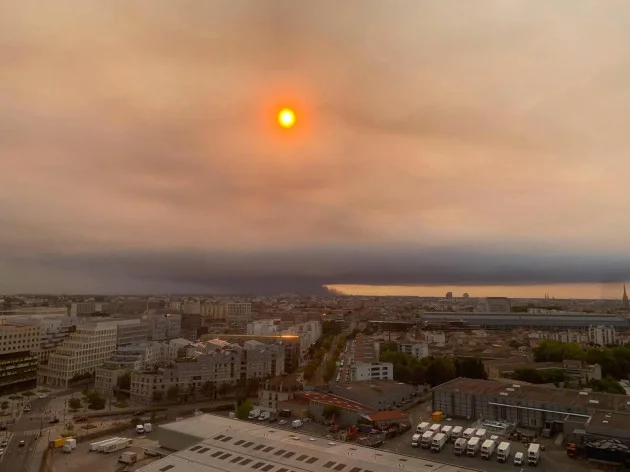
The main fire in France is in the Gironde forests to the west and northwest of Bordeaux. Firefighters are still fighting back the blaze, but authorities have said it is no longer making forward advances, and more than half of the residents evacuated from their homes have been allowed to return.
French President Emmanuel Macron has said that the weeks ahead will “be hard”, adding that the country “must hold firm”.
While Macron and Spanish Prime Minister Pedro Sanchez have both made comments about the role of man-made climate change in these fires, Carew says that on the ground there are concerns about the media’s coverage of the fires.
“The way it’s portrayed, it’s like the city is burning,” she said.
The Tipperary woman said that from the city centre there are blue skies overhead today, but in the last few days there has been “heavy smoke” and areas where no one can “open the windows”.
“Yesterday it was 40 degrees at 6pm, and a lot of people were in their masks because the wind really changed the quality of the air,” she added.
Travel and Aviation journalist Eoghan Corry, of Travel Extra, said that he is aware of around 100 Irish families who will have been impacted by orders to evacuate camp sites in the Lacanau area of France.
He said the fires have not affected airline schedules for next year and does not expect travellers to abandon destinations such as Malaga, Bordeaux and other parts of Spain and France.
The Irish Department of Foreign Affairs has advised that holiday goers should stay away from wildfire affected areas and follow evacuation orders from local authorities if in an impacted region.
To embed this post, copy the code below on your site