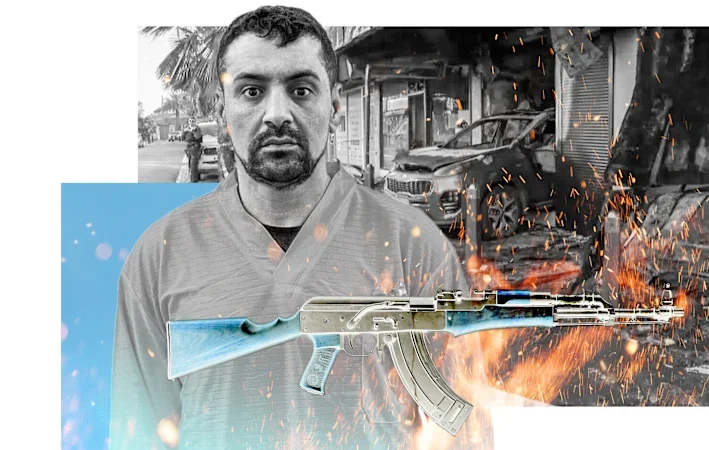
A: Arson. Every morning, it seems, we awake to a news report of another arson. Targets include tobacco shops, nightclubs, car yards, homes, gyms and cars. Adjoining businesses are often damaged and in one case an innocent person was killed when the buffoons hit the wrong property. Years ago, young males joined the Boy Scouts to learn how to make fire using sticks. Now they join gangs to learn how to torch businesses with petrol-filled jerry cans and disposable lighters (purchased at illicit tobacco shops).
B: Big Build. The practice of paying gangsters vast amounts of money to do nothing.
C: CFMEU. A union, which has fought for a better deal for its members while generously offering a second chance to convicted drug dealers, murderers, toothless bikies and kidnappers by employing them in influential positions within the Big Build.
D: Debt collecting. An opportunity for members of outlaw bikie gangs to leave their smoky clubhouses and take in the fresh air on their way to offices and private homes, where they politely request payment on behalf of third parties. The requests rarely involve paperwork and rarely are refused.
E: Extortion. A most popular criminal enterprise involving threatening firebombings and abductions unless certain financial demands are met (see A for arson).
F: Fagin’s Law. Introduced in 2017 it provides a maximum 10-year penalty for adult criminals who recruit underage hoods to commit crimes. It has been used a handful of times while offshore crime syndicates have more teenagers on their books than a medium-sized TAFE college. A 20-year-old Essendon man has been arrested and accused of recruiting kids. As per government policy, he was working from home.
G: Gatto (Mick). An industrial troubleshooter, previously an untroubled shooter, acquitted (on the grounds of self-defence) of the murder of underworld hitman Andrew Veniamin. A former heavyweight boxer, Gatto once ran the illegal two-up school, a crane company, dabbled in debt collecting then moved into mediating other people’s problems.
Investigative journalist Nick McKenzie reported Gatto had been paid millions from Big Build subcontractors. Gatto’s house was recently raided by police, and he was released without charge. Investigations continue.
H: Human sources. The most valuable instrument for criminal investigations are witnesses and there are two types, the innocent who see a crime, and “fizzes” – snitches who are inside the criminal networks. Under new rules, human sources have to sign up to say their anonymity cannot be protected. Cases are being dropped to protect the identity of sources, whose lives would be in danger if it were known they were talking. If that is justice, I’m a banana.
I: Investigative journalism. Think McKenzie (Nick). He has spent years exposing crime and corruption connected to Victoria’s Big Build. His (and colleagues’) revelations effectively forced premier Jacinta Allan out of office. McKenzie has the work rate of a Russian dissident in a salt mine, or he has been cloned and there are 20 of them beavering away at a secret off-site lab.
J: Jacking. A carjack used to be a mechanical device used to elevate the side of a car to replace a tyre. Now it involves young offenders stopping drivers, dragging them from the vehicle and taking off to commit further criminal activities. They may also burst into private homes and demand the car keys at the point of a machete that has not been placed (blade down) into a machete bin.
K: Kazem “Kaz” Hamad. Australia’s most powerful gangster who has just been sentenced to life in Iraq. While he is out of sight, he is not out of mind as his syndicate continues to import millions of illegal cigarettes, order daily firebombings, recruit young offenders to commit violent crimes and extort dodgy and legitimate businesses. His imprisonment sends a message to Australian gangsters working offshore. No one is untouchable.
L: Laughing all the way to the bank. Former crime boss Tony Mokbel, released from prison because some of his convictions were tainted (see X for Lawyer X). Once warned off racetracks, Mokbel continues to maintain a passion for the ponies, having persuaded the TAB to cough up $5400 he won on a horse.
One suburban pub has reported a massive spike in turnover since Mokbel turned up for a parma, pot and a punt. It seems no one in authority has any interest as to where the long-term inmate’s cash has gone, as in Mokbel’s case there is still an outstanding $4 million asset seizure order (plus the $55 million that has already been seized).
M: Machete. An implement used to cut cane or paths through leech-infested jungles. Now adapted by criminal leeches to threaten families in their own homes, attack young people in the street or wield in gang wars inside shopping centres.
The state government spent a fortune on specialist bins to allow people to surrender such weapons outside police stations. Some law-abiding types put some sharp-edged instruments in the bins rather than putting them out in a hard rubbish collection. It is unlikely one crook chose that path because, well, they are criminals.
N: Nothing to see here. The government’s discredited response to McKenzie’s stories.
O: Organised crime. In tough economic times, one of the few enterprises making record profits. Hamad’s syndicate is threatening to monopolise the tobacco market, forcing out multinational cigarette companies. In 1964, US Mafia investigator John T. Cusack completed a report on organised crime in Victoria stating criminal syndicates would use “large cash reserves and strong-arm tactics”, to create monopolies in labour racketeering, alcohol distribution, nightclubs and taverns and “building and road construction companies”. He was right.
P: Police recruiting. Chief Commissioner Mike Bush wants to open two regional training academies, and put double squads through the existing one to fill 1550 vacancies of sworn police by 2028. Working-from-home rules have disadvantaged police recruiting because you can’t drive a divisional van from your couch, but the AI revolution will make the security of a police job all the more attractive because a bot can’t snot a crook.
Q: Question time. A parliamentary procedure allowing grown-up politicians to call each other names late at night after drinking red wine in the members dining room.
R: Royal commission. An event you call for when in opposition and try to avoid in government. It can be expensive, as barristers are paid nearly as much as stop/go workers on the Big Build. New Premier Ben Carroll’s first move was to call one. We wait with interest to see the terms of reference.
S: Shopping centres. Once a place to purchase delicacies such as frozen fish fingers and tinned pickled herrings before sitting on plastic chairs to consume sandwiches laden with preheated smallgoods. Now a place where youth gangs re-enact the Battle of Hastings using sharp weapons stolen from nearby hardware shops.
T: Tobacco. We have 1400 illicit tobacco shops in Victoria, and we need that many as every night a couple get firebombed. They sell cheap cigarettes to smokers sick of getting ripped off by government tax declared as a policy to make people quit. It is nothing but a revenue grab.
Laws to give authorities the power to shut the shops are sitting in parliament. Perhaps the best deal would be to give Hamad the contract to blow them all up. Meanwhile, we have passed vital laws such as making it illegal to harness a goat or dog to a vehicle in a public place (Goat and Dog Towing: Section 8(c) of the Summary Offences Act 1966).
U: Undercover. We used to have police work undercover in bars and nightclubs to look for breaches of the licensing laws. Not any more.
V: Vedelago (Chris). Investigative reporter from The Age who continues to expose Middle Eastern crime groups (see K for Kaz Hamad). Vedelago is so dedicated to his craft he has taken up smoking (no doubt legal ones) to get an insider’s view of the tobacco war. We have urged him not to go undercover to probe the illicit massage industry.
W: Watchhouse. Police counters where people go to have documents witnessed, crimes reported and legal questions answered. Soon to be staffed by ex-police recruited as reservists. Many have been closed permanently, while the new premier wants them re-opened – surely a decision for the chief commissioner.
X: Lawyer X. Barrister Nicola Gobbo (see H for human sources and R for royal commission) became a secret police informer and didn’t that go well? There was a $100 million royal commission into what she did and why police were happy to take her information. No one was charged, while several crooks have had some of their convictions quashed.
Y: Yellow and youth. The colour of Kaz Hamad’s prison overalls, and youth offenders. While we are short of apprentice plumbers and electricians, there is no shortage of apprentice crooks. They are hired and trained by crime cartels, recruited through apps and have their work judged on the videos they take of the crimes they are committing. (See F for Fagin’s Law). Tragically, many see their futures in crime.
ZZZZ: The noise from within the state cabinet when it came to taking action over corruption in the Big Build, buried deeper than an incomplete railway tunnel to Box Hill. Finally, with an election looming, they appear to have woken up.