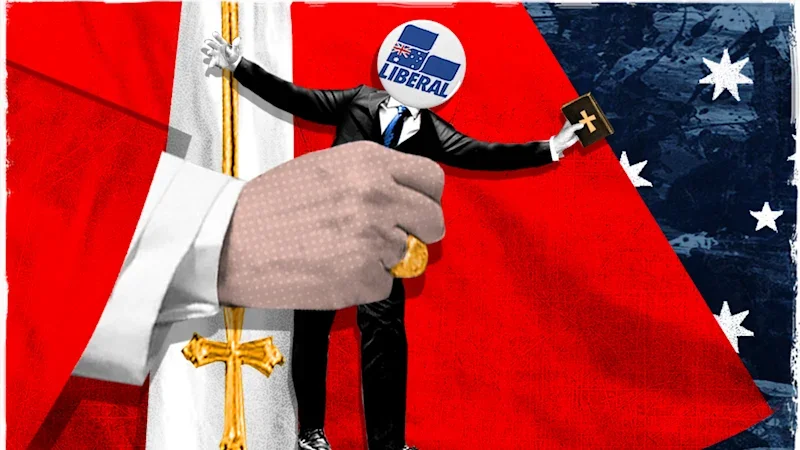
When young Liberal “Reformers” and Catholic Schools NSW employees were spending 60 per cent of their work time scheming on projects such as “David Elliott shit sheet.docx”, what was God doing?
It won’t be an explicit part of ICAC’s Operation Rosny inquiry, which will adduce evidence of allegedly illegal Liberal donations from property developers and hoteliers filtered through Catholic Schools NSW, but many of us would still like to know. Where did all of this self-described “standard factional warfare” fit into God’s plan? And where did it fit into Catholic Schools NSW’s job descriptions?
Religious politicians and parties expose themselves routinely to charges of hypocrisy. It’s the cross they choose to bear. God-fearing Scott Morrison was an architect of robo-debt. The devout just-buried US Republican senator Lindsey Graham was a man who, in his eulogist Donald Trump’s words, “never saw a war he didn’t like”. The history of political atrocities committed in the name of religion is lengthy, and the activities of the NSW Reformers are somewhat humdrum and suburban in scale compared with, say, the Spanish Inquisition.
But still. The Reformers were set up specifically to pursue a morals-based policy agenda in the state parliament: opposing, for example, the legalising of abortion, voluntary assisted dying and same-sex marriage. According to its original website, “NSW Reformers is a movement that seeks to promote Christian values in society. For years, we have seen the slow erosion of these values which has in turn effected [sic] the rights of everyday Australians in areas such as faith, life and speech. As such, we seek to reform this great state by adding a Christian voice to it.”
In 2018 and 2019, the Reformers held a function at Pennant Hills Bowling Club titled “Family Values in Politics”; at Cherrybrook it gathered to discuss “The Left’s March through Institutions”; and at Castle Hill RSL Club it held a lecture titled “Conservative Policy Series: Special Guest Alan Jones”.
The Reformers’ moral ideals were so pure that conservative premier Dominic Perrottet was abandoned, by one of their financial backers, publican Michael O’Hara, for being too “woke”.
So how did the nice Sydney Catholic establishment get caught up with people like this?
As a footnote to Australian political history, the Reformers are the endpoint of the Catholic Church’s long march from left to right. Traditionally, with their shared Irish working-class roots, the church was synonymous with the Australian Labor Party, which was commonly known as “the Catholic Church at prayer”. This bond was broken ideologically with the ALP-DLP split of the 1950s, and in policy terms with the Liberal Party’s support of government funding for Catholic schools under Sir Robert Menzies.
Menzies, who won the 1961 federal election by one seat thanks to Catholic DLP preferences, drew conservative Catholic support further away from the ALP by promising state aid for non-government schools. When the Labor Party eventually followed, making government aid for Catholic schools bipartisan, the church’s political positions shifted and spread. The “social justice” foundations of the ALP-Catholic bond remained, but socially conservative religious support moved towards specific morals issues, such as abortion and same-sex marriage.
By the 2010s, the federal Liberals had three Catholic leaders – Tony Abbott, Malcolm Turnbull and Peter Dutton – with an interlude for the Pentecostal Morrison. This was an earth-shaking change for a parliamentary party that, in Menzies’ time, had just one Catholic member. It also signalled the decline of Protestant-Catholic sectarianism in Australian society.
Not to be left out or characterised as the party for atheists or rationalists, Labor has tried to reassert its Catholic ties since its 2019 election loss was blamed, in part, upon a decline in support from religiously motivated voters. Anthony Albanese identifies as a Roman Catholic. In 2022, Tanya Plibersek gave a speech honouring Catholic Archbishop Daniel Mannix, saying: “There is no doubt in my mind that growing up Catholic has influenced my politics, as it has for so many in the Labor Party and the labour movement.”
Even as they decline as a demographic, with almost 10 million Australians declaring no religion in the last census, the big churches are able to project their influence into both major parties.
But that projection is based on moral suasion: religions stand for doing good. (Yes, that statement does call for a long list of caveats.) If we take the religious influence in politics at face value, then it’s legitimate to ask how, having nestled so deeply in the NSW Liberals’ conservative wing, Catholic Schools NSW can reconcile its religious agenda with an alleged systematic pattern of dirty tricks.
Under questioning in the ICAC inquiry, former Catholic Schools NSW employee and Reformers operative Dylan Whitelaw described the “hatred” motivating their campaign against Liberal minister David Elliott and building commissioner David Chandler as “standard factional warfare”. Whitelaw also said Robert Assaf, who was Catholic Schools NSW’s communications officer, had spent 60 per cent of his work time plotting to stack Liberal Party branches for the Reformers.
The inquiry will question Catholic Schools NSW director and Liberal ally Dallas McInerney, but other key persons of interest, such as Christian Ellis and the alleged sugar daddy of the scheme, disgraced property developer Jean Nassif, are overseas and refusing to appear.
It’s not ICAC’s business to probe the conscience of men who plot character assassinations Monday-to-Friday and kneel in church on Sundays. But it’s an enduring question. Where is their God on workdays? Is He turning a blind eye? Does He tell them that the ends (filling the parliamentary benches with anti-abortion crusaders) justify the means (destroying colleagues’ reputations and stacking branches and councils to get lucrative dodgy developments approved)? Where was He looking when the Reformers, in His name, prepared a fictitious dossier about an extra-marital affair for Elliott and a defamatory video about Chandler?
Separation of church and state is a foundational principle for Western democracies, but over the decades in Australia, they have never drifted too far apart. People whose religious beliefs guide their politics deserve representation like everyone else. But at the centre of the church-state convergence in Australia is the public funding of religious schools. When Menzies made his big move – to win votes, not to express conservative economic thinking – only a tiny percentage of Australian families benefited directly. Now, with 37 per cent of our students in private schools, government funding and the tax-free charitable status of some of our wealthiest institutions have bipartisan major-party support.
And yet, Australians are deserting organised religion at much the same rate as they are deserting the major political parties. Coincidence, or is there a big elastic band in Australian society stretching closer to its breaking point? The unfolding NSW scandal will bring closer an end to the consensus on taxpayer support for churches. In Menzies’ time, the Liberal Party was taking risks by associating itself with the Catholic Church. Today, it’s the Catholic Church that risks its reputation by its links with the Liberals. God only knows where it leads next.
Malcolm Knox is a journalist, author and columnist for The Sydney Morning Herald.
You can follow SMH’s live reporting of ICAC’s Operation Rosny as it unfolds, here.
More: