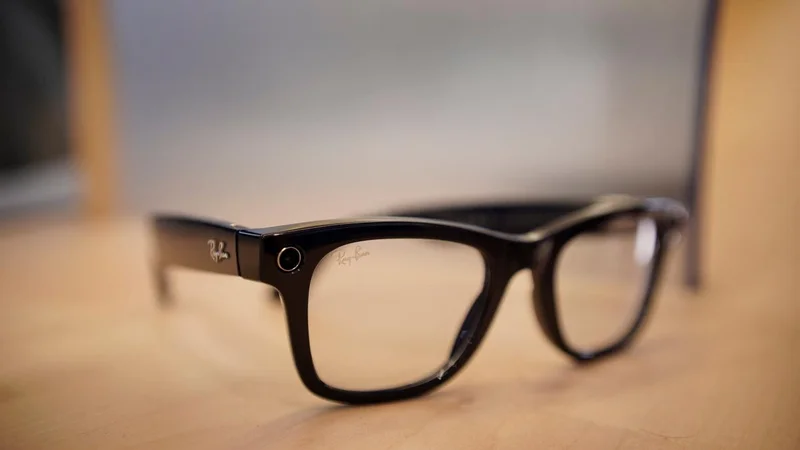
The story so far:During the Cockroach Janta Party (CJP) protests in July, people alleged a Delhi Police official on duty was seen wearing smart glasses — a wearable device capable of taking pictures and recording videos. Despite numerous AI-enabled security cameras installed near the protest site, Jantar Mantar, use of point-of-view (PoV) devices raises questions about the privacy of protesters, who were largely students in this case.
A protestor would hardly notice if someone is recording them, as the smart glass camera is discreet and subtle. The wearer just has to ask the virtual AI assistant, and it will record a video or take a photo without the subject knowing about it.
For example: Meta’s smart glasses, which look like traditional spectacles, are used by content creators around the world to record videos, click images, share media, and look up context such as the translation of a conversation or text. Apart from that, they can be used to answer calls, send or receive messages, and listen to music. To accomplish these hands-free tasks, you just need to talk to the AI.
What drives these smart glasses?
Strong AI models drive smart glasses. These glasses see what you see, and the AI responds to what you ask. In the case of Meta’s smart glasses, the AI understands the context as well as identifies objects, landmarks, and publicly available information. Meta’s AI device’s knowledge bank is still expanding as the models powering it continue to evolve. It might not supply each and every detail it sees or is asked about as it is trained with public data available with a cutoff — till 2024. Meta also uses data from its family of apps like Facebook and Instagram, and the web, to train the AI. But it does not seek personal information like user chats to do so. In that case, the AI does not provide personal information like names or ages.
Meta, with their second generation of AI glasses, added a blinking camera light around the privacy LED to let the subject know that they are being recorded or clicked. Tampering with the light will disable the camera of the glasses. However, when used outdoors, it is hard to notice the sensor light and hear the shutter sound.
Can smart glasses be used illegally?
There is mounting concern over such AI smart glasses being used to harass civilians, as well as carry out surveillance without proper authorisation.
Those media files can be used and cross-verified with other AI and surveillance systems by the government to identify people or a person in the frame, leading to police action or other legal challenges. Since these smart glasses do not warn or seek consent, the usage largely depends on the wearer’s intent. If the government machinery starts appropriating tech that was designed to make life fun, it becomes a tool of citizen surveillance and can have a chilling effect on peaceful protests and even participation in public life.
Smart glasses can be misused for cheating and piracy too. Users wear them during their examinations or while seeing confidential information. They can then ask the AI to help them or summarise the context. Similarly, smart glasses can be used during screenings to record and leak the content and monetise piracy. It could also be used to produce non-consensual nude images and videos.
On the flip side, there are also privacy concerns that directly affect the wearers of smart glasses. In February this year, Swedish news outlets reported that Kenya-based Meta contract workers who were processing data were able to see recorded footage of personal, and sometimes explicit, content from the smart glasses. The workers were deeply uncomfortable and shared their concerns about users recording or being recorded without their knowledge.
Can smart glasses enable policing through facial recognition?
In 2019, during the Hong Kong pro-democracy protests, China was accused of using facial recognition to identify the protesters. This led to arrests and further consequences like employment hurdles and police intimidation. The tech used largely for public safety was subverted and turned into a tool to suppress the movement. However, protesters wore masks to hide their faces, used lasers to disable such surveillance systems, made cash payments to avoid attention, and removed their phone biometrics to safeguard their personal information.
During the CJP protests in July, Delhi Police deployed their DP-Dristhi and Ikshana surveillance vans and a Mobile Command and Control Vehicle, which used AI-assisted facial recognition technology to scan live CCTV feeds. The police said the technology is used to identify known offenders and investigate violence.
After the protest was called off on July 26, Delhi Police said they identified as many as 2,873 people with previous criminal records who were present at the Jantar Mantar protests.
In the wake of the CJP protest, a PIL has also been filed in the Supreme Court by Rajya Sabha MP A.A Rahim on the usage of facial recognition technology and biometric surveillance during the protest. Mr. Rahim argued this violates the fundamental rights guaranteed under Articles 14, 19 and 21 of the Constitution.
How can smart glasses help with security?
These new age wearables can be helpful to anticipate and thwart security threats. For example, Delhi Police used AI-enabled smart glasses, integrated with facial recognition and thermal imaging technology, during the Republic Day security arrangements.
It was linked to the police database, allowing personnel on the ground to instantly access the information. The smart glasses categorised people on the basis of coded colours: green for no criminal record, and red for criminal records. With thermal imaging, wearers were able to detect metal or any concealed items.
Smart glasses can also be a helpful tool for those with vision conditions. Their daily lives can be made safer and easier once such devices become mainstream, and help them navigate while commuting and accessing public facilities.
Published - July 31, 2026 09:14 am IST