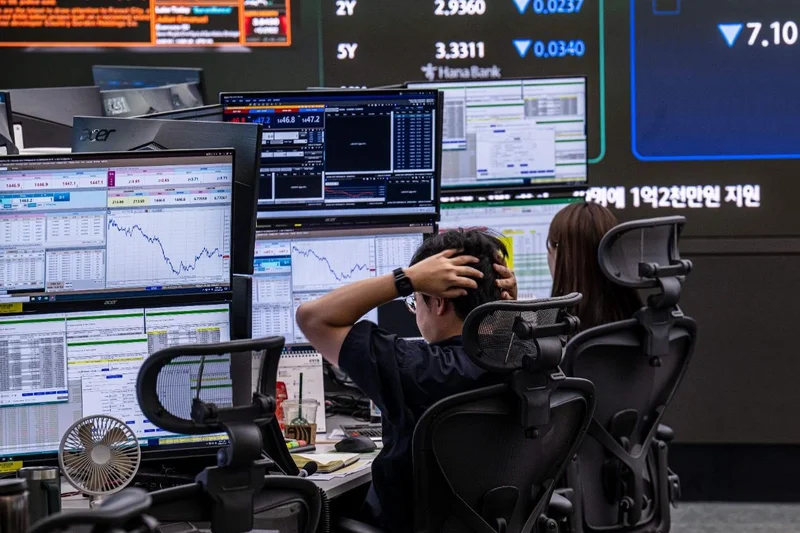
“This isn’t a stock market driven by corporate fundamentals anymore. It’s basically a coin toss.”
This was one investor’s verdict on X (formerly Twitter) after one of the most extraordinary weeks in Korean stock market history.
On Friday, the benchmark KOSPI surged 17.91 percent, or 1,001.89 points, to 6,595.45 — its largest one-day gain on record — after three consecutive sessions of losses.
The rally was fueled largely by a sharp rebound in Samsung Electronics and SK hynix as stronger-than-expected earnings from U.S. technology giants revived optimism over artificial intelligence (AI) investment. Foreign investors snapped up more than 7 trillion won ($4.9 billion) in shares.
Yet rather than restoring confidence, the dramatic rebound underscored just how disorienting the market has become for retail investors, leaving many to feel less like long-term shareholders than reluctant participants in a high-stakes timing game.
The phrase “Roller KOSPI” — a portmanteau of “roller coaster” and “KOSPI” — has become a fixture across online investing forums and social media, capturing the market’s relentless whiplash.
“What worries me isn’t that the market is rising,” another X user wrote. “It’s that it’s doing so through a violent V-shaped rebound instead of gradually building a bottom.”
Another questioned whether such conditions had become the new normal. “Is it normal for buy-side and sell-side sidecars to be triggered on alternating days?”
Sidecars, which suspend program trading for five minutes during extreme price swings, were once regarded as an emergency safeguard reserved for exceptional market conditions. This year alone, however, they have already been triggered 44 times on KOSPI, far exceeding the 26 activations recorded during the 2008 global financial crisis.
Investors split
The turbulence has exposed a widening divide among the country’s rapidly growing army of retail investors. For one group, every plunge has become another buying opportunity.
“Maybe I should’ve bought everything yesterday,” one wrote after Friday’s rally. “Oh well. There’ll be another chance.”
Another said this year’s market had fundamentally changed his investing philosophy. “From now on, I’ll probably keep increasing my exposure. High risk, high return while I’m still young.”
Others described a growing sense of fear of missing out. “Now that stocks are rising again, all my friends talk about is stocks. Most of them are still underwater and keep saying the market has to go higher.”
For another group, however, the market’s violent swings have had the opposite effect.
Deposits at Korea’s five largest commercial banks have increased by more than 24 trillion won over the past month, while customer cash held at securities firms has fallen by more than 32 trillion won over the past two months, suggesting many investors have shifted money back into bank deposits after experiencing the market’s abrupt reversals.
Lim, a dental technician in his 50s, said he now invests almost exclusively in U.S. stocks.
“Markets are supposed to rise and fall naturally. But over the past few months, it feels like people have been pushed toward stocks while property speculation has been discouraged. Even single-stock leveraged exchange-traded funds (ETFs) were introduced in such a short period of time. I’m worried about how this will all end.”
Split-second decisions
The market’s dramatic reversals have also raised concerns that even momentary decisions can result in unusually severe losses.
According to the Korea Financial Investment Association, forced liquidations of unpaid margin positions — shares automatically sold after investors fail to repay short-term brokerage loans — jumped more than fourfold to 61.1 billion won on Wednesday following the earlier market sell-off.
Leveraged inverse ETFs, designed to deliver twice the opposite of a stock’s daily return, attracted investors betting that semiconductor shares would continue to decline after the sell-off. By Friday, however, these products had plunged more than 59 percent as the chipmaker shares staged a dramatic recovery.
One clear example of how deeply this year’s rally has permeated Korean society came not from the market itself, but from politics.
On Thursday, the advocacy group Korea Shareholder Movement Headquarters announced that it had begun recruiting founding members for a new political party tentatively named “People and Shareholders,” open to anyone owning at least one share of stock.
Whether the initiative ultimately develops into a viable political force is beside the point.
Its very emergence illustrates how rapidly this year’s market has expanded the number of Koreans whose savings, emotions and, increasingly, even political identity have become intertwined with the stock market.