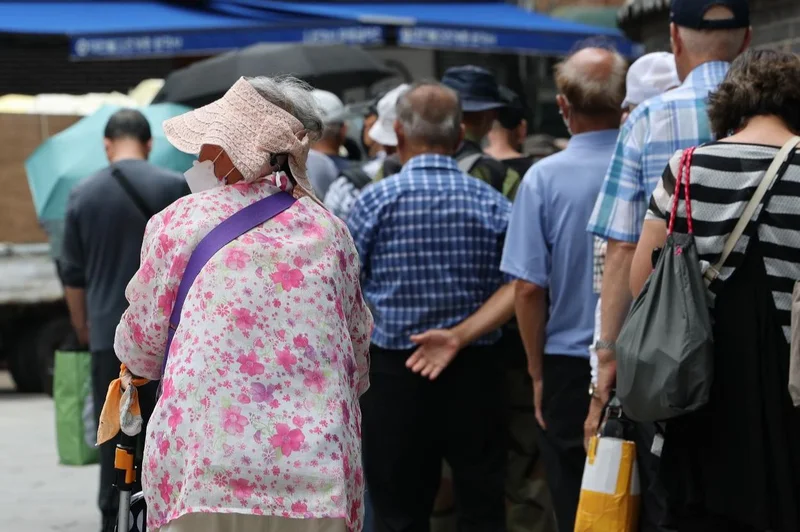
The number of recipients of the nation's Basic Livelihood Security Program increased by 6.1 percent last year from a year earlier, with more than 1 in 10 seniors receiving government assistance, highlighting the country's persistent elderly poverty problem.
According to the Ministry of Health and Welfare's 2025 Statistics on National Basic Livelihood Security Recipients, released Thursday, the number of recipients stood at 2,836,706 as of the end of last year, up 163,221, or 6.1 percent, from the previous year.
Of the total, 2,732,235 people, or 96.3 percent, were general recipients, while 104,471 people, or 3.7 percent, were institutional recipients living in social welfare facilities or similar institutions.
By age group, adults aged 65 or older accounted for the largest share of general recipients at 1,212,262 people, or 44.4 percent of the total. They were followed by those aged 40 to 64 at 31.7 percent, people aged 20 to 39 at 9.9 percent, those aged 12 to 19 at 8.8 percent, children aged 6 to 11 at 4 percent, and children aged 5 and younger at 1.2 percent.
Among the country's total population over 65, 11.2 percent were general recipients of basic livelihood benefits, meaning more than 1 in 10 elderly people relied on the program. General recipients accounted for 5.3 percent of the total population, rising to 5.5 percent when institutional recipients were included.
By gender, women accounted for 1,517,149 recipients, outnumbering the 1,215,086 male recipients.
Regionally, the highest recipient rates were recorded in North Jeolla Province at 8.2 percent, followed by Busan at 7.9 percent and Gwangju at 7.6 percent. The lowest rates were reported in Sejong at 2.6 percent, Gyeonggi Province at 4 percent, Ulsan at 4.6 percent and South Chungcheong Province at 4.9 percent.
This article from the Hankook Ilbo, the sister publication of The Korea Times, is translated by a generative AI system and edited by The Korea Times.