- Tyrants and Traitors by Ken Dark (Bloomsbury Academic £20, 232pp)
After centuries of mythologising, can we ever really know the truth about King Arthur?
Yes, we’re getting closer all the time, says the author of this history of the British Dark Ages, thanks to some startling revelations from the latest archaeology.
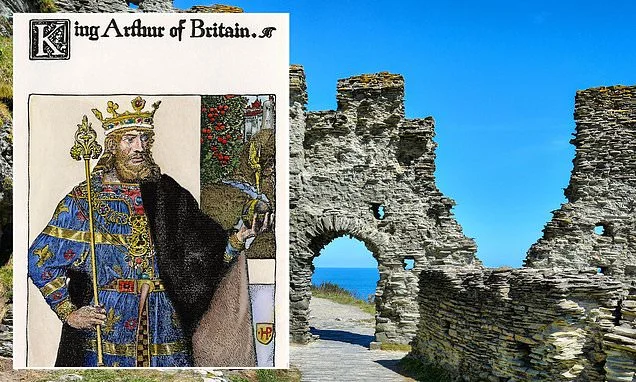
King Arthur from a 14th century tapestry
And towards the end of the book he even suggests the real identity of King Arthur – whom he believes to be a far more flesh-and-blood figure than other experts think.
Professor Ken Dark also sees him much as how the myths and legends portray him: a great and benevolent Christian ruler, amid the chaos of the times, fighting battles to keep the barbarians back . . . in vain.
They certainly were a barbaric bunch. The Dark Age chronicler Gildas, in his apocalyptic history, The Ruin Of Britain, records how the ruling elite of 5th and 6th century AD Britain waged merciless war, slaughtered the innocent, went around with ‘violent and immoral military companions,’ a personal retinue of thuggish warriors, yet outwardly displayed Christian piety.
Gildas detested them. One such tyrant, Maglocunus, killed his wife and nephew in order to marry his nephew’s wife . . . after spending time in a monastery to atone for his sins!
Despite this, trade continued. Dark Age Britain might be imagined as a remote, mist-shrouded island, but this is far from the truth.
There was even a strong connection with Byzantium, today’s Istanbul at the other end of the Mediterranean, with plentiful findings of Byzantine coins and copper weights.
Extraordinarily, some of the saints names in Wales and Cornwall, including Saint Materiana at Tintagel, are of Byzantine origin. In exchange for European wines and Byzantine silks, we traded our mineral wealth, including gold, silver and copper. We even bought in spices: the Hoxne Hoard from Suffolk, dating from 407AD, includes four pepper pots. The pepper could only have travelled from India.
Meanwhile, the phrase ‘British metal’ suggests rock bands like Iron Maiden, but in Dark Age Europe it meant tin – Cornwall had the finest reserves.
Which brings us to Tintagel. Until the 1970s that stunning Cornish headland was thought to be a monastery, but is now understood as a wealthy fortress and trading post, ruling over some of the richest mining areas. The one disappointment is Professor Dark doesn’t believe it’s especially connected with the ‘real’ King Arthur, whom he argues was a king of Dyfed, South Wales, ‘Arthur son of Pedr’.
We’re learning more all the time, but surely the haunting legend will live on: a heroic Christian king and his knights fighting through this epoch of wealth and bloodshed, of massacres and monks . . . and an outbreak of bubonic plague.
One historian has said the year 536AD, when King Arthur most likely lived, was ‘the worst year in history to be alive’. I shall remember this the next time I grumble about potholes.