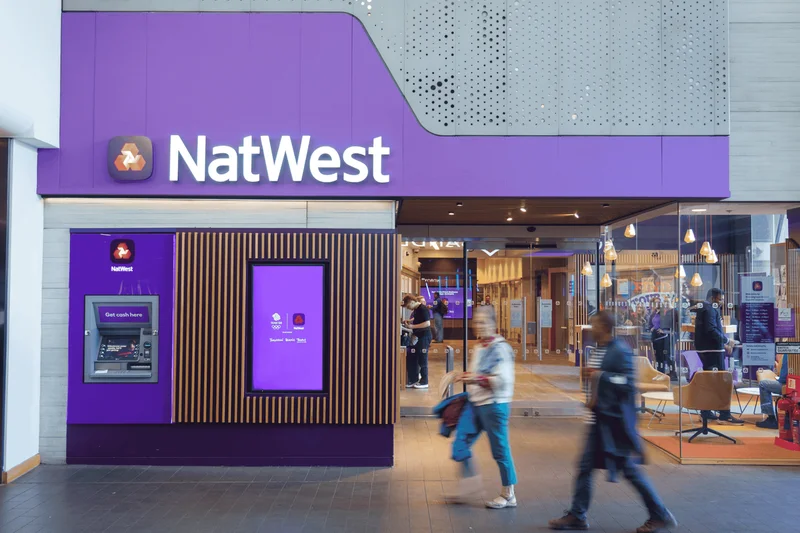
NatWest has become the latest high street bank to report a bigger-than-expected jump in earnings, after growing its wealth arm and an AI-led tech drive.
The British banking group made an operating pre-tax profit of £4.3 billion for the six months to the end of June, up 20% on the same period in 2025.
This was more than the £4.1 billion that most analysts had been expecting.
NatWest follows Barclays and Lloyds Banking Group in beating analysts’ expectations for profit growth over the first half of the year.
Income generated by the bank jumped by 11% year on year, driven by growth across its retail, commercial and wealth management arms.
Meanwhile, it reduced its cost-to-income ratio – meaning the amount it spends on running the business as a percentage of what it generates in income – by 2.8 percentage points year-on-year.
This was helped by around £250 million worth of gross cost savings over the first half.
“This has been driven by ongoing structural simplification and sustained investment in our technology platforms to improve productivity and deliver simpler, faster and better customer experiences,” according to the bank.
This has involved a drive to adopt AI (artificial intelligence) across its operations and as a tool for customers.
Chief executive Paul Thwaite said that AI “alters how people live and work” and that “there is no doubt that AI is reshaping financial services”.
He added: “The real value of AI comes not from the technology but when it builds stronger relationships, supports productivity and strengthens trust.”
He said NatWest had “put AI into the hands of our 60,000 staff” and that the technology “creates opportunities to serve our customers better”, such as through fraud protection and the first agentic AI assistant.
Meanwhile, the banking group said its recent acquisition of wealth management firm Evelyn Group were bearing fruit and was set to improve its financial performance for the year.
Mr Thwaite said he thought that wealth management was a “fast-growing area of the economy and of our bank”.
“I think it’s incredibly important for the country that we have widely available good financial planning and investment advice,” he said.
“I don’t think it reflects well on the country that only 9% of the population get financial advice.
“So when we think about private banking and wealth management, we’re thinking about our retail bank, our mass affluent customers, as well as high net worth customers.
“So structurally we see it as a big opportunity.”