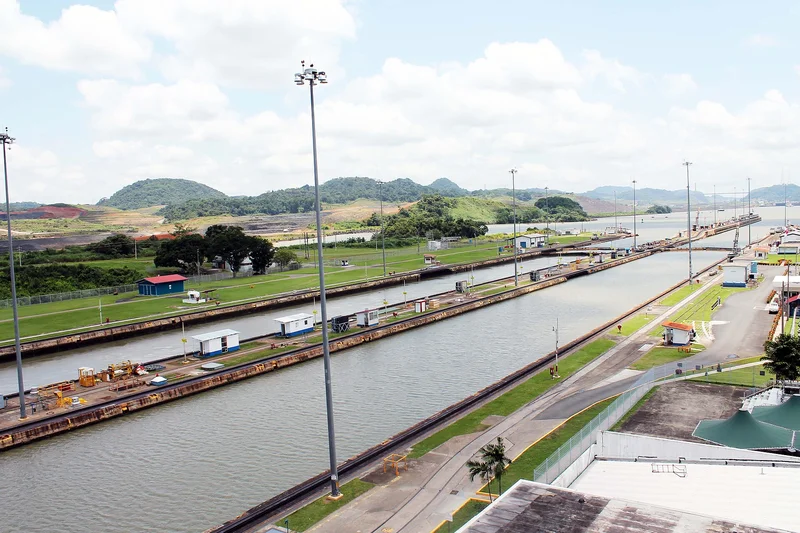
Panama Canal Draft Cut Again as El Niño Threatens Water
Panama · Shipping
Panama Canal draft limits are being tightened again, with the Panama Canal Authority (ACP) announcing a two-step reduction that will bring the maximum authorized depth for vessels down to 48.5 feet by mid-August 2026.
How the New Panama Canal Draft Limits Work
The ACP confirmed that the maximum authorized draft will be lowered to 49.0 feet (14.94 meters) in Tropical Fresh Water (TFW), effective July 24, 2026. A second cut will follow on August 15, 2026, reducing the limit further to 48.5 feet (14.78 meters).
These figures represent the deepest point a vessel’s hull can sit below the waterline while transiting the canal. The change directly limits how much cargo a ship can carry, as heavier loads push the vessel deeper into the water.
Why Gatun Lake is the Critical Factor
The entire Panama Canal system depends on fresh water from Gatun Lake, a vast artificial reservoir in central Panama that feeds the locks and sustains operations. Every time a ship passes through the locks, millions of gallons of fresh water are released from the lake into the sea.
Gatun Lake also supplies drinking water to Panama City, the nation’s capital and home to nearly half the population. The ACP must balance the competing demands of global maritime trade and domestic water security.
The lake’s water level is entirely dependent on rainfall across the Panama Canal Watershed, a sprawling catchment area of tropical forest. When rainfall drops, the lake shrinks, and the canal’s operational depth decreases accordingly.
The draft restrictions are a direct conservation measure. By requiring ships to float higher and carry less weight, the ACP reduces the volume of water needed for each transit, preserving Gatun Lake’s reserves for the dry months ahead.
The 2023-24 Drought Precedent
The current situation echoes a severe drought that gripped the canal during the 2023-2024 period, which was also driven by an El Niño weather pattern. That crisis forced the ACP to slash daily transits from the normal 36-38 ships down to as few as 22 per day.
Ship queues stretched for weeks, and some vessels carrying millions of dollars in cargo were forced to wait or reroute around South America. The disruption snarled global supply chains and pushed up freight rates on key routes between Asia and the US East Coast.
The memory of that crisis is why shippers and global trade analysts are watching the current El Niño forecasts with heightened concern. The ACP’s early move to tighten draft limits is a direct lesson learned from that experience, aiming to avoid a repeat of the drastic transit cuts.
Draft vs. Transit: A Crucial Distinction for Shippers
A critical point for the shipping industry is that the ACP is not cutting the number of daily transits. In May 2026, the authority explicitly ruled out transit restrictions for the remainder of the year, and that position holds despite the new draft limits.
Draft restrictions and transit restrictions are fundamentally different tools. A draft limit controls how much a single ship can carry, while a transit limit controls how many ships can pass through the canal each day.
By tightening draft but not transits, the ACP is prioritizing the continued flow of vessel traffic. Shippers can still get their slots through the canal’s booking and reservation system, but they will have to sail with lighter loads.
For a large Neopanamax container ship, a reduction of one foot in draft can mean carrying hundreds of fewer containers. This forces shipping lines to either leave cargo behind or split loads across more vessels, increasing operational costs.
Surcharges and the Cost for Global Trade
Several major ocean carriers are already preparing to pass these higher costs on to customers. Shipping lines are announcing fresh surcharges for cargo moving on trans-Pacific routes that rely on the Panama Canal crossing.
These weight-limit surcharges are designed to compensate for the lost revenue from carrying fewer containers per voyage. Importers and exporters moving goods between Asia and the US East and Gulf Coasts will feel the impact directly on their freight invoices.
The Panama Canal handles a significant share of world maritime trade, serving as the primary shortcut for vessels traveling between the Atlantic and Pacific Oceans. Any sustained restriction on cargo capacity ripples through commodity markets, retail supply chains, and energy shipments.
The canal is particularly vital for US grain exports, South American fruit and copper shipments, and liquefied natural gas (LNG) tankers moving from the US Gulf Coast to Asia. Heavier bulk carriers and fully loaded gas tankers are among the vessel types most sensitive to draft reductions.
Outlook for the 2026 El Niño Season
Updated meteorological forecasts indicate that the current El Niño pattern is strengthening, with a high probability of below-normal rainfall across the Panama Canal Watershed for the remainder of the year. The ACP’s two-step draft reduction is a proactive response to this outlook.
The authority has stated it will continue to monitor water levels and weather projections, leaving the door open for further adjustments if conditions worsen. For now, the focus remains on conserving water while keeping the canal open for business at full transit capacity.
For international investors and expatriates following Latin American trade infrastructure, the situation underscores the Panama Canal’s acute vulnerability to climate variability. The waterway’s operational health remains a barometer for the reliability of one of the world’s most critical trade arteries.
Connected Coverage
Related reporting from The Rio Times: Panama Canal Drops Transit Restrictions for Rest of 2026.
Frequently Asked Questions
What is the new Panama Canal draft limit for August 2026?
The maximum authorized draft will be 48.5 feet (14.78 meters) in Tropical Fresh Water, effective from August 15, 2026. This follows an initial reduction to 49.0 feet on July 24, 2026.
Is the Panama Canal reducing the number of daily ship transits?
No. The Panama Canal Authority has not reduced the number of daily transits. It ruled out transit restrictions in May 2026, and that decision remains in place. Only the maximum draft, or vessel depth, is being restricted.
Why is the Panama Canal draft being reduced?
The reduction is due to a strengthening El Niño weather pattern, which is forecast to bring significantly lower rainfall to the Panama Canal Watershed. Less rain means lower water levels in Gatun Lake, the main reservoir that feeds the canal’s lock system.