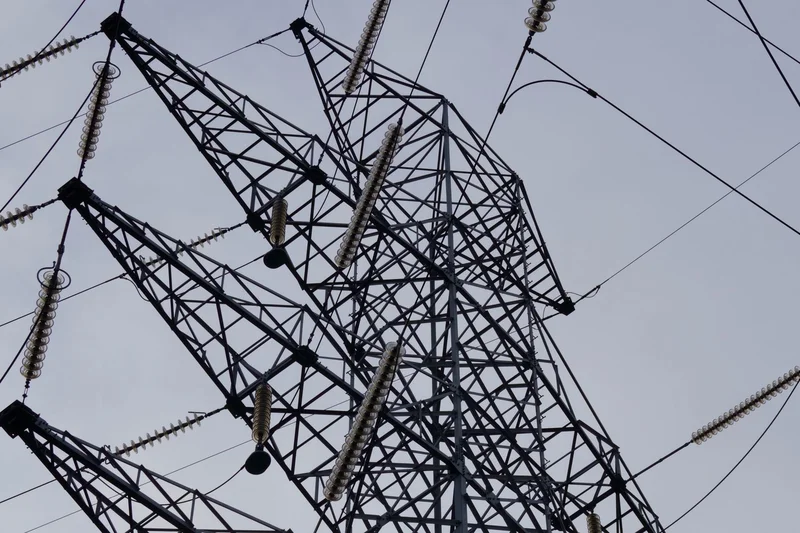
The strongest strategic signal in today’s source window is the transition from model-scale competition to power-system-scale competition.
Brookfield and NextEra Energy have announced plans for a privately financed AI infrastructure and energy complex at a former U.S. nuclear-weapons site in Paducah, Kentucky. The project could involve approximately $100 billion in investment, two gigawatts of gas-fired generation, and 2.6 gigawatts of battery storage. The U.S. Department of Energy is supporting the project through access to federal land, while developers say infrastructure costs will not be transferred to household consumers.
This is capability conversion at industrial scale. Compute is being packaged together with dedicated generation, storage, land, federal coordination, and long-term capital. The model resembles an integrated AI utility rather than a conventional data center connected passively to an existing grid.
Britain is confronting the opposite side of the same transformation. Ofgem is considering substantial upfront commitment fees for data-center developers seeking grid connections. The regulator says the connection queue includes 315 projects representing 73 gigawatts of potential demand—far above Britain’s current peak electricity demand. The proposal is intended to deter speculative applications and reserve constrained grid capacity for credible projects.
Together, these developments establish a new control surface: the right to occupy future grid capacity. Capital alone no longer guarantees access. Developers may increasingly need to demonstrate financial commitment, construction progress, dedicated generation, flexible demand, or public benefit before securing a place in the electricity system.
The frontier-model signal is efficiency. OpenAI published new material on July 29 describing GPT-5.6 as combining frontier intelligence with greater efficiency. It also reported that enabling two specific settings tripled its results on the ARC-AGI-3 benchmark and announced an academic-research programme built around ChatGPT. These are company-reported results and require independent evaluation, but they reinforce the broader shift toward capability-per-unit-of-compute rather than raw model scale alone.
Meta is moving in the same direction at the hardware layer. Current investor reporting indicates that it plans to begin manufacturing its Iris custom AI chip in late 2026, release additional custom accelerators through 2027, and double data-center compute capacity from approximately seven gigawatts in 2026 to 14 gigawatts in 2027. These figures remain forward-looking corporate plans rather than completed capacity.
China’s semiconductor push remains a parallel strategic story. CXMT’s Shanghai listing supplied the Chinese memory-chip producer with at least $8.6 billion in new capital, while reports indicate that a Chinese state-backed manufacturer has begun limited production of domestic immersion lithography systems. Neither development eliminates China’s dependence on foreign tools or closes the technological gap, but both improve its ability to convert strategic intent into industrial depth.
Europe, meanwhile, has entered a new implementation phase. Amendments to the AI Act adopted through the EU’s digital-simplification package entered into force on July 27, while enforcement powers covering general-purpose AI obligations are due to apply from August 2. Europe’s strategic test is whether it can connect regulation to domestic compute, cloud, semiconductor, open-source, and energy capacity rather than govern infrastructure largely supplied from abroad.
Ranked Top Developments
1. A $100 billion U.S. AI campus integrates compute with dedicated power
Source link: Financial Times — Brookfield and NextEra to build $100bn AI campus on former nuclear-weapons site
What happened: Brookfield and NextEra Energy announced plans to develop a large AI data-center and energy complex in Paducah, Kentucky. The proposed development would combine data-center infrastructure with approximately two gigawatts of gas generation and 2.6 gigawatts of battery storage. Initial operations are targeted for 2028, with broader completion envisaged by 2032.
Why it matters: The project joins computing, energy, capital, land, and federal support inside one infrastructure programme. This reduces dependence on uncertain external grid expansion and makes energy development part of the AI investment itself.
Layer tag: Industrialisation / Operationalisation
Control surface: Dedicated generation, battery storage, federal land, project finance, grid interconnection, construction timelines.
2. Britain considers charging data centers for scarce grid access
Source link: The Guardian — Data-center projects face fees for grid access, Ofgem says
What happened: Ofgem proposed a data-center commitment fee ranging from 2.5% to 7.5% of average project cost. Developers could lose both their fee and queue position if they fail to reach defined construction milestones. The regulator says 315 proposed projects currently represent around 73 gigawatts of potential demand.
Why it matters: Grid queues are becoming strategic allocation systems. Requiring financial commitment distinguishes credible infrastructure programmes from speculative claims and gives regulators greater control over the geography and timing of AI expansion.
Layer tag: Industrialisation / Governance overlay
Control surface: Grid-connection queues, commitment fees, development milestones, regulatory approval, electricity allocation.
3. OpenAI reframes frontier competition around model efficiency
Source link: OpenAI — How GPT-5.6 fuses frontier intelligence with frontier efficiency OpenAI — How enabling two settings tripled our scores on ARC-AGI-3
What happened: OpenAI published technical and research material presenting GPT-5.6 as a more efficient frontier system. The company also reported that two configuration changes tripled its ARC-AGI-3 performance. These findings are company-reported and should not be treated as independently validated evidence of general capability improvement.
Why it matters: The economically decisive metric is increasingly capability per dollar, watt, chip, and unit of latency. Efficiency improvements can widen access, reduce infrastructure costs, and increase deployment even without a proportionate increase in peak benchmark performance.
Layer tag: Invention / Operationalisation
Control surface: Model architecture, inference efficiency, configuration settings, benchmark design, pricing, deployment cost.
4. Meta links custom chips to a planned doubling of compute capacity
Source link: MarketWatch — Investors await details on Meta’s custom-chip roadmap
What happened: Meta is reportedly preparing to manufacture its Iris custom AI chip beginning in late 2026 and plans further accelerator releases through 2027. It has also outlined an ambition to increase data-center compute capacity from around seven gigawatts in 2026 to 14 gigawatts in 2027. These remain prospective targets.
Why it matters: Custom silicon can reduce dependence on merchant accelerators, improve workload economics, and align hardware more closely with proprietary models and recommendation systems. The scale of Meta’s planned capacity also demonstrates that hyperscalers are becoming major actors in energy planning.
Layer tag: Industrialisation
Control surface: Custom accelerators, foundry capacity, data-center construction, software–hardware integration, capital expenditure.
5. China adds capital and equipment depth to its semiconductor stack
Source link: Associated Press — China memory-chip maker CXMT’s shares soar in Shanghai listing Tom’s Hardware — China begins production of domestic immersion lithography machines
What happened: CXMT raised at least $8.6 billion through its Shanghai listing, supplying additional capital for Chinese DRAM production. Separately, a Chinese state-backed manufacturer reportedly began limited production of domestic immersion deep-ultraviolet lithography machines, with initial deliveries expected to SMIC, Hua Hong, and CXMT. Reported production volumes remain small, and critical foreign components are still required.
Why it matters: Memory and lithography are both critical conversion bottlenecks. China does not need immediate technological parity for these investments to matter; it needs sufficient domestic capacity, learning, and reliability to reduce the strategic leverage associated with external denial.
Layer tag: Industrialisation
Control surface: Equity financing, DRAM production, lithography tools, domestic equipment supply, fabrication learning, procurement.
6. Europe enters a more operational phase of AI governance
Source link: European Commission — European approach to artificial intelligence European Commission — Strengthening Europe’s technological sovereignty
What happened: Targeted amendments to the AI Act entered into force on July 27. The EU is also advancing a broader technological-sovereignty package covering semiconductors, cloud, AI development, open source, and the digitalisation of energy. GPAI enforcement powers are scheduled to apply from August 2.
Why it matters: Europe is attempting to connect regulation with industrial capacity. The effectiveness of that strategy will depend on whether European institutions can translate rules into evaluation capability, procurement, cloud capacity, semiconductor investment, and scalable deployment.
Layer tag: Governance overlay / Industrialisation / Operationalisation
Control surface: AI Act implementation, cloud rules, semiconductor policy, open-source strategy, public procurement, model evaluation.
Alternative Stacks and Sovereign AI
China’s semiconductor developments demonstrate that sovereign AI cannot be reduced to foundation models. It requires memory, lithography, fabrication, packaging, accelerators, networking, software, power, and capital.
CXMT is strategically important because memory is a growing constraint for training and inference systems. Its listing gives China a large domestic financing channel for expanding DRAM production. Yet market capitalisation should not be confused with technological parity. CXMT still trails Samsung, SK Hynix, and Micron in scale and remains exposed to restrictions on foreign equipment.
The reported domestic immersion-lithography programme addresses a different chokepoint. Even limited and lower-performing machinery can contribute to process learning, supplier development, workforce formation, and reduced dependence in mature-node production. However, reported reliance on Japanese components and very low initial production volumes indicate that substitution remains incomplete.
China’s sovereign stack is therefore best understood as a portfolio of partial substitutions:
- domestic models reduce dependence on foreign APIs;
- Huawei and other accelerator providers reduce dependence on Nvidia;
- CXMT expands domestic memory supply;
- local equipment programmes reduce exposure to foreign toolmakers;
- state and domestic capital markets absorb the cost of slower or less efficient substitution.
The strategic measure is not whether every component matches the global frontier. It is whether the system can deliver sufficient capacity for priority economic, scientific, military, and administrative tasks despite external constraints.
The United States is developing a different form of sovereignty: vertically integrated private infrastructure. Hyperscalers and investment groups increasingly combine proprietary models, custom chips, cloud platforms, dedicated generation, storage, and financing. Sovereignty in this model is mediated through a small number of firms whose infrastructure may exceed the capacity of many states.
Europe’s proposed model is regulatory-industrial sovereignty. Its success remains uncertain because rules, public funding, and strategic procurement must compensate for weaker frontier-firm and hyperscale-platform positions.
Energy and Grid Constraint
Today’s infrastructure developments show that grid access is becoming a priced and governed strategic resource.
The Kentucky project attempts to internalise the energy constraint by developing generation and storage alongside compute. This approach can shorten dependence on external transmission investment, but it also risks extending fossil-fuel infrastructure. The presence of large battery capacity improves flexibility but does not remove the emissions implications of two gigawatts of gas generation.
Britain’s proposed commitment fee addresses a different problem: speculative demand. When companies can reserve grid capacity at low cost, they may submit applications before securing finance, customers, land, or planning approval. These applications can block hospitals, housing, industrial projects, and more credible data-center developments.
The capability-conversion sequence is therefore becoming more demanding:
- obtain access to chips;
- secure sufficient capital;
- reserve grid capacity;
- build or contract generation;
- obtain planning and environmental approval;
- construct transmission and substations;
- maintain public and political legitimacy;
- operate workloads flexibly enough to protect grid reliability.
Research on power-flexible AI data centers shows that GPU clusters can reduce load quickly, sustain curtailment, and shift work geographically while preserving priority services. A separate connect-and-manage framework suggests that batch training can absorb much of the required flexibility while frontier training and inference remain protected. These findings are promising, but they remain early and cannot eliminate the need for physical grid investment.
GOAI interpretation: access to electricity is becoming analogous to access to advanced chips. Both are scarce inputs governed through technical standards, contractual conditions, political decisions, and strategic allocation.
Standards and Evaluation Watch
OpenAI’s ARC-AGI-3 result highlights the importance of evaluation configuration. If two settings can triple a reported score, benchmark outcomes depend not only on model weights but on scaffolding, tool access, inference budgets, and test conditions. Transparent reporting of these conditions is essential for meaningful comparison.
This has direct implications for AI governance. Regulators and evaluators must decide whether they are assessing:
- the base model;
- the deployed product;
- the model with tools and memory;
- an agent operating across external systems;
- or the maximum capability achievable with extensive inference-time resources.
Europe’s approaching GPAI enforcement milestone makes this distinction operational. Documentation, systemic-risk assessment, security testing, and incident reporting will be credible only if providers and regulators use comparable evaluation boundaries.
The EU’s recent AI Act amendments also create a need for rapid clarification. Simplification can reduce unnecessary compliance costs, but repeated adjustment risks creating uncertainty if firms cannot determine which obligations apply, when they apply, and how conformity will be demonstrated.
The broader technological-sovereignty package signals that the Commission recognises regulation alone is insufficient. Chips, cloud, open-source software, AI deployment, and energy infrastructure must be treated as connected components of European capacity.
Conference/Event Watch
The International Conference on Artificial Intelligence in Education Technology is taking place in Zagreb from July 29 to July 31. Although it is not a major geopolitical forum, it reflects the continued institutionalisation of applied AI across education systems. The relevant strategic questions concern procurement, teacher capacity, data governance, platform dependency, and whether educational AI systems are locally controlled or supplied through foreign cloud platforms.
Post-WAIC assessment remains more geopolitically significant. The key task is to determine which Chinese announcements convert into:
- delivered chips and servers;
- sustained model availability;
- reliable inference capacity;
- developer adoption;
- domestic procurement;
- international technical assistance;
- standards participation;
- and durable institutional partnerships.
Bengaluru INDIA NANO 2026, scheduled for August 3–5, will highlight the convergence of AI and nanotechnology. Its strategic relevance lies in commercialisation: advances in materials, sensing, packaging, and fabrication can affect AI hardware efficiency and supply-chain resilience.
The next major applied-enterprise signal will come from Ai4 in Las Vegas on August 11–13. Its significance will be less about frontier-model announcements and more about evidence of operational adoption across enterprises, infrastructure providers, and regulated sectors.
Cyber, Infrastructure & AI Risk
1. Maximum-severity VeloCloud Orchestrator flaw is actively exploited
Incident or vulnerability: A CVSS 10.0 unauthenticated command-injection vulnerability affecting Arista’s VeloCloud Orchestrator has reportedly been exploited in the wild and added to CISA’s Known Exploited Vulnerabilities catalogue.
Affected actor/sector: Enterprises, government networks, managed-service providers, branch networks, cloud-connected organisations, and critical-service operators.
Source-confidence level: High for active exploitation where confirmed by the CISA catalogue; technical details in the immediate source window are supplemented by the Cloud Security Alliance briefing.
Why it matters: Network-orchestration platforms manage distributed connectivity and can provide high-leverage access across multiple sites. AI services, cloud workloads, and public-sector deployments rely on these underlying network-control systems.
GOAI relevance: Direct at the infrastructure layer.
Connection to AI/geopolitics: Indirect in ordinary exploitation; direct where attackers target state networks, strategic industry, AI infrastructure, or critical services.
Source link: CISA — Known Exploited Vulnerabilities Catalog Cloud Security Alliance — CISO Daily Briefing, July 29, 2026
2. Fastjson zero-day creates unpatched supply-chain exposure
Incident or vulnerability: The Cloud Security Alliance’s July 29 briefing reports exploitation of a critical Fastjson 1.x vulnerability with no patch available at the time of reporting. The affected library is widely embedded in Java applications and may not be visible in organisations’ top-level inventories.
Affected actor/sector: Government, finance, cloud services, enterprise software, public-facing Java applications, and software supply chains.
Source-confidence level: Medium-high based on current specialist threat reporting; organisations should verify affected versions and mitigations through vendor and authoritative technical channels.
Why it matters: Embedded libraries create hidden exposure. AI platforms often inherit extensive application and data-processing dependencies, allowing compromise below the model or orchestration layer.
GOAI relevance: Direct for AI and cloud supply-chain security.
Connection to AI/geopolitics: Indirect by default; direct when exploitation targets government, strategic technology firms, critical infrastructure, or AI service providers.
Source link: Cloud Security Alliance — CISO Daily Briefing, July 29, 2026
3. AI-agent development infrastructure remains an active attack surface
Incident or vulnerability: CISA recently required U.S. federal agencies to patch an actively exploited remote-code-execution vulnerability in Langflow, a visual framework used to build AI-agent workflows. The flaw could permit unauthenticated attackers to execute code with root privileges.
Affected actor/sector: AI application developers, agent-platform operators, enterprises, government agencies, and organisations exposing low-code AI tooling.
Source-confidence level: High for active exploitation and federal remediation requirements.
Why it matters: AI-agent frameworks connect models to credentials, databases, APIs, and executable tools. Compromise can provide access not merely to a chatbot but to the operational systems the agent is authorised to use.
GOAI relevance: Direct.
Connection to AI/geopolitics: Direct where agent platforms support public administration, defence, critical infrastructure, or strategic research; otherwise indirect.
Source link: BleepingComputer — CISA orders urgent action on actively exploited Langflow RCE flaw CISA — Known Exploited Vulnerabilities Catalog
Watchlist for the Next 24-72 Hours
- Identification of technology tenants or anchor customers for the Kentucky AI-and-energy campus.
- Details on how the project will allocate gas generation, battery storage, grid exports, and ratepayer risk.
- Industry reaction to Ofgem’s proposed data-center commitment fee.
- Independent testing of OpenAI’s GPT-5.6 efficiency and ARC-AGI-3 claims.
- Additional detail on Meta’s Iris accelerator, manufacturing partner, and software stack.
- Evidence that China’s domestic immersion-lithography tools have entered operational production lines.
- CXMT spending plans following its Shanghai listing, especially for advanced DRAM and AI-server memory.
- Final provider preparations before EU GPAI enforcement powers apply on August 2.
- Technical guidance for the AI Act amendments that entered into force on July 27.
- New CISA or vendor disclosures involving network orchestration, agent frameworks, identity systems, or embedded software libraries.
- Post-WAIC evidence of implemented procurement, international AI-cooperation programmes, and domestic-stack adoption.
Source
- Financial Times — Brookfield and NextEra to build $100bn AI campus
- The Guardian — Data-center projects face fees for grid access
- OpenAI — Newsroom
- OpenAI — Research newsroom
- MarketWatch — Meta custom-chip roadmap
- Associated Press — CXMT’s Shanghai listing
- Tom’s Hardware — Chinese immersion-lithography production
- European Commission — European approach to artificial intelligence
- European Commission — Strengthening Europe’s technological sovereignty
- European Commission — AI Act
- European Commission — Apply AI Strategy
- CISA — Known Exploited Vulnerabilities Catalog
- Cloud Security Alliance — CISO Daily Briefing, July 29, 2026
- BleepingComputer — Actively exploited Langflow RCE flaw
- AIET 2026 — Zagreb
- Power-Flexible AI Data Centers
- Grid Integration of Gigawatt-Scale AI Data Centers
- Cyber-Capable AI Agents: Vulnerabilities, Evaluation Containment, and Defensive Response