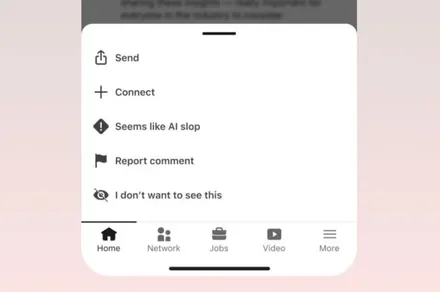
LinkedIn has a serious AI slop problem, and it’s now turning to its own users to help fix it. The platform is rolling out a new button that lets users flag posts they suspect were generated by AI. It plans to use that feedback to fine-tune the system that decides how much reach a post gets outside a user’s own network, based on how AI-generated it appears.
The announcement comes shortly after an analysis by Pangram found that more than forty percent of long-form LinkedIn posts are fully AI-generated, and it suggests that the reach-trimming measures the company rolled out earlier this year haven’t been enough on their own.
A crowdsourced slop detector
Chief Product Officer Hari Srinivasan laid out the changes in a recent LinkedIn post, saying AI slop has become a top priority for the company because users come to the platform for real perspectives and expertise, not generated text. He said LinkedIn now catches hundreds of thousands of automated comment attempts every day, and has blocked billions of other automation attempts, including large-scale slop posting, over the past couple of months.
The new flagging button feeds directly into that effort, alongside improved classifiers meant to catch AI slop and low-quality posts before they reach people outside the poster’s network. Srinivasan acknowledged that slop is hard to define and that the definition keeps shifting, which is part of why LinkedIn wants user reports to strengthen its automated detection.
A tool to coach users instead of penalizing them
LinkedIn is also testing a private dashboard flag that tells members when their posts come across as inauthentic or heavy on AI. The tool is meant to give users a chance to adjust their approach, instead of penalizing them outright. Srinivasan said the flag runs on signals from users rather than an automated AI detector, since plenty of people use AI to refine their thinking without producing slop and deserve accurate feedback instead of getting incorrectly flagged by a detection tool.
The company is also retiring its “enhance your post” AI writing feature and replacing it with a proofreading tool that fixes grammar without altering the user’s voice. It’s a subtle acknowledgement that the feature LinkedIn once pushed for writing help likely contributed to the flood of AI-sounding posts it’s now trying to clean up, even if that’s not how Srinivasan framed the decision.
LinkedIn isn’t alone in this fight against AI slop. Substack also rolled out a tool earlier this month that flags AI-written newsletters for readers. Whether such tools can successfully curb the spread of AI slop remains to be seen.