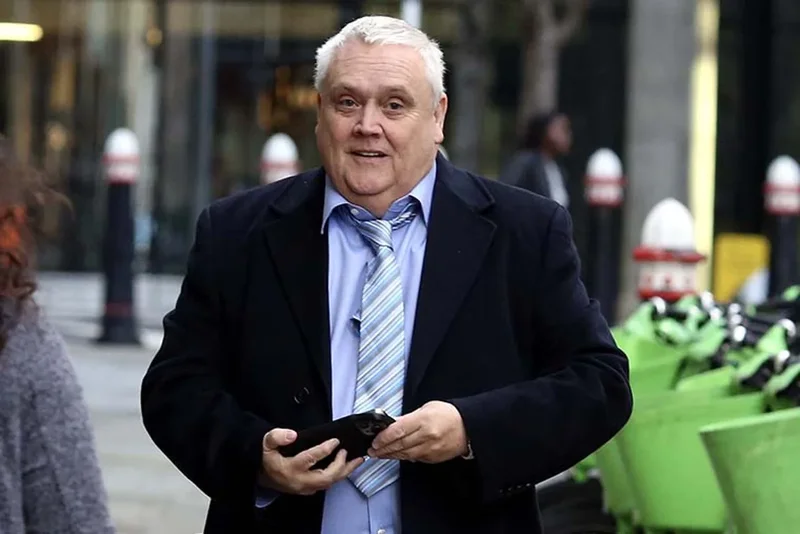
A used car tycoon who went from living on the street to building a £500 million fortune has lost a legal bid to prove that he was wrongfully dismissed from his own business.
However, he has secured an overall ruling that his company was the victim of a “pre-conceived and orchestrated plan” designed to sideline him and assume control of the £200m company.
Peter Waddell went from being a homeless teenager in Glasgow to owning a London mansion recently listed for £23.5m and a fleet of luxury cars.
The driving force behind the Kent-based used car empire Big Motoring World, Mr Waddell sold a third share of his companies to the private equity firm Freshstream for £72m in 2022, in hopes of spending less time working and more with his family.
The agreement included a "call option" clause, which would have enabled Freshstream to acquire another third of the business, along with overall control, for an additional £72m.
However, in April 2024, the investors initiated a process to oust Mr Waddell as chief executive and seize control of Big Group without paying the further £72m.
They accused him of numerous incidents of gross misconduct, including making sexist, racist, and abusive comments toward colleagues.
It was alleged that he told a female cleaner “I bet you'd like to suck my d***” and referred to Hindi people as Hyundais.
The sacked tycoon, personally and through the company through which he holds his two thirds Big Group stake, Peter Waddell Holdco Ltd (PWHL), went on to sue.
He claimed that he was wrongfully dismissed and that the actions of those aligned with Freshstream, in orchestrating a deliberate plot to sideline him and “strip value” from the formerly thriving business, were “unfairly prejudicial” and not in the best interests of the business.
After a 28-day High Court trial followed by three months of deliberation, Mr Justice Marcus Smith on Friday ruled that Mr Waddell’s dismissal was not unfair.
The judge said that he was guilty of a string of incidents of gross misconduct, the first of which was the comment to the cleaner.
But he went on to find that the unfair prejudice petition on behalf of Mr Waddell's company must succeed, saying that there had been a deliberate plan to oust him and take control of the company by those aligned with Freshstream.
Part of that unfair prejudice had involved not giving Mr Waddell warnings over his language and a chance to moderate his behaviour before he committed gross misconduct, the judge said.
“An otherwise valuable employee can be taught to avoid inappropriate conduct and disciplined through warning, rather than the nuclear option of immediate termination,” he said.
“Mr Waddell’s early inappropriate behaviour was not gross misconduct – although it was misconduct – and I consider that if spoken to firmly and clearly enough... Mr Waddell would have ameliorated his behaviour and not been dismissed in April 2024, or at all. I consider that Mr Waddell was able to control his behaviour, if incentivised to do so.”
He continued: “I have found the formation and execution of a pre-conceived and orchestrated plan which worked backwards from Freshstream’s aim of achieving permanent control of, and Mr Waddell’s removal from, the business without having to exercise the call option.
“The prejudice to PWHL is obvious. Instead of receiving £72m for its shares, PWHL has seen BIG lost to strife, with money lost on massive and commercially unproductive litigation.
“This plan was, in substance, successful.
“The unfair prejudice to PWHL would appear to be obvious. As majority shareholder, PWHL had an interest in BIG being operated lawfully under the direction of its properly appointed CEO, Mr Waddell.
“The execution of the plan was enormously damaging to BIG, with more-or-less open warfare being conducted between the Waddell 'team' and the Freshstream 'team'.
“Whilst it is difficult to quantify the extent of this prejudice, I do not need to do so. It is sufficient that PWHL was deprived of its chosen CEO; and that over a period of two years, the business was run extremely badly and in a state of conflict, some overt, some covert.”
He went on to say that the consequences of his ruling for the company would be decided at a later hearing.
A spokesman for Mr Waddell said outside court after the ruling, “Mr Waddell now sits back on the board from today”, adding that he intends to “take back control of his company”.
In a statement, Mr Waddell said that the fight had personally cost him £20m, as well as costing the business a similar sum.
Mr Waddell has an astonishing rags-to-riches story, being taken into care at a children's home in Fairlie, North Ayrshire, aged four and living rough on the streets of Glasgow as a teenager before moving to London and becoming a taxi driver.
From a base in Teynham, Kent, he went on to build Big Motoring World, Britain's second biggest second-hand car empire, selling 60,000 vehicles a year and now worth around £500million after branching out into property and haulage.
His Grade-I listed 56-room mansion Holwood House, near Bromley, Kent, was put on the market at £23.5m in 2025.
Mr Waddell has reportedly built an identical pile on Spain's billionaire's row in Puerto Banus, where his neighbours include Novak Djokovic and Simon Cowell.
The house is steeped in history and boasts a swimming pool complex, two gyms, a cinema, music room and tennis court and is set in 50 acres of parkland.
But the tycoon's life was thrown into turmoil when he was removed as the boss of his business in April 2024, after an internal investigation found he had made sexist, racist and abusive comments towards colleagues.
The businessman, suing, said that private equity firm, Freshstream, drove the “unfair” investigation to kick him out of his company.
Alan Gourgey KC, for Mr Waddell, told the court in his written submissions that Freshstream as part of its investment had a contractual “call option” right to eventually buy out the rest of the company and also a right to “step-in” and remove Mr Waddell from the helm of the business under certain circumstances.
Bluebell Cars Holding Ltd said that after a series of complaints of misconduct by staff relating to Mr Waddell making racist, sexist or offensive statements, the “step-in” clause was triggered and it was entitled to remove him and bring in new management.
But his barrister said: “A plan was hatched to oust Mr Waddell from the business through these means. Needless to say, all this took place behind Mr Waddell’s back.
“Whilst the Big Group was hugely profitable under the management of Mr Waddell, its performance significantly deteriorated under the management of [the new chairman] and the FS-controlled board.”
He added that consumer complaints have soared since 2024 and that the business's Trustpilot and Google review scores have plummeted since Mr Waddell was ousted.
“Big Group’s performance has performed disastrously since Mr Waddell’s exclusion from management. It is clear that had he remained in control, he would have steered the business in a very different direction and the business would have been profitable.”
Accusing Freshstream of “unfairly prejudicial conduct”, the barrister said: “It is submitted that the investor is continuing to prioritise its own collateral interests in these proceedings over the objective interests of the business in the mistaken belief that it can simply take the cash from the assets of the business to ultimately achieve a return on its investment.”
Giving his ruling, the judge said that some of Mr Waddell's behaviour at work had been “deeply unattractive” and that he had not been unfairly dismissed.
But he went on to find that there had been a plan to get rid of him, which had caused unfair prejudice to the business overall.
“The unfair prejudice alleged is in essence that the business has been less well run than it would have been had Mr Waddell been CEO. Mr Waddell’s witness statements are full of examples where Mr Waddell asserted that the business had been 'run into the ground'.
“I have found the formation and execution of a pre-conceived and orchestrated plan which worked backwards from Freshstream’s aim of achieving permanent control of, and Mr Waddell’s removal from, the business without having to exercise the call option.
“The execution of the plan was enormously damaging to BIG, with more-or-less open warfare being conducted.
“The prejudice to PWHL is obvious. Instead of receiving £72m for its shares, PWHL has seen BIG lost to strife, with money lost on massive and commercially unproductive litigation.
“Mr Waddell’s early inappropriate behaviour was not gross misconduct – although it was misconduct – and I consider that if spoken to firmly and clearly enough, Mr Waddell would have ameliorated his behaviour and not been dismissed in April 2024, or at all. I consider that Mr Waddell was able to control his behaviour, if incentivised to do so.
“Again...the prejudice to PWHL is obvious.
“In conclusion, I find that the petition succeeds,” the judge concluded.