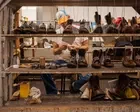
For 18 years, one of the most important relationships in Luke Mayfield’s life was with his boots. As a hotshot – one of the US’s elite firefighting crews sent deep, on foot, into wildfires – Mayfield hiked a thousand miles a fire season in his boots, stood in them 16 hours a day and slept near them on assignments that lasted weeks in terrain no truck could reach.
Like every wildland firefighter, he learned the rituals of their upkeep: how to grease them, how to lace them, how soon before the season to break in a new pair so the blisters came during training instead of on duty.
“For all that, they really are the best boots for the job,” Mayfield says. “It’s crazy to me that that’s the case, considering it’s 2026.”
The boot in question is a very particular object, and it has barely changed in more than a century. Eight inches of full-grain leather, minimum, laced high to protect against cuts and hot ash. A sole rated to take heat that could melt an ordinary shoe. A tall, stacked heel that bites into a slope going up and holds the foot steady coming down.
While there are some newer parts, such as fire-resistant Technora threads that self-extinguish in seconds, the majority of the boot is still made the traditional way: by hand, at a small constellation of family workshops in the Pacific north-west. One of them, White’s Boots in Spokane, Washington, is credited with originating the design in 1939, as a variation of the logger boot they had been making since the early 1900s.
It’s part artisan history, part law; many of the boot’s heritage aspects were built into guidelines the National Fire Protection Association (NFPA) released for certification.
Despite the rigorous standards of certification, the boots are not a guarantee. Stand too long in hot ash and the heat eventually conducts through the sole; crews call it hot foot. When he was a young firefighter, Mayfield recalls, the lugs on his boots melted clean off.
In the face of these conditions, the boots were made to be rebuilt rather than replaced. A good pair can last the better part of a decade – but that craftsmanship comes at a price. Fire boots of the highest caliber can cost $800 a pair, with less expensive models in the $300-$500 range.
Those sums would be trivial on the budget sheet of the federal government, but Washington DC is rarely the buyer. In fact, the US’s wildland firefighters are largely responsible for equipping themselves.
Part of that is due to a surprising, and consequential, bureaucratic classification. Until only recently, the US government did not formally consider wildland firefighters to be firefighters at all. On paper, they were forestry technicians.
That designation carried genuine weight. It helped keep the burden of equipping the workforce on the “forestry technicians” themselves; the word “fire” did not appear in their job title and neither, reliably, did the government’s duty to outfit them.
The costs that do get covered aren’t shared evenly, either. How a crew is funded and equipped can vary sharply from one to the next, as a function of which agency or region a firefighter happens to land in. Mayfield says he once ran a hotshot crew with six figures in discretionary spending, while a comparable crew a few hundred miles south, in a different region, made do with a small fraction of that.
All of these issues are contributing to a problem of retention. The US interior department acknowledged in 2025 that compensation “has not kept pace” with the work, with firefighters “finding it increasingly difficult to remain in these jobs”. Until recently, wages ran so low that in 2021 the government moved to ensure a floor of no less than $15 an hour.
Demand on these firefighters is only mounting. The US Forest Service no longer references a fire season; it now speaks of a “fire year”. “What used to be a three-month job can be eight months-plus of fighting fire, away from your family,” Mayfield says.
That churning workforce is still, all things considered, a market. The federal wildland firefighting force has stayed essentially flat for more than a decade; about 11,000 people work at the forest service, with several thousand more across the interior agencies. For the handful of companies that still make fire boots by hand, that is not, whatever the price tag might suggest, a particularly lucrative model.
No one understands that better than the people making the boots. Shuyler Mowe, CEO of Spokane-based Nicks Handmade Boots, founded in 1964, thinks his boots are, if anything, underpriced. “People are always like: ‘Wow, your boots are $600,’” he says. “These should be, like, $2,000!”
Mowe’s thoughts are less a complaint than an accounting. The Technora fire-resistant thread is notably difficult to work with; the leather used in the boot is considerably thicker than any consumer boot and, consequently, more difficult to shape; the boot is left on a mold, called a “last”, shaping the leather more effectively, for longer than is practical at scale.
“It’s a lot of these little things that add up to a completely different product,” Mowe says. Being overbuilt is the point – everything is thicker and heavier than it strictly needs to be, which helps a pair bounce back after multiple rebuilds and last for years. “You’re paying for the institutional knowledge.”
The birthplace of that knowledge is White’s, the company where Nicks’ founder learned the trade before striking out on his own in the 60s. (“The Coke to our Pepsi,” Mowe jokes.) White’s has been making boots since 1853, longer than the US Forest Service has existed.
Making the boots is a work of craft. It takes 2,000-3,000 pairs before someone is any good at hand-welting, says Eric Kinney, White’s president (and a bootmaker of 26 years). “Everyone thinks they can do it until they try it for a while.” In all but a handful of White’s Boots’ 168 years, the company has been run by a bootmaker.
White’s Smokejumper model is still considered the gold standard; it was first worn in 1939 by Francis Lufkin, one of the country’s first smokejumpers – elite firefighters who parachute in to remote wildfires – and bought for about a week’s pay. Nearly a century later, that’s the cost ratio White’s has maintained for their premier line.
“The price has stayed true to that course throughout its history,” says Kinney. “Seven hundred and seventy-five dollars is probably on the low end for a week’s pay, but that’s what we’re selling them for.”
That price has held even as the business model has shifted. White’s once stocked 6,000 pairs of its hand-welted Smokejumper; now, it sells closer to 1,500 a year. Demand has been redistributed across White’s other construction styles, which still move from 10,000 to 15,000 annually, according to Kinney – but the premium, handmade boot that once defined the company is being squeezed.
For many firefighters, the boots are getting harder to justify. A pair built to last a decade only pays off for someone fighting fire hard and long enough to wear it out – and a younger, increasingly transient workforce means fewer feet will be around to do so.
Mayfield himself made that same calculation; by the time he reached hotshot captain, he says, he had blown through two pairs of White’s in a single season, $600 apiece. Fed up, he moved to Nicks. When those also suffered damage years later, he was convinced to try out the boots that his newer crewmates were turning to: a hunting boot at half the price. His feet, he says, felt good immediately, without the need to break in stiff shoe leather. He hasn’t gone back – but he hasn’t gotten rid of his old boots, either.
“I have a fully rebuilt pair of Nicks sitting in my garage,” Mayfield says. “If I were cutting trees down and all that stuff, I would want people in a taller leather boot, because accidents happen. I fully recommend that.”
Mayfield is far from alone. There are now a number of companies making boots like his new pair: lighter hunting-style boots often manufactured in Italy, without a long break-in period. Many of those boots also sidestep NFPA certification, and may be less durable in the long term. That tradeoff matters less to a workforce that often turns over within a few seasons. To adapt, White’s is preparing to release an Italian-made boot of its own. “It’s a great-looking boot, just not our traditional stuff,” Kinney says.
For his part, Kinney is looking to steward the Pacific north-west boot tradition through his tenure. “I’ve probably got seven or eight years left at the company,” he says. “We’re doing everything we can to do it the same way on the high-end, hand-welted stuff. We’ll see what happens in 10 years.”
There has been genuine movement on the government side. In March 2025, after years of temporary patches, Congress made permanent the first major pay raise in decades, and the current administration has since moved to extend hazard pay to more of the work. But reform reached the pay and stopped at the boots.
A stipend meant to cover boots has sat at $500 since 2020. The most basic piece of equipment the job requires – the one thing between a person and hot ground – is still something firefighters buy themselves, made by a shrinking number of highly skilled hands.