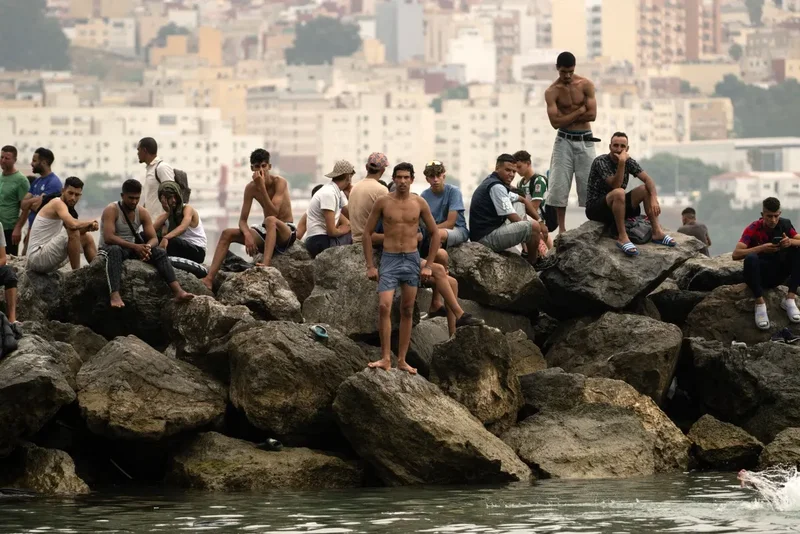
The massive and sudden influx of 60,000 migrants into Spain's enclave of Ceuta, located in the north of Morocco, has triggered a crisis for Spain, and the European Union.
How big an influx?
The numbers of migrants suddenly flowing into Ceuta is outsized for the territory's population of 80,000.
Some 60,000 migrants have so far entered over the past two or three days, estimated the local regional president Juan Jesús Vivas.
Around 200 migrants were arriving "every minute", according to Ignacio Cembrero, a journalist specialised in migration in North Africa.
Spain's interior ministry counted 37,500 who have since left Ceuta to return to Morocco, Spain's interior minister said later on Friday.
The scale is far bigger than that in May 2021 when, over a few days, some 12,000 migrants flowed into Ceuta, according to the Ceuta and Melilla Observatory.
Is Morocco facilitating?
According to Cembrero, since Wednesday it appeared that Moroccan security forces "have been sitting on their hands."
"To reach the breakwater that marks the border between Ceuta and Morocco, there are cordons of police and auxiliary forces, and it’s obvious they've been allowed through. Otherwise, this would not have happened," he said.
Carolos Echeverria, the head of the Ceuta and Melilla Observatory, said that there was an argument to use the controversial term "invasion" because "thousands of people cross an international border illegally, exerting pressure on a neighbour".
Why now?
According to experts consulted by AFP, there are several possible explanations.
One would be the ruling by Spain's Supreme Court on July 8th, which determined that the immediately return of a migrant without opening an administrative expulsion procedure does not apply in the case of sea arrivals.
"Without a doubt, the July 8th ruling ... has played a role. But that doesn't explain the level of mobilisation, which is very high," Cembrero said.
The mass arrival could have been encouraged by Spanish government's recent move to regularise people who arrived in the country illegally. Or that Spain's government could change, to be replaced by one with a firmer line on immigration. But both of these hypotheses are difficult to confirm, analysts say.
There are also political analysts who believe Spain's recent rapprochement to Algeria could be behind Morocco's decision to not prevent the mass crossing.
Pedro Sánchez visited Algiers on July 20th to "usher a new phase in relations", and ten days later - coincide or not - Morocco has turned a blind eye to what's happened in Ceuta.
Relations between Spain, Algeria, and Morocco have faced severe strain in recent years primarily due to a deep regional rivalry over Western Sahara and Spain’s sudden diplomatic shift in 2022, endorsing Morocco's autonomy plan for the disputed territory.
This deeply angered Algeria, a supporter of Sahrawi independence, and who Spain depend on significantly for natural gas supplies.
Many considered the mass migrant crossing into Ceuta in 2021 to be a direct act of diplomatic retaliation by Morocco, as the event occurred soon after Spain secretly permitted Brahim Ghali, the leader of Western Sahara Polisario Front, to enter the country for medical treatment.
In essence, there is a belief that whenever Spain does something Morocco doesn't like, they open the border at Ceuta and Melilla.
Leverage for Morocco?
"The most important thing, the backdrop, is that permanent blackmail" by Morocco, Echeverria said.
Analysts say that the recurring migration crises and the alleged laxity of Moroccan security forces are tools of diplomatic pressure.
Morocco has claimed sovereignty over Ceuta and Melilla since its independence in 1956, while Spain has flatly rejected any negotiation over the two enclaves.
READ ALSO: Why are Ceuta and Melilla Spanish?
According to Cembrero, "the Moroccan authorities have seen an opportunity to force Spain to negotiate the future of these cities".
Faced with this "unacceptable" territorial claim, Echeverria said the issue should be "Europeanised".
"We must obtain retaliatory measures from the European Union, as a member state," he says.
Article by AFP's Pol Costa, with additional reporting by The Local's Alex Dunham.