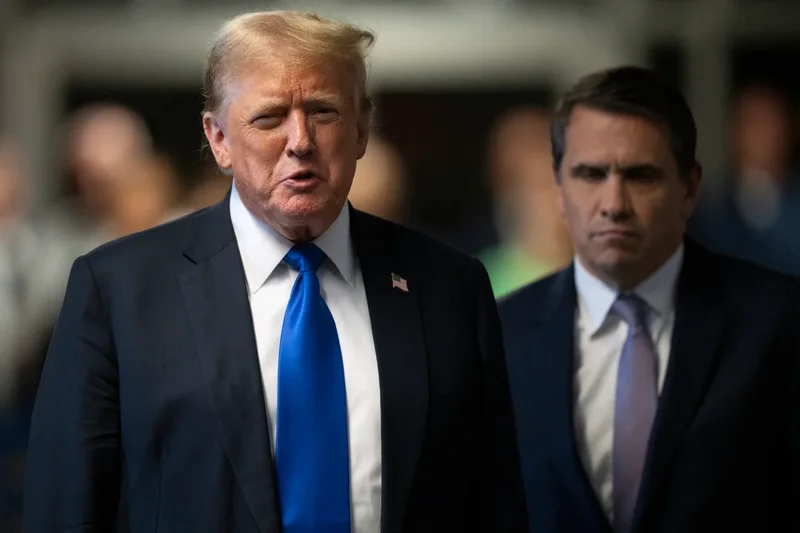
More than two years after a jury in New York found him guilty on 32 counts, President Donald Trump is desperately trying to erase his felony convictions in his latest “urgent” request for a federal court to take up his case.
Trump was convicted in state court in Manhattan, but his legal team has been trying, unsuccessfully, to remove the case into federal jurisdiction, where he hopes his Department of Justice could make it disappear.
U.S. District Judge Alvin Hellerstein heard arguments in Trump’s attempt to move the case to federal court in February. A ruling will determine whether state court was the proper venue for the president’s trial and his “immunity” argument.
“Respectfully, this lengthy delay is prejudicial to President Trump because, in these circumstances, ‘justice delayed is justice denied,’” his attorneys wrote late Thursday. “If the Court does not issue a ruling within the next several weeks, President Trump will have no choice but to seek immediate appellate relief to vindicate his urgent right to a federal forum.”
In a lengthy argument to a state appellate court this week, the Manhattan district attorney’s office asked judges to reject Trump’s challenge to the jury’s guilty verdict in his hush money case.
Prosecutors said Trump is not entitled to presidential “immunity” for the “private conduct” at the center of the case, which involves the president’s scheme to boost his chances during the 2016 presidential election through a series of covered-up payments to adult film actress Stormy Daniels to bury politically embarrassing stories about their alleged affair.
Trump’s then-attorney Michael Cohen paid Daniels $130,000 for the rights to her story, and Trump then reimbursed Cohen in a series of checks, some of which were cut from the White House. Those reimbursements were falsely recorded in accounting records as “legal expenses,” fulfilling a conspiracy to unlawfully influence the 2016 election, the jury found.
Prosecutors then shared that filing with Hellerstein, which Trump’s legal team says is proof that the “heart” of the case and Trump’s appeal must be heard in federal court.
Manhattan District Attorney Alvin Bragg “would not have used an entire appellate brief’s worth of words on these federal issues if the president’s arguments were not at least colorable,” according to his lawyers.
Throughout his appeal, Trump has claimed that Manhattan prosecutors improperly used testimony from White House aides and other evidence that he claims should have been shielded from criminal prosecution by the Supreme Court’s decision on presidential immunity.
Prosecutors have argued that Trump’s attempts to cover up payments to protect himself from a political scandal have nothing to do with “official” acts in office.
“The criminal charges here arose from defendant’s unofficial, non-presidential conduct — as multiple courts have already found,” Manhattan District Attorney Alvin Bragg wrote.
“As the Supreme Court recognized, a president can engage in unofficial actions, and all of the evidence that is the subject of defendant’s current complaints arises from his unofficial actions during his presidency,” he argued.
Trump’s attorneys argue certain evidence — including Twitter posts and trial testimony from former White House aides — should never have been shown to a jury under the Supreme Court’s immunity decision. Those arguments were already rejected by Justice Juan Merchan, the Manhattan criminal court judge who presided over the trial, finding that the case involved Trump’s private conduct, not his official duties as president.
Even if prosecutors relied on evidence that was shielded by immunity, “ any error in admitting this evidence was harmless: a mountain of evidence unaffected by any claim of official presidential immunity overwhelmingly established defendant’s guilt,” Bragg wrote.
Falsifying business records, on their own, are misdemeanor offenses. But Manhattan prosecutors elevated those charges to felonies by tying them to another crime – one that involves a conspiracy to manipulate an election through “unlawful means.”
Trump’s lawyers claimed that prosecutors wrongfully invoked election law to target the president with drummed-up charges.
Bragg labeled that argument “meritless.”
After a wave of indictments against the president, Bragg’s criminal case is the only one to stick against Trump, who is the first sitting president with a felony conviction.
On January 10, 2025, Trump received a sentence of “conditional discharge” — which preserved the jury’s verdict but came with little, if any, criminal consequences. Trump was sworn into office a second time 10 days later.