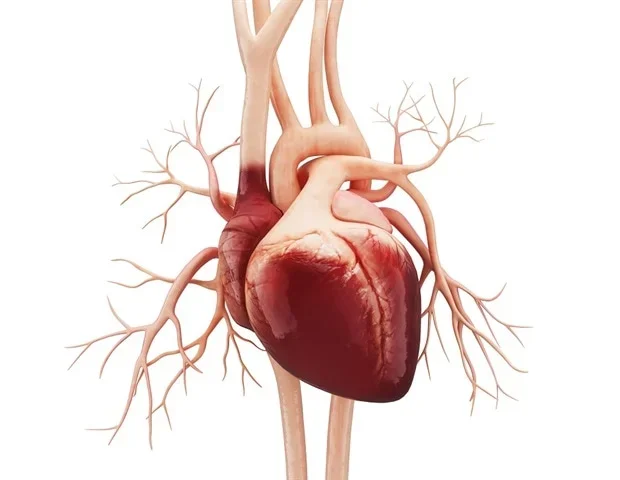
An estimated 10 million Americans have atrial fibrillation (AFib), according to the National Institutes of Health's National Heart, Lung, and Blood Institute. AFib is a condition in which the upper chambers of the heart beat out of rhythm with the lower chambers, leading to less-efficient blood flow. It is usually a product of age and the lifelong cardiovascular strains on an older heart, but some families carry a rare mutation that puts them at a high risk for AF much earlier in life, raising the risk of complications such as stroke or even sudden death.
"For many people, their first symptom of AFib is a stroke," said Dawood Darbar, new chair of the Department of Medicine at Penn State College of Medicine, who has spent his career studying AFib to understand the causes of this abnormal heart rhythm. "If we can prevent even one stroke, the impact on that person and their family would be huge."
Darbar led a multi-institutional study published in Nature Communications that showed how these rare mutations converge with the small variations in DNA shared by millions of people to quiet the genes that keep the heart's electrical activity on a steady rhythm, potentially leading to early onset AFib.
In this Q&A, Darbar discussed what happens inside a cell to produce a heartbeat, the role genetics plays in AFib, and how this work fits into a broader effort to identify at-risk patients before they ever have a stroke.
Q. What happens when the heart beats? What breaks down during AFib?
Darbar: Every heartbeat begins with an electrical impulse generated by specialized cells in the heart's natural pacemaker. This impulse travels through the upper heart chamber, or atria, causing the heart muscle cells to contract in a coordinated fashion and pump blood into the bottom heart chambers, known as ventricles. The electrical signal then passes through the ventricles, producing the heartbeat that pumps blood throughout the body.
In AFib, this orderly electrical system breaks down. Instead of a single, coordinated electrical impulse, multiple abnormal signals spread through the atria simultaneously. As a result, the atria "quiver" rather than contract effectively, leading to an irregular heartbeat and increasing the risk of stroke, heart failure and other cardiovascular complications.
Q: AFib is usually described as a disease of aging. Where do genetics come in?
Darbar: Most AFib is related to high blood pressure, diabetes, and heart disease. But roughly 20% is genetic. Some people inherit a rare genetic mutation that substantially increases their risk of developing AFib at an early age. However, in our recent study in Nature Communications, we saw that these mutations do not act in isolation.
Each of us also carries hundreds or even thousands of common genetic variants - or single-nucleotide polymorphisms (SNPs), pronounced "snips" - that individually have only a very small effect on AFib risk. But when many of these common variants occur together, they can amplify the impact of a rare AFib-causing mutation. It's the interaction between rare and common genetic variants that appears to matter.
We refer to this as "additive" risk because rare and common genetic variants work together to provide a more complete picture of a person's likelihood of developing AFib than either type of variant alone. In our analysis of the U.K. Biobank, a health and genetic database that includes more than 500,000 participants, individuals with a high burden of common genetic risk variants had approximately twice the risk of developing early-onset AFib.
**Q. What is an example of this additive effect? **
Darbar: Some families carry a rare mutation in a gene called LMNA, which helps organize DNA inside the cell. LMNA mutations have been linked to inherited forms of heart disease and AFib. In our study, the mutation altered how tightly certain regions of DNA were packaged, which in turn affected how easily those regions could be accessed and regulated.
Using blood samples - donated by individuals with and without AFib - to generate personalized human heart cell models, we found that the rare LMNA mutation and SNPs converged on many of the same DNA regulatory pathways. Several of those SNPs were located within regions of DNA whose accessibility had been altered by the LMNA mutation. One of these regions helps regulate the movement of sodium ions into heart cells, a process that is essential for generating and conducting the electrical signals that produce a normal heartbeat.
This provides a concrete example of additive genetic risk: the rare LMNA mutation creates a vulnerable cellular environment, while a person's background of common genetic variants can further increase or modify that risk. Together, these factors may help explain why some people develop AFib much earlier than others. It also suggests that predicting AFib risk may require looking beyond a single harmful mutation and considering a patient's broader genetic landscape.
Q: What does this all mean for a patient sitting in your clinic?
Darbar: These studies were conducted in laboratory-based cell models, so the findings are not yet ready to guide routine clinical care. What they do provide is a clearer understanding of how rare and common genetic risk factors can converge to disrupt the heart's electrical system. With additional research, including studies in patients, this knowledge could eventually help us identify who is at greatest risk for developing AFib at a young age.
Genetic testing is already an important part of evaluating patients with inherited heart rhythm disorders and their families because it can identify people who may be at increased risk before symptoms appear. In the future, combining information about a rare disease-associated mutation with a person's broader genetic background may allow us to estimate risk more accurately, for example, identifying someone who may be more likely to develop AFib in their 30s or 40s.
Our findings also suggest that LMNA should be considered in genetic testing panels for inherited arrhythmia syndromes. LMNA has traditionally been associated with cardiomyopathy and heart failure, but our work shows that some individuals with LMNA variants may first present with AFib, before structural heart disease becomes apparent. Identifying these patients earlier could lead to closer monitoring, earlier treatment, and screening of family members who may also be at risk.
The long-term goal is to move from reacting to complications to preventing them. For example, if we can identify a high-risk individual early, we might use a wearable heart monitor to detect AFib before it causes a stroke. That would be a very different and much more proactive conversation than the one we are often able to have with patients today.
This work was supported in part by the National Institutes of Health's National Heart Lung and Blood Institute under award numbers R01 HL148444, T32 HL139439 and R01 HL164773; the U.S. Department of Veterans Affairs under Merit Award 2I01BX004268; and the American Heart Association under award numbers 25CDA1447820 and 24PRE1178922. Full funding details are available in the paper. This content is solely the responsibility of the authors and does not necessarily represent the official views of the National Institutes of Health, the U.S. Department of Veterans Affairs or the American Heart Association.
Source:
Journal reference: