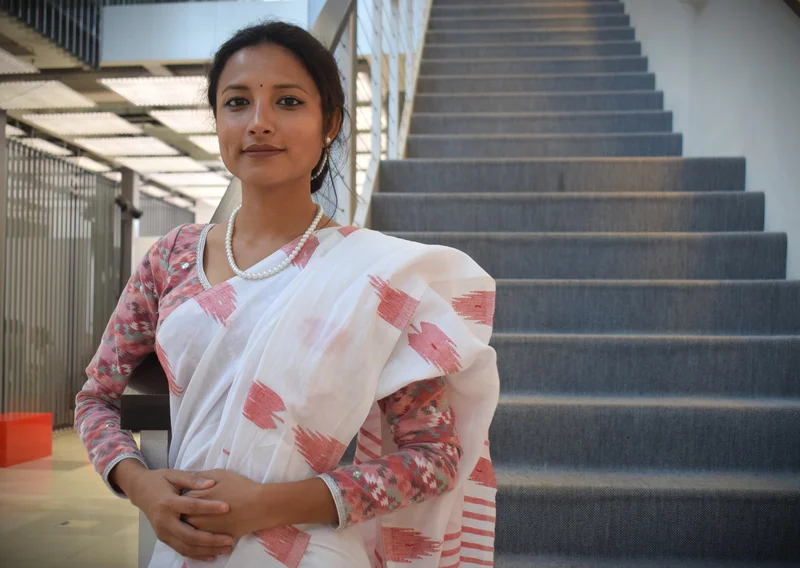
When Rakshya Bam, 26, saw Nepali flags flying over the Gen Z protests in Madagascar, she realized that what her generation in Katmandu had accomplished was historic. Just a few days before protests broke out on the African island in September 2025, the actions started by young people born between the end of the 1990s and the beginning of the 2000s had culminated with the fall of K.P. Sharma Oli’s administration. “In Madagascar, they used our flag as a symbol of rebellion. But without a doubt, we were also inspired by other countries. We followed the movements in Bangladesh and Indonesia. The entire world was suffering,” recalls Bam, the coordinator of Nepal Gen Z Front.
Her interview with EL PAÍS took place at the Hamburg Sustainability Conference, to which she had been invited to participate in a panel on youth political mobilization. “But I think this is the moment to pause and reflect. We need peace right now, we have seen too much destruction,” she adds.
The young activist and feminist, who graduated with a degree in social work and a master’s in gender studies, was one of the most prominent faces of the movement born online and in the streets after the government of Nepal prohibited 26 social media platforms, among them YouTube, Facebook, Instagram and WhatsApp. Gen Z rose up to protest corruption, abuse by the ruling parties and lack of opportunity in their country. Around 56% of Nepal’s population is under 30 years old, according to its 2021 census.
Even though at the time, the Nepali Gen Z movement had no official leaders or spokespeople, Bam used to be one of its individuals who gave speeches in front of vast crowds. She was also one of the 10 activists called on by the military, after the fall of the government, to attend a meeting to evaluate next steps. She left the table when she realized the other guests were supporters of the monarchy, which had been abolished in 2008.
Bam remembers that when the government fell, she couldn’t feel anything. “We had lost many friends at the protests. We were full of rage and frustration and suddenly, there was this vacuum of power. Our democracy was under threat,” she says. “At that moment, we thought, ‘Now it is our responsibility to step forward and lead.”
I think this is the moment to pause and reflect. We need peace right now, we have seen too much destruction
Nearly a year has passed since the protests ended in deadly chaos: 76 people died and more than 2,000 were injured. After the exit of the prime minister, an interim government was appointed, presided over by the former chief justice of the Supreme Court, Sushila Karki. In March there were elections, and rapper Balendra Shah and his Rastriya Swatantra Party won an absolute majority, coming to power in a country awash in uncertainty. The beginning of July marked their first 100 days in office.
The Gen Z movement, explains Bam, still exists, but it has divided into different missions. Some work with the ruling party in the ministries, or with the prime minister; others like her remain in the streets, monitoring the new administration. “In Nepal, civil society is weak; all these problems that have arisen are due to that. We don’t want this government to fail, which is why we need a strong citizenry who asks questions and demands responsibility,” she explains. “Generation Z is the best opposition to this new government. Today, the movement has extended to the citizens and it is everywhere.”
“We are happy that our current prime minister fights for good governance, because that is one of our goals, but we are not content with the way in which he is operating. Balen [as Shah was commonly known before] does not attend Parliament or provide clear accountability. It is as if some of his activities weren’t transparent to citizens. That is not a democratic way of governing,” she says.
The 35-year-old Shah was the mayor of Katmandu at the time of the shutdown in Nepal. After becoming prime minister on March 27, he opted for a centrist, pragmatic position and has promised to fight corruption, create 1.2 million jobs to reduce the emigration of young people and transform the Nepali government. But, as local press has documented, legislators from his own party have criticized his leadership and that of his ministers in areas related to security, agriculture and freedom of the press, among others.
“But that doesn’t mean we aren’t hopeful,” clarifies Bam. “Our hope does not lie in this administration, this prime minister or even the legislators. We have hope in the power that the people have bestowed on them.”
Parallel to monitoring the government, Bam continues to work on her own projects. “I have political aspirations and it could be that I go into electoral politics within the next five years,” she confesses.
Until that day arrives, the activist has reunited with her old causes. She has returned to the Ujwal Thapa Foundation, where she worked as executive coordinator before the September protests, as an information access consultant. “I hold sessions about that right for high school and university students. In Nepal, things are going well, but we must continue to defend it,” she says.
I have political aspirations and it could be that I go into electoral politics within the next five years
Through the Nepal Gen Z Front, she is also waging a battle against the government to defend the rights of people living in settlements whose homes have been demolished. “They promised to give them land, but two months have gone by and they haven’t done anything. They’ve simply kept them in a shelter,” she says.
Opportunity-seeking generation
Bam does not foresee abandoning Nepal, but she is aware that a lack of professional opportunities pushes thousands of young people to look for work outside the country every year. In 2024, the unemployment rate for people between 15 to 24 years old reached 20.8%, according to data from the World Bank, which places Nepal among the world’s poorest economies, with the slowest growth of any Asian nation. That same year, more than 741,000 of its citizens applied for permits to work outside the country. Of these, 77% were between 18 and 34 years old, according to the Ministry of Labor.
The activist thinks that in the short term, the government must guarantee the security of its citizens abroad. “They can sign a memorandum of understanding today with other countries to protect citizens. It’s important to allow them to make a living and give them that guarantee,” she says. In the long term, she adds, it will be necessary to promote agriculture, tourism and investment in business to strengthen the economy. “The government should contribute some kind of starting capital to young people so that they can get projects going. The entrepreneurial spirit is the future of Nepal,” she says.