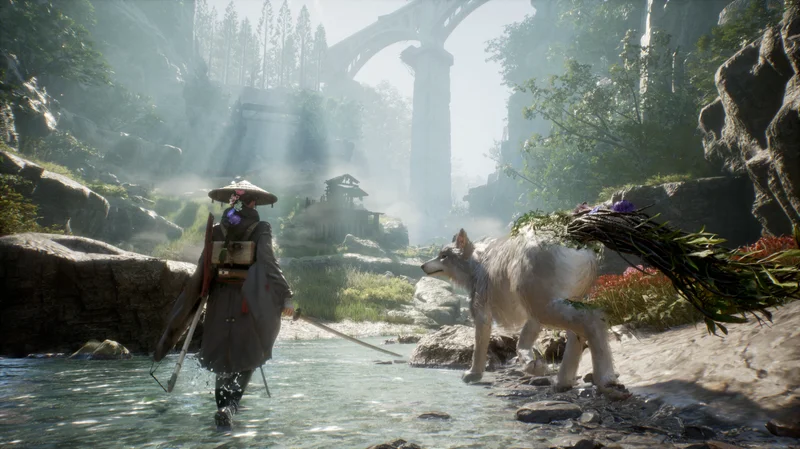
Game Freak’s Beast of Reincarnation arrives with high expectations. The action role-playing game, due Aug. 4, was widely seen by fans as a chance for the Pokemon developer to show what it could do beyond the long-running series.
Early previews indicated a massive departure from the creature-capturing and battling mechanics Game Freak has become known for. Even skeptical fans had hope for a new action RPG franchise and a potentially renewed creative spark for future Pokemon titles.
On July 23, I was among about 20 reviewers invited to a closed-door demo of Beast of Reincarnation limited to the game’s prologue and first chapter.
Despite some fertile world-building and decent sound design, Beast of Reincarnation plays like a bland, paint-by-numbers action RPG that borrows elements from more successful games without satisfactory execution, often leaving you wondering why they’re there at all.
For example, parrying is one of Beast of Reincarnation’s crucial gameplay elements. Set in a postapocalyptic Japan in the year 4026, the game follows Emma, an outcast infected by a mysterious blight, as she battles golems (automatons both docile and rogue) and malefacts (creatures infected by the same blight). Emma’s successful parries charge a meter and unlock attacks from her canine companion, Koo, who also has the blight.
Parrying is a common mechanic in many modern action RPGs, and games such as the critically acclaimed Sekiro: Shadows Die Twice and the award-winning Clair Obscur: Expedition 33 make it central to combat.
But blocking an enemy’s blows is only as interesting as the enemies throwing them. In Sekiro, as well as this year’s Nioh 3, enemies attack in a rhythm that is challenging yet comprehensible and exploitable. The pleasure lies in overcoming the initial difficulty, discerning how to chip away at an enemy’s health and occasionally punishing them with massive attacks.
In Beast of Reincarnation, by contrast, most enemies have just one or two attack patterns, reducing parrying to a rote exercise. Even the nushi, blight-infected guardian spirit animals that serve as each level’s boss, rarely move beyond this paradigm.
Even above-average action RPGs typically use boss battles to introduce more aggressive and varied attacks, pushing players into greater danger and, ultimately, greater triumph. In Beast of Reincarnation however, the second phase of this climactic fight is essentially a repeat of the first. Even on higher difficulty levels, combat that should be the most rewarding fails to become more than the sum of its disjointed parts.
Combat is only one of Beast of Reincarnation’s problems. The game also struggles with its soundtrack, particularly whenever the airy J-pop ballad that plays during exploration abruptly transitions to a generic battle anthem when the player encounters an enemy. And on the storytelling front, Emma as a character is largely devoid of emotion despite her harrowing circumstances; the game presents some brief justification for this, but it still amounts to a main character more akin to a brick wall than a likeable avatar for the player.
If a swath of the Pokemon fandom was hoping this latest outing from Game Freak would be a harbinger of good things to come, that doesn’t appear to be the case — at least not where official Pokemon games are concerned.
On July 10, Palworld — often dubbed “Pokemon with guns” — released its official 1.0 version. Developed by Tokyo-based Pocketpair — and wholly unaffiliated with the official Pokemon franchise — the game first launched in a beta form in early 2024 to massive success. Its full release suggests enthusiasm remains high for a Pokemon-esque game with new mechanics and a grittier story: After drawing 2.1 million concurrent players on Steam during its early-access launch — a feat matched by only two other games — Palworld’s version 1.0 release again approached 1 million concurrent players.
There’s still hope for a fresh take on the sanctioned Pokemon formula when Winds and Waves, the next mainline entries in the series, release in 2027. If there’s a silver lining to Beast of Reincarnation, it’s that Game Freak was willing to step outside its comfort zone — even if the result suggests the studio still has plenty to learn about the genre.