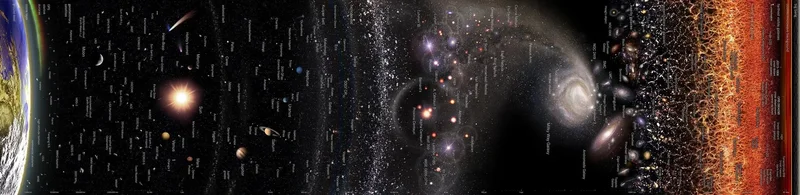
The Universe is unfathomably huge, with over 2 trillion galaxies in an "observable" volume measuring 93 billion light-years in diameter. Even our galaxy, the Milky Way, is incredibly huge, measuring an estimated 100,000 light-years across and containing between 100 and 400 billion stars. As we explored in a previous article, it would take centuries to millennia to travel to even the nearest star in our galaxy.
As with launching spacecraft to orbit, which is subject to the tyranny of the Rocket Equation, where it takes a significant mass of propellant to place even 1 kg (2.2 lbs) into space, achieving interstellar travel is subject to the tyranny of Einstein's Theory of Relativity. As a result, reaching even a fraction of the speed of light would require tremendous amounts of energy, the discovery of exotic physics, or both. However, since the dawn of the Space Age, several concepts have been proposed that could achieve the dream of interstellar flight.
As time and technology have progressed, proposals for interstellar spacecraft have evolved from huge, ambitious projects to miniaturized and automated vehicles. The propulsion methods, paradoxically, have also become more exotic and more practical. As the Space Age wound down, the source of the proposals began to transition away from space agencies towards non-profit organizations and private research institutes.
Alas, the dream of reaching another star is fraught with monumental, nay herculean, challenges. As with most advanced concepts (such as space elevators, O'Neill Cylinders, interplanetary settlements, etc.), it all comes down to two questions:
"How much are you willing to spend, and how long are you willing to wait?"
Having addressed that, what are the options for an interstellar mission? First, let's take a look at possible destinations.
Worlds Next Door
As noted, the field of exoplanet studies has exploded in the past two decades. To date, scientists have confirmed the existence of 6,333 exoplanets in 4,747 star systems. While Earth-like (terrestrial) planets account for a small minority, only 222 confirmed to date, a number of these are relatively close (in astronomical terms) to the Solar System. Within 50 light-years of Earth, there are 31 known terrestrial planets, 30 of which orbit low-mass, M-type red dwarf stars.
The closest of these is Proxima b, a rocky planet comparable in size and mass to Earth that orbits within its sun's habitable zone (HZ). Discovered in 2016, scientists estimate that it has an average surface temperature of -39 °C (-38 °F), compared to 15 °C (59 °F) for Earth. Given that this planet is tidally locked with its star, where one side is constantly facing its sun (which is common with M-type stars), scientists are divided on the question of its habitability.
Nevertheless, unless some potentially habitable planets exist within the Alpha Centauri system, Proxima b is the nearest confirmed terrestrial planet beyond the Solar System. It shall therefore serve as our reference point, at a distance of 4.25 light-years from Earth. With that covered, let's examine the propulsion systems proposed over the years, in chronological order.
Nuclear Propulsion (1950â1973)
Our first stop is the Cold War, a time characterized by two superpowers locked in a constant game of one-upmanship and a nuclear arms race. It was also a time of intense scientific discovery and experimentation. Having benefited from breakthroughs in rocket science, including the wartime development of ballistic missiles, the U.S. and Soviet Union (USSR) were also determined to achieve spaceflight before the other. From 1958 to 1972, this competition would come to be known as the "Space Race."
Even before the first astronauts and cosmonauts would reach space, scientists, engineers, and mission planners were contemplating how to send humans to orbit, the Moon, and beyond. Naturally, the idea of sending humans to the nearest stars was also considered, leading to the emergence of several projects. By the 1950s, having achieved many breakthroughs in the development of nuclear reactors that relied on the slow decay of fissile material (uranium) to generate heat and electricity.
This led the U.S. and Soviet Union to initiate programs to create reactors that would power nuclear rockets. By 1958, President Dwight D. Eisenhower signed the National Aeronautics and Space Act into law, which established NASA as the country's space program. From that point onward, NASA would take over existing programs and mount its own development efforts. By the end of the Space Race, both the U.S. and the Soviets created and tested multiple nuclear reactors designed to power nuclear engines.
This established the foundation for nuclear propulsion research that is still used today, which can be grouped into two categories:
Nuclear Thermal Propulsion (NTP): Concepts falling into this category consist of a fission reactor that heats propellant (typically liquid hydrogen), causing it to expand and form plasma that is funneled through nozzles to generate thrust. NTP engines have the advantage of offering a strong burst of acceleration, reaching a specific-impulse (Isp) of 830 to 1,000 seconds, 25,000 to 33,000 pound force (lbf), and an exhaust velocity of 8,000 to 9,000 m/s (29,304 km/h; 18,208 mph).
Nuclear-Electric Propulsion (NEP): Concepts in this category consist of a fission reactor that generates electricity for a separate Hall Effect thruster (Ion engine) that generates magnetic fields to ionize a propellant (such as xenon). This is then funneled through nozzles that provide less initial acceleration, but much more consistent thrust, allowing for 1,500 to 10,000 lsp over time, 15,000 to 25,000 lbf, and an exhaust velocity of 14,710 to 9,8067 m/s (52,956 to 353,040 km/h; 32,905 to 219,370 mph).
In the U.S., efforts to realize a nuclear rocket engine began in 1955 when the U.S. Army and the Atomic Energy Commission (AEC) initiated Project Rover. The plan called for an NTP concept where a fission reactor paired with liquid-hydrogen propellant would power the upper stage of a rocket, whereas the second-stage booster would rely on conventional chemical propellant.
In 1959, NASA replaced the USAF, and the focus shifted to the development of nuclear propulsion for long-duration spaceflight. Their efforts bore fruit in 1965 with the creation of the Nuclear Engine for Rocket Vehicle Application (NERVA), which was designed to be part of an NTP system. The AEC conducted several successful tests of NERVA reactors between 1965 and 1969, but the program was canceled in 1973 before any spaceflight tests could be conducted.
In 1977, astronaut Franklin Chang-Diaz, a veteran of seven Space Shuttle flights, began working on a nuclear engine concept known as the Variable Specific Impulse Magnetoplasma Rocket (VASIMR). Chang-Diaz conceived of the idea for a nuclear-powered helicon engine (which relies on magnetic cells to accelerate plasma) while still a graduate student at MIT. The process consists of neutral hydrogen propellant being injected and processed by three magnetic cells.
The gas is ionized in the first cell, then heated by radio waves in the second, causing it to reach temperatures of more than 50,000 °C (90,032 °F), turning it into a molten plasma. This plasma is then injected into the third magnetic cell (a magnetized nozzle), which directs the plasma into an exhaust that provides thrust. By 1993, Chang-Diaz and his colleagues continued to work on the engine at the Advanced Space Propulsion Laboratory (aka. Eagleworks Laboratories) at the NASA Johnson Space Center.
In 2005, Chang-Diaz and several colleagues formed Ad Astra Rocket Company in Houston, Texas. By 2015, NASA entered into a partnership with the company through the Next Space Technologies for Exploration Partnerships (NextSTEP) Program to develop high-power electric propulsion for future NASA missions. Such a system could theoretically reduce transit times to just 39 days, greatly reducing the hazards associated with deep-space travel.
However, neither an NTP, NEC, nor bimodal concept would be a feasible means of reaching Proxima Centauri. Given the distances involved, it would take a nuclear rocket roughly 1,000 years to arrive in the system and establish orbit around its only Earth-like planet (that we know of).
Project Orion
Similarly, post-war research was conducted in the U.S. to design the first interstellar spacecraft concept. It began in 1946 at the Los Alamos National Laboratory, where the Manhattan Project was completed two years prior, with Polish-American physicist Stanislaw Ulam proposing a framework for Nuclear Pulse Propulsion (NPP). By 1955, he and Frederick Reines (who also worked on the Manhattan Project) wrote a classified paper proposing a spacecraft powered by nuclear warheads. As they wrote:
The scheme proposed in the present report involves the use of a series of expendable reactors (fission bombs) ejected and detonated at a considerable distance from the vehicle, which liberate the required energy in an external "motor" consisting essentially of empty space. The critical question about such a method concerns its ability to draw on the real reserves of nuclear power liberated at bomb temperatures without smashing or melting the vehicle.
Converting these explosions into acceleration (and protecting the ship and crew) would be handled by a shock-absorbing plate with heavy springs and pneumatic systems mounted on the rear. With each detonation, the spacecraft would be accelerated further, eventually achieving a theoretical lsp of 6,000 seconds. This works out to an exhaust velocity of 58,840 m/s (211,824 km/h; 131,620 mph). At this velocity, the spacecraft could reach the Moon (384,400 km; 238,855 mi) in 1 hour and 49 minutes, and Mars (55 million km; 34 million mi) when it's closest to Earth in about 11 days!
In 1958, the United States Air Force (USAF) and the Advanced Research Projects Agency (ARPA) came together to realize an NPP concept, known as Project Orion. The project was led by Ted Taylor at General Atomics and physicist Freeman Dyson (for whom the Dyson Sphere is named). That same year, the National Aeronautics and Space Administration (NASA) was created and assumed control of the program. While Orion was not intended for interstellar travel, Dyson and his colleagues acknowledged that the Orion spacecraft had that potential.
In fact, Dyson produced calculations that showed that an Orion spacecraft equipped with hydrogen bombs (which also emerged during this time) with an energy efficiency of 25% (between the explosion and the spacecraft) could achieve a lsp of 100,000 seconds. This would provide an Orion spacecraft of this configuration with a top velocity of 980,000 m/s (3.528 million km/h; 2.192 million mph), or 3.3% the speed of light. At this speed, an Orion spacecraft could reach Proxima Centauri and its terrestrial planet in about 129 years.
Depending on the configuration and its mass-ratio, the spacecraft could even achieve an estimated velocity of 5% the speed of light, shortening the trip to about 85 years. However, the project's price tag was prohibitively expensive, and the use of nuclear devices raised significant concerns. Originally, the plan involved the Orion taking off from Earth, which would produce a dangerous amount of fallout from atmospheric detonations. When NASA took over the project, this was scrapped in favor of using multiple Saturn V rockets to lift it to space.
However, the size and mass of an Orion spacecraft - 300 to 400,000 metric tons (330 to 440,925 U.S. tons) - this was also deemed unrealistic. The matter was further put to rest with the passage of the Partial Nuclear Test Ban Treaty in 1963, which banned the testing of nuclear weapons in space, in the atmosphere, or underwater. This effectively ended Project Orion and all research into NPP. Henceforth, NASA remained committed to developing nuclear rockets for the sake of interplanetary travel.
As you can see, the Cold War and Space Age brought about some truly interesting research into nuclear propulsion systems, which has experienced something of a renaissance in recent years. Unfortunately, all concepts on the table right now are designed for interplanetary missions, most notably for the crewed missions that NASA and other space agencies hope to send to Mars in the coming decades. Nevertheless, there has been renewed interest in NPP research since Project Orion was mothballed.
And many other concepts emerged during this same period (and since) that must be considered. These will be coming out in the next few days and weeks. Our next stop on the journey: Fusion Propulsion! Stay tuned!