On that moonlit night in October 1946, the dark clouds scudding above Nuremberg’s Palace Of Justice seemed to presage the fate of the condemned men within.
Over ten months and ten days, the testimony from almost 300 witnesses during the first and most high profile of the Nuremberg Trials had shocked the world by laying bare for the first time the full scale of the atrocities committed by the Nazi High Command.
Now, starting at the stroke of midnight, 11 of their number were about to be brought to account on the three black-painted scaffolds erected in the adjacent prison’s grimy gymnasium.
They included Hans Frank, who had overseen the brutal exploitation and murder of millions of Polish citizens and Jews, and Joachim von Ribbentrop, the Foreign Minister who masterminded Germany’s invasion and persecution of nations across Europe.
But chief among them was undoubtedly Hitler’s deputy Reichsmarschall Hermann Goering. He had been described in the closing speech of Justice Robert Jackson, chief prosecutor at the trials, as a ‘half militarist and half gangster’ figure who ‘stuck a pudgy finger in every pie’.
It was Goering who, on July 31, 1941, had written an infamous letter authorising a ‘final solution to the Jewish question’.
It was Goering, too, who had founded the Gestapo, built up the Luftwaffe and hurled it at Germany’s defenceless neighbours, and set up the first concentration camps.
With Hitler dead, the Allies needed one man to be held ultimately responsible – a man whose hanging as a common criminal would symbolise the end of the Third Reich – and Goering was that man.
Herman Goering had founded the Gestapo, built up the Luftwaffe and hurled it at Germany’s defenceless neighbours, and set up the first concentration camps
Hans Frank had overseen the brutal exploitation and murder of millions of Polish citizens and Jews
Joachim von Ribbentrop, the Foreign Minister who masterminded Germany’s invasion and persecution of nations across Europe
The plan was for him to be the first to die. But at 6am the prison’s ashen-faced commandant, Colonel Burton Andrus, entered the Press room and announced that, with less than two hours to go, the senior Nazi had instead committed suicide by biting into a cyanide capsule.
In the eyes of his legions of followers, this enabled him to exit this world as a martyr and hero who lifted the spirits of his defeated nation in its darkest hours. It was the very departure the Allies were so desperate to avoid – and the question of how he obtained the poison has baffled historians in the 80 years since.
Over the years, suspects have included Herbert Lee Stivers, a US Army guard who claimed that he had, at the request of an attractive German woman named Mona, been persuaded to smuggle to Goering a fountain pen containing ‘medicine’.
Another contender was General Erich Bach-Zelewski, a German SS officer imprisoned in Nuremberg at the same time as Goering. He insisted that he had hidden the capsule in a bar of soap which he handed over as they passed each other in a prison corridor.
But neither account has withstood scrutiny – Stivers suspected of seeking fame and fortune and Bach-Zelewski’s story questioned because the two men were known to hate each other, Goering describing the Nazi general as ‘a b*d… the bloodiest murderer in this whole system’.
As the decades have passed, the chances of solving the mystery have seemed ever more remote but a new book offers a very unexpected answer.
Author Paul Hooley provides compelling new evidence that the cyanide was supplied to Goering with the complicity of two of Britain’s most highly regarded soldiers.
One was Airey Neave, best known in later life as the MP who masterminded Margaret Thatcher’s campaign to become leader of the Conservative Party, only to be assassinated by the Irish National Liberation Army weeks before her first General Election victory in May 1979.
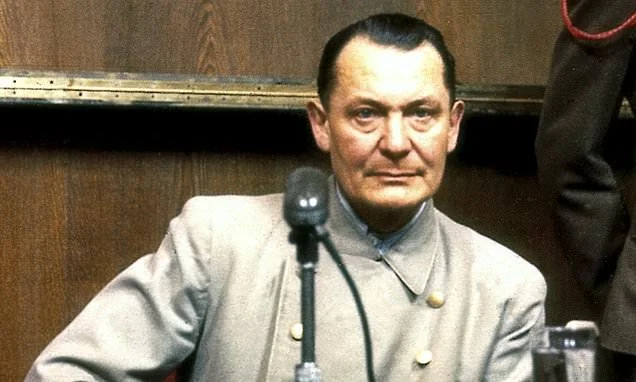
Herman Goering smiles at the Palace of Justice during the Nuremberg Trials
General Erich Bach-Zelewski, a German SS officer imprisoned in Nuremberg at the same time as Goering
Airey Neave, best known in later life as the MP who masterminded Margaret Thatcher’s campaign to become leader of the Conservative Party
The other was Wolfe Frank, the Army captain and interpreter whose relaying of the death sentences to the prisoners led to him being nicknamed the Voice Of Doom.
It was the latter’s involvement that led to Hooley’s investigation into Goering’s suicide.
In 2018, he published a biography of Frank, whose role as chief interpreter at Nuremberg was somewhat at odds with his reputation as an exceptionally handsome playboy.
Born in Germany on Valentine’s Day 1913, the son of a wealthy industrialist who later took his own life after realising what Hitler’s rise to power meant for Jews like him, Frank joined an underground resistance movement smuggling Jewish citizens to safety before fleeing to England and joining the British Army.
After the war, he went undercover to track down and single-handedly arrest the German general ranked fourth on the list of the Allies’ ‘most wanted’.
But he was a much better secret agent than he was a husband, cheating on all five of his wives and ending up a lonely recluse living in the Wiltshire village of Mere.
It was near there in the spring of 1988 that, suffering ill-health and beset by financial difficulties, he committed suicide by gassing himself in his car after washing down a meal at his favourite local restaurant with a bottle of vintage champagne.
His was a remarkable life by any measure – but Frank had saved the best for last. A woman who he had asked to become his sixth wife approached Hooley after his book was published.
Wolfe Frank, the Army captain and interpreter whose relaying of the death sentences to the prisoners led to him being nicknamed the Voice of Doom
She confided that in Frank’s last months, perhaps knowing that he was going to kill himself and would be free from prosecution under official secrets legislation, he disclosed to her and others that he had been present when the cyanide capsule was handed to Goering.
Hooley did not know what to make of this information until he stumbled across an interview given to The Spectator magazine in February 2003 by 90-year-old Edwin Putzell. He was formerly second-in-command at America’s Office of Strategic Services (OSS), the Second World War’s largest and most powerful intelligence agency, and the forerunner to the CIA.
In it, he claimed that he had given the capsule to Goering on the orders of his boss General William ‘Wild Bill’ Donovan, America’s most highly decorated war hero and founder of the OSS.
The reason, according to Putzell – but far more complicated, as we shall see – was that Goering had cooperated with the Allies and was ‘deserving of some sort of mercy’.
Hooley was particularly intrigued by two lines in Putzell’s 2003 interview – describing how Goering had been given the cyanide capsule ‘with the agreement of the British contingent’ and in the presence of a witness.
What did that mean?
His research revealed that the only British representatives in Nuremberg at the same time as the Americans Donovan and Putzell were Wolfe Frank and Airey Neave, who had been sent ahead of their interpreting and prosecution colleagues.
The first British prisoner-of-war to escape from Colditz, Neave was a barrister in civilian life and this, together with his fluent German, saw him trusted with the task of visiting the defendants’ cells, accompanied by Frank, to inform them of the charges to be laid against them.
General William ‘Wild Bill’ Donovan, America’s most highly decorated war hero and the founder of the OSS
In his autobiography, Neave described Hitler’s deputy as an ‘actor’ who seemed ‘in possession of the stage’ and recalled ‘a trace of geniality in those cruel eyes’ as Goering gestured him towards the bed.
‘It was as if to say, “I’m sorry I cannot offer you a chair”.’
What Neave did not mention about that encounter in October 1945 was a detail Hooley discovered by chance while looking through an extensive collection of his papers placed in the House of Lords Records Office by Airey’s widow Diana, Baroness Airey.
Within a manila folder, he found a previously unpublished document entitled The Suicide Of Goering. Much of what Neave describes in it is already known – but then there is an anecdote which is suspiciously similar to one described by Wolfe Frank in his memoirs.
Both men relate how, on first visiting Goering, they wondered whether he had forgotten to put in his dentures because he was talking in a curious fashion.
Only after his suicide did they realise that he might have been hiding the cyanide capsule in his mouth at the time.
Their accounts are so similar that Hooley believes that – if what the elderly Putzell claimed in that 2003 Spectator interview was true – this may have been a cover story agreed between them and the Americans.
The implication was that, since Goering had had the poison even before the trials started, he must have brought it into the prison with him. This would deflect any investigation into who might have given it to him while he was there. This was the conclusion eventually reached by the official inquiry, so the cover stories were never needed.
But they would have carried great weight – coming as they did from two British men of such fine standing.
As to why Neave and Frank would have agreed to this plan, we need to understand the motivations of their American co-conspirators.
Both Donovan and his protege Putzell, as befitting their role in the founding of the future CIA, were masters of the dark arts of espionage.
Recruiting experts such as American biochemist Stanley Lovell – the inspiration for the spymaster Q in the James Bond books – Donovan had schooled Putzell in skills such as disguising explosives as camel dung and bringing convicted counterfeiters from prison to help doctor passports and currency.
In 1943, the two men had even conspired in an audacious plan to capture Hitler while he was on a yacht, a plan aborted only because President Franklin Roosevelt decided it might set a precedent for kidnapping future heads of state.
They were easily capable of pulling off a trick like getting a cyanide capsule to Goering. But why would Donovan have authorised this?
As described in a 2011 biography by veteran American journalist Douglas Waller, Donovan, a leading lawyer who had been appointed special assistant to the Chief Prosecutor at Nuremberg, saw the trials as far more than a chance to get retribution for the many OSS intelligence officers put to death by the Nazis.
For him, they were also an opportunity to showcase his own skills as a prosecutor. To achieve this, he would rely on the American method of plea bargaining, whereby 95 per cent of cases are resolved by negotiated agreements.
He was convinced that this would be the most expedient and pragmatic way of achieving the result the prosecution and the world wanted – and help persuade Roosevelt’s successor Harry S. Truman to approve his plans to turn the OSS into a permanent postwar intelligence agency.
This meant that, almost from the start, there were tensions between Donovan and chief prosecutor Justice Robert Jackson, as Waller’s book describes.
‘Jackson thought the prosecution strategy should depend heavily on the thousands of documents he had accumulated to demonstrate Nazi guilt rather than on the flashy examinations and cross-examinations Donovan envisioned.
‘Donovan argued intensely that the case needed live Germans and Holocaust victims to testify instead of Jackson spending days reading dreary records to judges.’
Despite Jackson’s resistance, Donovan set about holding a series of private meetings with Goering, working hard to cultivate him as a star witness. Knowing that the Reichsmarschall liked to drape himself in military decorations, Donovan was careful to wear his own medals during their discussions.
Eventually, he convinced Goering that, although he could not escape death, he could avoid hanging – considered the ultimate disgrace in military circles – by taking the stand and informing on his fellow Nazis.
In return, he would be executed as a soldier before a firing squad.
This was all Goering had asked for and he began to cooperate immediately but he needed an insurance policy in case the Allies reneged on their promise. Possession of a cyanide capsule would ensure that he would never face the drop – but this would depend on it remaining undiscovered.
The prison’s commandant Colonel Andrus had gone to great lengths to arrange ‘anti-suicide cells’ in which even the tables were designed to collapse under a man’s weight.
Each prisoner was watched by a 24-hour guard and yet, according to Wolfe Frank, the search regime organised by the ‘simple-minded’ Andrus was amateurish and predictable.
‘It went something like this: Every Monday: search blankets. Every Tuesday: look under the seats of the toilets in the cells. Wednesday: windowsills. Thursday: the prisoner’s mouths. Friday: the rectum.
‘The odds in favour of the brilliant mind of a Goering versus such military non-ingenuity must have been enormous. Goering had no other aim or purpose than to outwit his jailers. He succeeded.’
If Goering did obtain the capsule from Putzell, then he was shrewd to insist on it because Justice Jackson was furious that Donovan had been negotiating with him. So much so that on November 26 1945, a week into the trials, the judge fired Donovan.
Four days later, Donovan and Putzell left Nuremberg and had nothing more to do with the proceedings. Both Frank and Neave were there until they concluded the following year and if, as Hooley suggests in his book, they were fully aware that Goering had the cyanide in his possession, they clearly made no attempt to stop him using it.
For Frank, a man who once said that ‘breaking rules is one of my favourite pastimes’, there may have been an element of delight in conspiring in such an audacious plan.
As for Neave, perhaps his experience as a barrister persuaded him that Donovan was right in doubting Justice Jackson’s ability as a prosecutor.
Certainly, he had misgivings about Jackson’s conduct during the trials – later describing one point at which he seemed ‘overwhelmed by his documents and in his resonant voice, Goering offered to help him. I was appalled to see that Jackson was near to tears... Goering smiled his wide, triumphant smile and looked directly at me as if to say, “What do you think of that?” Then he swaggered back to the dock as if he were still the Reichsmarschall.’
Ultimately, of course, Jackson did secure the right verdicts and more than 400million radio listeners across the globe tuned in to hear Wolfe Frank deliver the sentences.
What they could not see as Goering was told that he, like the others, would face ‘death by hanging’ was what one reporter present described as his ‘little ironic smile’.
Was this a signal which only Frank and Neave would have understood?
If so, its meaning would soon become horribly apparent to a world shocked that he had somehow managed to pick how he would die – a choice never extended to the millions he condemned to death.
Adapted from Goering’s Suicide: ‘They Will Not Hang Me!’ by Paul Hooley. Frontline/Pen & Sword Books, £28 © Paul Hooley 2026. To order a copy for £25.20 (offer valid to 23/08/26; UK P&P free on orders over £25) go to mailshop.co.uk/books or call 020 3176 2937.