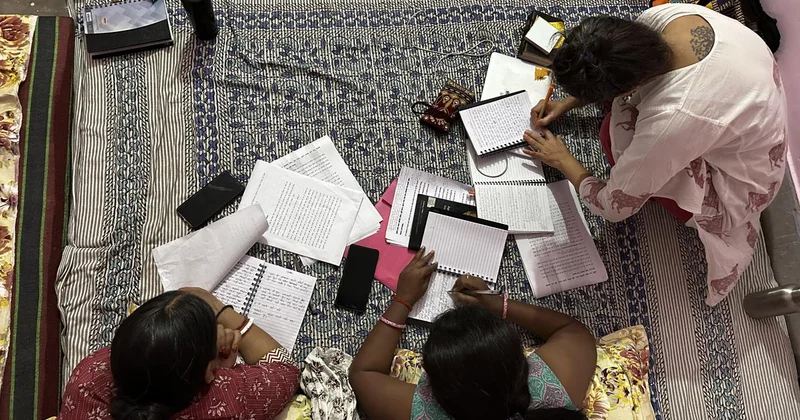
At some point in the early years of Khabar Lahariya, a story about a stolen buffalo calf made the front page. The women who put it there understood that the theft of a calf in rural UP was not a minor story dressed up as news. It was a story about inter-caste harassment, about whose losses count and who gets to decide what the public needs to investigate. The Good Reporter: A Memoir of Journalism in the 21st Century is a memoir about journalism built on that understanding.
The book opens with a warning. “This is a somewhat elliptical, unreliable autobiography of ten very different women,” it says before you have properly settled in. The story of what this collective has done over two decades of rural journalism in UP “has always been a better story to tell than how we have done it and keep doing it.” That distinction between the what versus the how is what the entire book turns on. If you came for the rousing version, the collective has already clocked you.
A collective memoir
The Good Reporter is written by ten women from the Khabar Lahariya collective, alongside journalist and co-founder Disha Mullick, and no single voice carries it alone. It has no protagonist or narrative arc to speak of, nor a climax or a neat conclusion that ties 20 years into a tight structure. Instead, it moves inside and outside, between memory and institution, between the individual and the collective, with a deliberate restlessness. It is disorienting for about 15 pages and then it becomes the only honest way to tell this story. A memoir about collective journalism with a single hero at its centre would be a contradiction.
Mainstream journalism has long maintained a fantasy about what a good reporter looks like. They are detached, objective and unencumbered by personal history or community loyalty. What this fantasy obscures is that it was always a description of a very specific kind of person – urban, mostly upper-caste, with journalism degrees, arriving in communities they do not belong to and would likely never return to. The women of Khabar Lahariya, by contrast, may not have known the difference between a Member of Parliament and a Member of the Legislative Assembly when they started, but they knew who couldn’t show their face in certain neighbourhoods, who would not be tolerated at certain water sources, which communities felt safe and which did not. Their early training involved building on identities and status in the areas they reported from. Several of the collective’s members are Dalit women reporting from and on communities they belong to and the journalism that resulted is inseparable from their social status. What they know is because of where they stand, not in spite of it.
The body is where the book keeps returning. Fear is something these women felt in their bodies, staying awake all night “haunted by the voice that said we could never be good journalists if we felt fear.” Sexual harassment in public spaces is remembered as “invisibilising” yourself, the body folding inward to counter someone else’s presence. And then there are the illnesses, diseases contracted through years of field reporting without access to adequate healthcare; their bodies ended up paying a price that nobody accounted for.
The book does not look away in the moments when the collective’s feminist politics and its members’ lived realities don’t align. One of them reported critically on the Sati temple in Jari, questioning its history. She also asked for blessings every time she passed it. Another laughed at a sexist joke in the field and felt the shame of it later. A woman spent years reporting on dowry harassment while simultaneously saving up for her own relative’s dowry. These confessions are offered as evidence of something the collective understands about political life that most institutions prefer not to admit – that you can hold a feminist nazariya in your mind and still be held by older beliefs in your body. A transformation is a slow and non-linear process.
A part of the whole
The chapter on institutional architecture, where the collective describes what they actually built to make this work possible, is the part of the book that stayed with me the longest. “The first design principle, the most foundational,” they write, is that “we have put the body of the woman – in our case, the rural marginalised woman – at the heart of the organisation: her life, her needs, her fears, and her desires.” What follows is a description of an organisation that saw its members whole: their legal battles, their medical crises, their domestic violence cases, the tedium of accompanying a colleague through years of court dates. The word they use for this is “care,” but what they actually describe is labour – hard, expensive and even thankless at times. The book is clear-eyed about the fact that not everyone in the organisation bore this equally and that as Khabar Lahariya grew and went digital, the pressures of efficiency pushed people into lonely silos in ways that sat uncomfortably against everything they had said they were building.
The book does not end so much as stop. Twenty years since their inception, they continue to cover stories, renegotiate their beliefs while also acknowledging the contradictions of their own selves. The collective asks early on whether you would allow for a narrative that liberates them from the success story, the archetypes of hero and/or victim. By the time you reach the end, you understand that this was less a request and more a notice. They were always going to tell their stories on their own terms, and you were always going to lend them an eager ear.
The Good Reporter: A Memoir of Journalism in the 21st Century, Disha Mullick with Geeta Devi, Harshita Verma, Kavita Bundelkhandi, Lakshmi Sharma, Lalita, Meera Devi, Nazni Rizvi, Shyamkali, and Suneeta Prajapati, Simon and Schuster India.
We welcome your comments at letters@scroll.in.