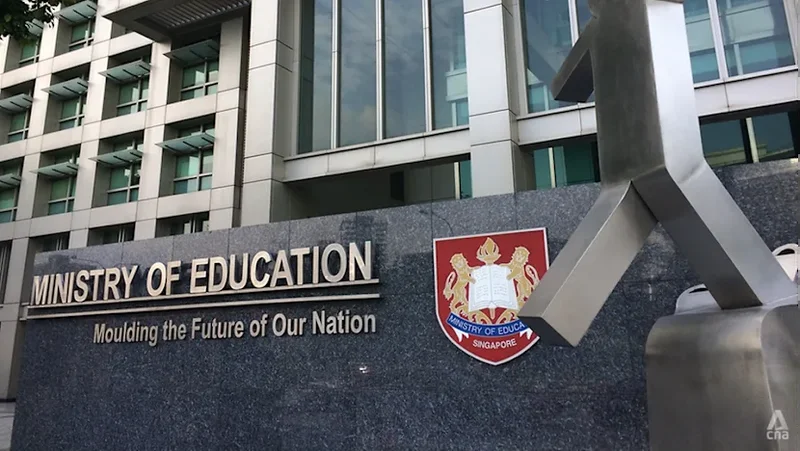
More students can pursue mother tongue languages under expanded programme from 2027
The Ministry of Education will expand Tamil and Chinese language elective programmes and the Malay (Special Programme), giving more students opportunities to deepen their learning of mother tongue languages.
SINGAPORE: More students will be able to pursue the study of mother tongue languages and literature at an advanced level from 2027, as the Ministry of Education (MOE) expands its Mother Tongue Language Elective Programme (LEP).
Education Minister Desmond Lee announced this at the 14th Mother Tongue Languages Symposium on Saturday (Aug 1), with the expansion aimed at giving more students opportunities to deepen their language proficiency and appreciation of culture and literature.
From 2027, MOE will broaden access to the Tamil language elective programme at both the secondary and junior college levels through a centre-based approach at the Umar Pulavar Tamil Language Centre.
This is in addition to the two junior colleges - Anderson Serangoon and National - and three secondary schools - Commonwealth, Riverside and Yishun Town - currently offering it. The move will allow students from schools that do not currently offer the programme to participate and provide a clearer pathway for such students going from secondary school to junior college.
The Chinese language elective programme at the junior college level will be expanded to a sixth school, Anderson Serangoon Junior College.
MOE will also expand the Malay (Special Programme), which allows students whose mother tongue language is not Malay to learn it as a third language, and gain an understanding of the Malay community in Singapore and regionally.
From 2027, National Junior College will become the programme's fifth centre, enabling more students to take up Malay as a third language.
"We want to create pathways for students who want to learn Mother Tongues more deeply," said Mr Lee.
He also noted efforts to strengthen Mother Tongue language education at other levels.
"At preschool, we have been piloting more Mother Tongue language exposure at six of our MOE Kindergartens, increasing it from one hour to 1.5 hours each day. Early results are encouraging ... We are studying the pilot further to assess whether it should be scaled up," Mr Lee added.
The language elective programme, offered at selected secondary schools and junior colleges, is designed for linguistically talented students with a strong interest in Chinese, Malay or Tamil.
At the secondary level, the programme focuses on building a strong foundation in language and cultural appreciation through the study of mother tongue literature, while the junior college programme seeks to cultivate deeper interest through cultural activities.
In another initiative, MOE will launch a new AI essay marking system for Chinese language in secondary schools from September.
The system, which will be available on the Singapore Student Learning Space platform, will help Chinese language teachers handle routine marking, such as grammar, spelling and sentence structure in handwritten and typed essays.
"This will free up time for our mother tongue teachers to focus on supporting students who need more guidance, while ensuring that our teachers remain firmly in the driver’s seat to guide their students on how to improve," said Mr Lee.
MOE added that teachers will remain responsible for reviewing and curating feedback generated by the system.
They will also be able to customise the system's settings to suit students with different language proficiency levels, allowing for more personalised feedback.
Mr Lee also touched on a new programme launched by the Committee to Promote Chinese Language Learning alongside Tengah grassroots organisations to help parents engage infants in Chinese through "sight, sound and touch".
"We will be developing similar programmes for Malay and Tamil as well, in collaboration with the Malay Language Learning and Promotion Committee and the Tamil Promotion Committee," he said.