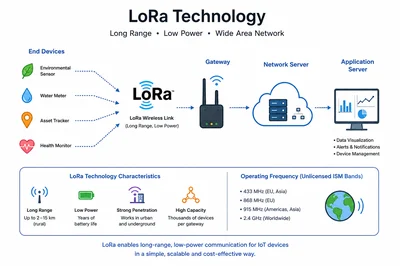
I get asked this question at every trailhead, every muster point, every post-exercise debrief: "Why not just use your phone?" Fair question. Phones are good. They are also a rented service that depends on a tower, a backhaul link and a company that has no idea you exist. Most of the time that arrangement works fine. The rest of the time, it fails exactly when you need it most and that gap is where mesh earns its keep.
I have spent enough dawns raising masts and staring at blinking LED rings to have opinions on this, so let me lay them out plainly. No marketing copy, just field notes.
The Default Case: Cell Wins, and It Should
Let's not pretend cellular is bad technology. It isn't. For the vast majority of daily life, a phone on LTE or 5G beats any mesh radio I own. Bandwidth is enormous, latency is low, the infrastructure is someone else's problem, and the device fits in your pocket next to your keys. If you're coordinating a weekend hike near a trailhead with two bars of signal, or running logistics for an event in a city, cell is the right tool. Don't overthink it. Don't show up with a mast and a case full of nodes when a group chat would do.
The mistake I see, especially from people new to off-grid gear, is treating mesh as a cellular replacement. It isn't. It's a different tool for a different failure mode.
Where Cell Actually Breaks
Three situations keep showing up in my logs, and they are the ones that matter:
Dead zones
Not every place has a tower nearby and coverage maps lie more than people expect. Canyons, dense forest, backcountry roads, the far side of a ridge — these zero out a phone regardless of carrier. I've watched people stare at "SOS only" for hours, which sounds reassuring until you remember SOS only works if the emergency system on that particular network is configured for it in that particular region. A LoRa mesh node doesn't care about a tower. It cares about line of sight and hop distance to the next node. That's a fundamentally different failure surface, and it's one you can engineer around with node placement instead of hoping a carrier expands coverage.
Disasters
This is the ugly one. Cell networks are built for daily load, not disaster load. When a hurricane, wildfire or earthquake takes out towers or overloads the ones still standing, everyone in the area reaches for their phone at once and the network falls over from congestion even where hardware survives. I've been on comms during exercises simulating exactly this, and the pattern repeats: voice fails first, SMS degrades, data crawls. Mesh doesn't have that congestion collapse in the same way, because there's no central tower to overload. Messages hop node to node. A well-placed relay on a truck bed or a ridge can keep a small area talking long after cell has gone quiet. It's not glamorous. It's a text that says "we're at the staging point, two injured, need transport" getting through when nothing else can.
Group coordination without infrastructure
This one surprises people. Even with full bars, cell isn't great for tight group coordination in the field — hiking teams spread across a valley, a search party, a small crew working a site with no cell tower for twenty miles. Group texts depend on everyone having signal simultaneously, and that rarely happens outdoors. Mesh nodes talk to each other directly and relay automatically, so a group of six spread across a ridge line can share position pings and short messages without a single tower in range. I run this setup on every multi-day exercise now; small handheld nodes, a beacon interval tuned to battery life, and a shared map that updates as people move. It's not instant messaging. It's closer to a slow, reliable heartbeat, and for coordination that's often exactly what you want.
Where Mesh Loses, Honestly
I'd be lying if I said mesh wins everywhere. It doesn't. LoRa mesh is low bandwidth; you're sending short text and position packets, not photos, not video, not much of anything data-heavy. Latency is worse than cellular; a message might take seconds to hop across a chain of nodes instead of arriving instantly. Range depends heavily on terrain and antenna placement, so a mesh that works beautifully on open water can struggle in dense tree cover without careful node siting. And it requires you to actually own and carry hardware, which means battery planning, firmware updates and a bit of a learning curve that a phone simply doesn't ask of you.
If your comms need involves anything bandwidth-heavy, or if you're somewhere with reliable cell coverage and no reason to expect it to fail, mesh is extra weight for no benefit. Bring it as insurance, not as your primary.
The Actual Decision
Here's the checklist I use before a deployment, and it's the same one I'd hand anyone else:
- Will there be reliable cell coverage the entire time? If yes, mesh is backup only
- Is there any chance of a dead zone, congestion event, or infrastructure failure? If yes, mesh becomes primary for critical traffic
- Does the group need to coordinate across distance without a tower? Mesh, every time
- Do you need to move data, not just short messages? Cell, or a hybrid setup with a gateway bridging mesh to a satellite or cell backhaul when available
The honest answer to "cell or mesh" is usually both, layered, with mesh picking up exactly where cell drops. That's not a compromise. That's just how resilient comms actually get built, not by picking a winner but by knowing which tool covers which failure.