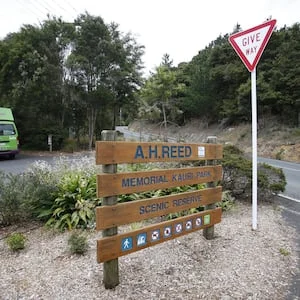
Parks and recreation manager Sarah Snowden said protecting kauri is a shared responsibility, and council will work in partnership with hapū to ensure this response is guided by tikanga and kaitiakitanga.
Signs will be placed at all entrances to the park to alert the public to the presence of kauri dieback. A hui will be held on Wednesday to work out a biosecurity response, which would likely include track closures.
There will also be active monitoring and testing of the ngāhere (bush) for further disease.
The fungus-like organism causing kauri dieback, phytophthora agathidicida, infects the root system, preventing trees from taking in vital nutrients.
Signs of infected trees include yellowing leaves, dead branches and lesions which bleed gum.
AH Reed Memorial Kauri Park contains kauri trees up to 500 years old, which can be viewed from a raised walkway. Photo / NZME
The phytophthora spreads by the movement of soil or water, with humans and animals being vectors, and can be spread by root contact of infected trees.
The disease is almost always fatal to infected kauri trees, with no known resistance or cure.
The discovery has disappointed Hōri Parata (Ngāti Kororā, Ngātiwai, te whānau o te Hinetapu), who is part of Ngātiwai Trust Board’s Kauri Dieback Team.
While kauri dieback has been around for many years, he blamed the spread on people walking through infected areas.
“People want to go for a walk, sure, but you’re going around poisoning the place as you go.”
Parata wanted to see the park managed in a way that took into account He Whakaputanga and Te Tiriti o Waitangi.
Phoenix Ruka, chairman of council’s Te Kārearea Strategic Partnership Committee, sent an email to mana whenua and other stakeholders on Friday to explain the discovery.
A kauri dieback wash station was installed at AH Reed Memorial Kauri Park in 2018. Pictured from left are then-Department of Conservation workers Richard Greenhill and Clayton Blackwood, and Jerome Luiten from NZ Track Works. Photo / NZME
Kauri hold deep spiritual significance to tangata whenua, and the wider community, as tupuna (ancestors) and kaitiaki (guardians), he explained.
“We take this discovery extremely seriously,” he said.
“Our priority is to act responsibly, transparently, and in partnership to minimise risk and protect our taonga species and wider ngāhere.”
Ruka said the work will include tikanga processes guided by kuia and kaumātua.
The council will engage with hapū, mana whenua, Department of Conservation and specialists such as Kauriology and Kauri Ora, to work out risk mitigation and longer-term management.
Auckland Council, which has experience managing kauri dieback in its Waitākere Ranges, has also been approached to give advice.
AH Reed forms part of Whangārei’s popular Hātea River Walkway.
A high-tech boot cleaning station to prevent kauri dieback spread was donated by DoC and installed at the park entrance in 2018.
Denise Piper is a news reporter for the Northern Advocate, focusing on health and business. She has more than 20 years in journalism and is passionate about covering stories that make a difference.