After Iraq faced unprecedented joint U.S.-Saudi airstrikes against Iran-backed militias on its territory early on Wednesday, its government has declared its “top priority” is to modernize the country’s air defenses. Baghdad made similar declarations over six years ago following American and Iranian strikes on its sovereign soil.
Tensions between Saudi Arabia and the Houthis in Yemen boiled over in July, threatening the March 2022 ceasefire. Amid renewed Houthi attacks on Saudi energy infrastructure, the kingdom also found itself under fire from drones launched from Iraq to its north. Iran-backed militias in Iraq previously targeted Saudi Arabia during the height of the Iran war and even after the April 8 ceasefire. This time Riyadh joined the United States by launching a series of airstrikes against those Iraqi militias backed by Iran’s powerful Islamic Revolutionary Guard Corps.
“U.S. and Saudi fighter aircraft struck multiple terrorist logistics and weapons sites across eastern Iraq in a strong response to over 30 IRGC-directed aerial drone attacks in the last 72 hours,” read the U.S. Central Command statement on the joint attack. Iraq’s Popular Mobilization Forces stated that the strikes killed 20 and wounded 32 of their fighters. The PMF are a state-sanctioned paramilitary force but also have groups within its ranks that operate independent of Baghdad and at Tehran’s behest.
Baghdad was clearly caught off guard by these strikes. Government spokesperson Haider al-Aboudi said Iraq hadn’t “granted any approval for attacks on specific sites or groups within Iraqi territory” nor had the government had any “prior knowledge of the attacks on Iraqi territory.” Iraqi Prime Minister Ali al-Zaidi canceled a trip to Saudi Arabia previously planned for Thursday.
Zaidi’s spokesperson Sabah al-Numan said the prime minister had “issued strict and immediate orders… to raise alertness and readiness to maximum across all camps and bases, particularly at the official bases of the armed forces and the Popular Mobilization Forces.”
Furthermore, Numan said that modernizing and rebuilding the country’s air defense through the acceleration of plans to acquire radar and air defenses is a “top priority.”
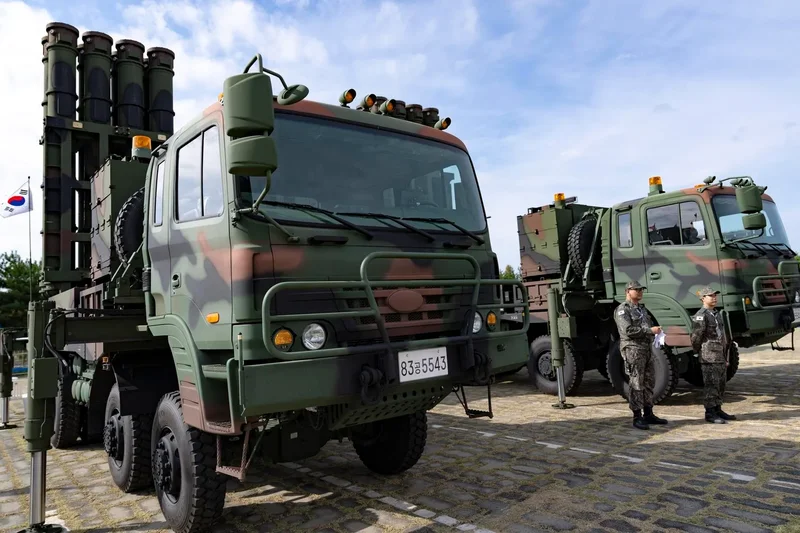
Such comments are nothing new. In fact, Iraq began 2026 with what looked like a promising outlook for the future of its limited and neglected air defenses. Reports from late 2025 indicated that it would begin receiving the medium-range Cheongung-II, or KM-SAM, air defense missile system it had ordered from South Korea as part of a landmark $2.78 billion deal. It’s also expected to finalize a deal for 14 advanced Dassault Rafale F4 multirole fighter jets from France and was already upgrading its airspace coverage with acquisitions of French-made Thales Grand Master 403 and GM200 radars.
Far from accelerating air defense procurement, Baghdad may actually fail to realize its initial plans to upgrade its air defenses that predated the present Iran war.
Earlier in the Iran war, Numan told Iraqi Kurdistan’s Rudaw Media Network that the government had decided to manufacture air defense systems for countering repeated drone attacks. The systems envisaged by the plan would provide point defense for important facilities. Furthermore, he said they would protect facilities inside the autonomous Kurdistan Region of Iraq, which faced constant attacks from Iran and militias inside Iraq, in addition to the federal provinces.
However, that nascent plan has already hit a major stumbling block. In July, Iraqi Kurdistan’s BasNews reported that Iraq is unable to protect Iraqi Kurdistan’s airspace. Iraq’s air defense commander reportedly told lawmakers that the autonomous region’s airspace isn’t under Iraqi control and therefore “we are not permitted to protect its skies.” According to the report, Muhannad Ghalib al-Asadi also clarified that the Cheongung-II delivery has been delayed since Baghdad still hasn’t paid its second installment. “The first payment has been made, and the second installment is still pending,” he said.
Earlier in July, Iraq’s Shafaq News reported that Iraq is at risk of losing the contract altogether, with South Korea warning that it could even sell the system elsewhere if Iraq doesn’t complete its payments. Iraqi MP Faleh Al-Khazali told the outlet that Iraq paid the initial $500 million installment but has delayed further payments that were due last year.
It’s worth noting that the United Arab Emirates received its first Cheongung-IIs at the height of the Iran war when it was under daily fire, swiftly pressed them into service and achieved multiple intercepts, marking the system’s combat debut. Consequently, Seoul would presumably not baulk at delivering these systems to Baghdad amidst active regional conflict once it fulfilled its payments in full.
Iraq also recently ordered Turkish systems, most likely the Korkut anti-aircraft gun for point defense against drones. Effectively integrated, these Korean and Turkish systems could potentially provide a layered defense for Iraq against everything from fast high-flying ballistic missiles to small slow low-flying drones. The Korkuts could even provide essential protection for the higher-end Cheongung-II batteries against close-range threats like FPV drones launched from nearby.
All this seems up in the air for the moment.
In the late 2010s, Iraq openly flirted with upgrading its air defenses with long-range Russian S-300 or S-400 strategic air defense missile systems. Baghdad was aware that it could end up incurring American sanctions under the Countering America’s Adversaries Through Sanctions Act introduced in 2017 and reportedly suspended talks on an S-300 acquisition in 2019 due to this real risk.
Baghdad’s calculations briefly changed in January 2020. After U.S. airstrikes killed 25 Iran-backed Kataib Hezbollah militants in Iraq and Syria in late December 2019 in retaliation for a militia rocket attack that killed a U.S. military contractor in Kirkuk, large protests occurred at the U.S. Embassy in Baghdad. On January 3, President Trump made the fateful decision to order a drone strike that killed Qassem Soleimani, head of Iran’s IRGC’s extraterritorial Quds Force, and Kataib Hezbollah commander Abu Mahdi al-Muhandis. They were both killed as their car left Baghdad International Airport. A few days later, Iran ordered a direct ballistic missile attack targeting an Iraqi airbase hosting U.S. troops.
Iraq similarly felt scandalized that its sovereignty had been so blatantly affronted and disregarded. It immediately signaled it would restart the process of acquiring the strategic Russian systems to give it some capability to deter or prevent such attacks in the future. Iraqi Ambassador to Iran Saad Jawad Qandil and the chairman of the Iraqi Parliament Defense Committee Mohammad Reza al-Haider both told media that Iraq was negotiating an S-300 acquisition.
Moscow encouraged Baghdad, suggesting it should opt for the more advanced and expensive S-400 over the S-300 it previously opened negotiations over. Echoing Turkey’s justifications for its contentious S-400 acquisition completed the year before, which led a ban from the F-35 program and CAATSA sanctions slapped on Ankara, Iraqi officials claimed America offered no viable alternative. “We are talking to Russia about the S-400 missiles but no contracts have been signed yet,” Karim Elaiwi, a member of the Iraqi Parliament Security and Defense Committee at the time, told The Wall Street Journal. “We need to get these missiles, especially after Americans have disappointed us many times by not helping us in getting proper weapons.”
Igor Kurushchenko, a member of Russia’s defense ministry’s general council, also pitched the S-400 as a sure way for Iraq to ensure its “sovereignty and reliable protection of its airspace.” “Iraq must be able to protect itself from missiles fired from the U.S. and Iran,” he said.
Russian Ambassador to Iraq Maxim Maksimov clarified that Iraq didn’t make any formal request for S-400s. As Iraq seems to have rediscovered with the Cheongung-II delay, acquiring higher-end air defense systems can require a hefty financial commitment.
None other than Russian President Vladimir Putin hawked his air defense wares a few months before the Soleimani assassination. On September 14, 2019, Saudi Arabia endured an unprecedented drone attack against its vital oil infrastructure claimed by the Houthis but widely suspected of being orchestrated by Iran. (Incidentally, the enormous Abqaiq facility targeted then appears to have been targeted again in past week’s attack that Saudi Arabia just retaliated against alongside the United States.) Barely concealing his evident glee, Putin dubiously boasted that Saudi Arabia’s American-made air defenses failed where Russia’s would’ve succeeded. Therefore, he urged Riyadh to follow in Turkey's and Iran’s steps by buying S-400s and S-300s. It’s worth recalling in the years since then that Israeli airstrikes destroyed all of Iran’s S-300s without losing any fighter jets and that Turkey is presently exploring a feasible way to dispense with its unused S-400s to regain entry into the F-35 program.
Despite its emotional response to the violations of January 2020, Iraq’s renewed bid for S-300s or S-400s ultimately went nowhere. Today, it remains to be seen whether its “top priority” for modernizing its air defenses will achieve anything tangible in the months and years to come.