It's typical, you wait for ages for a home energy revolution and then two come along at once — or at least that's what appears to be happening in the UK.
You've probably heard about the first landmark moment. 'Plug-in solar' hit the headlines last week when the UK government announced that small, solar panel kits that feed electricity directly into your standard home socket can legally go on sale from August 27.
That's a big deal. Plug-in solar means that millions of people who have traditionally been locked out of generating their own clean electricity — renters and flat owners, for example — will be able to join the residential solar party, albeit on a more modest scale.
But not everyone was celebrating wildly with biodegradable confetti. Across the country, energy nerds bemoaned one glaring omission in the government's new legislation — a legal pathway for 'plug-in batteries'.
For many, these small home batteries — think a mini Tesla Powerwall that plugs into a standard wall socket — are the "real game-changer", as Octopus Energy and Anker both described them to me. That's because they promise to be even more accessible than plug-in solar and act as a money-saving brain that makes your home an active part of a smarter UK electricity grid.
Bold claims indeed, so I spoke to four of the biggest players in this burgeoning space — Anker, Octopus Energy, EcoFlow and Windfall Energy — along with the UK government to find out when plug-in batteries might be coming, what the drawbacks are and, most importantly, how much you can really expect to save...
When are they coming?
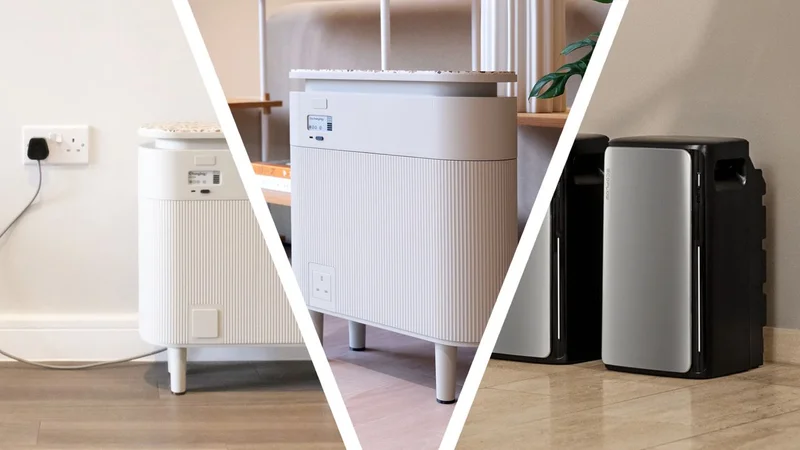
The main premise of plug-in home batteries, like the Windfall Battery above, is simple — they charge automatically using cheap-rate electricity (usually at night), then discharge that electricity around your home during more expensive peak-rate periods. "Even without solar panels, a plug-in battery delivers meaningful savings through grid arbitrage alone," Anker Solix's EU CEO, Kelvin Cao, tells me. Savings estimates range from between £100-£400 per year, depending on your battery, tariff and usage.
Sign up for breaking news, reviews, opinion, top tech deals, and more.
Great, so when exactly will they become legal in the UK? When I asked the Department for Energy Security and Net Zero (DESNZ), the official answer was predictably vague. "We are rolling out plug-in solar, which will be quickest to reach the market — helping to bring bills down for good," a DESNZ spokesperson said.
Plug-in batteries are smart energy storage devices that connect to your home's electrical network through a standard wall socket, without any professional installation. They automatically charge from the grid when electricity is cheap and release energy back into your home during peak-rate hours to cut your energy bills. They can work on their own or alongside solar. While they're not currently legal in the UK, that could potentially change soon.
The DESNZ told me its main focus right now is plug-in solar kits and that plug-in batteries have their own technical and regulatory hurdles, which it's currently investigating. Still, there are hopes that grid-connected batteries that plug into your wall socket could be legalised within the next year.
Several big players are quietly preparing plug-in batteries — which are already available in countries like Germany — for a UK launch. Anker, for example, has built a page for its Solix Solarbank 4 that clearly explains the benefits of plug-in batteries, should they become legalised in the UK. "We are eager to support the rise of the plug-in era in the UK and become part of its evolving energy landscape," Anker Solix's EU CEO, Kelvin Cao, told me.
Octopus Energy also recently announced that its new plug-in Nook Cube battery will go on sale sometime in 2027. More confident on the timescale is Windfall Energy, a London startup that's designed the best-looking piece of home energy kit I've seen for a while, the Windfall Battery.
"I was at a roundtable with a Minister of Parliament about a month ago, and everyone there was pretty much calling for batteries to come hot on the heels of plug-in solar," Windfall Energy's co-founder Rob Hallifax told me.
So when is Windfall expecting to start selling its 2.5 kWh home battery, which has an RRP of £1,200 and had previously been slated to ship in autumn? "Winter is more likely now. We want to time it with the plug-in regulations. It’s looking like the end of this year, early next," he added.
Why now?
You'll probably have noticed that the UK has been on an energy rollercoaster that can technically be described as 'not fun'.
Back in the late 1990s and early 2000s, inflation-adjusted gas and electricity prices were actually stable or even falling. But there was a huge spike for both in early 2022 and they've never returned to pre-energy crisis levels. Electricity prices are still 13% higher than in January 2020, according to the UK government, and they continue to move in the wrong direction.
Plug-in batteries promise to be, if not a cure, then at least a much-needed pain killer for our energy bills headache. They're emerging now because of three things — falling prices for lithium-iron-phosphate (LFP) batteries, the easing of electrical regulations in some regions (Germany created the world's first dedicated plug-in solar product standard in late 2025), and soaring wholesale gas prices that are reflected in the graph above.
As Anker's Kelvin Cao tells me, this has "reshaped how European households think about electricity". Unfortunately, that double-digit increase in energy prices is also "unlikely to come down any time soon". That's why Germany started the trend, and the UK is (hopefully) about to follow.
So how exactly do plug-in batteries save you money? "There’s two parts to the price saving," Windfall Energy's co-founder Rob Hallifax tells me. "The simple one is just the price arbitrage. So if you're paying 10p at night and 30p in the day for electricity per kilowatt hour, then you buy it at 10p, use it when it's 30p, you're saving 20p kilowatt hour," he says.
That part's pretty simple — with the Windfall Battery, this 'buy low, use when prices skyrocket' approach makes up about £168 of its promised £250 per year savings. But there are also extra savings from getting your plug-in battery really singing in tune with the electricity network.
The UK grid acts a bit like a giant smart thermostat, signaling when the system needs more or less electricity, and the idea is that energy suppliers could follow by telling plug-in home batteries when to charge and discharge. Smaller plug-in batteries would likely be capped at an 800W output (without professional installation), so wouldn't be exporting power to the grid. But they could still play a role in balancing demand.
This makes tariffs the second big factor in the money-saving potential of plug-in batteries — and that's something Octopus Energy has been a UK leader in.
"The energy sector overall has not really embraced the fact that you can just offer different types of products to different types of consumer customer groups," Alex Schoch, Group Director for Flexibility at Octopus Energy, tells me. "Of our eight million customers, 1.2 million are on some kind of smart tariff," he adds.
Octopus Energy told me there could potentially be dedicated plug-in battery tariffs or bolt-ons for existing ones. If you've ever been baffled by choosing the right energy tariff, this could also get simpler thanks to plug-in batteries.
"I equate it to the evolution of mobile phone plans," Octopus Energy's Alex Schoch tells me. "First, they were incredibly generic. Then they got so complicated that Carphone Warehouse came into being just to explain the complexity. And now we’re at a stage where we create hyper-personalised plans based on your needs as a consumer. We’re on that same journey when it comes to energy".
But doesn't this also demand a lot of trust in energy companies? Windfall Energy's Rob Hallifax agrees, but thinks falling bills will ultimately convince consumers. "It's their (consumers'] battery, they're in control of it, but the energy company is controlling it a bit to help them maximize the savings," he says. "The consumer has to trust that the energy company is doing this to save them money, and I think that will come when they see their bills go down," he adds.
What's the catch?
Clearly, plug-in batteries won't be a magic wand for everyone's bills, even if the batteries could be subsidised or even given away for free by the UK government to lower income households, as the i Paper reported recently (the DESNZ declined to comment on this when I asked).
For most plug-in batteries, the payback period (the time it takes for savings to cover the cost of the battery) is expected to be around 3-4 for years, so not exactly a financial quick fix. The Windfall Battery promises annual savings of £250 (with an RRP of £1,200), while Anker tells me that the larger Solix Solarbank 4 on a dynamic tariff like Octopus Agile could save you just under £400 per year. That battery has no UK price yet, but retails for €1,999 in Europe (around £1,700).
The other concern raised by skeptics is safety. Is allowing potentially millions of households to connect batteries to their electricity networks without professional installation really a good idea? Windfall Energy's Rob Hallifax acknowledges that it's an understandable concern. "People see a battery, and they think of scooters and fires, and there some valid concerns. Obviously, safety is critically important, and just one battery fire would be one too many," he says.
"But modern batteries are generally extremely safe,' he adds. "There are some studies out of Germany now where they compare batteries to EVs and other home appliances. One headline is that they’re typically about as safe as a washing machine," he adds. The other common comparison is with fan heaters, which are legal in the UK but carry a higher risk of 'user error' incidents than plug-in batteries.
Still, the added complexities of grid-charging batteries mean some agree with the UK government's top-dipping approach. EcoFlow, one of the biggest global players in home batteries, is among them. "We're aware and completely understand that these things take time," Lorna Wallace-Smith (EcoFlow's Head of UK PR) told me. "The fact that they were able to move forward with at least one step is is great" she added.
But hasn't Germany's rapid adoption of both plug-in solar and home batteries shown it's safe? "I think that's something we should learn from, as well as not fast-track into into something without knowing it's absolutely built for UK homes," she added.
Could they outshine solar?
Despite these concerns, it seems clear that plug-in batteries have the potential to eclipse the more complex plug-in solar kits in the UK — and most of the experts I spoke to agreed.
"They are the fundamental great equalizer," says Octopus' Alex Schoch on plug-in batteries. "It’s such an important thing for renters because you can then take it with you to your next place," he adds.
"I think in the next couple of years we will see plug-in batteries really be the transformational scale deployment. I think it has the potential of being a mass market thing even faster than solar," he predicts.
Windfall Energy's Rob Hallifax naturally agrees when comparing plug-in batteries to their solar equivalent. "There are 28 million homes in the UK and about half of them are either rented or flats and small homes. So more people could get them, millions, and there’s also the benefit to the grid and to the system," he says.
There is one other obvious comparison with an accessory that's cheap, easy to use and promises to save you money. "We use air fryers as quite a good example. Four or five years ago they just came from nowhere and suddenly half the country has one," he says.
But wouldn't an 'air fryer' level of popularity also cause a problem for plug-in batteries? After all, a lot of their money-saving potential comes from tapping into today's so-called 'delta' between cheap-rate and peak-rate electricity. If plug-in batteries help to solve the imbalance of today's grid demand — and tariffs are adjusted to reflect that — could that start to diminish their savings potential?
"I think yes and no," says Windfall Energy's Rob Hallifax. "So maybe in 50 years the whole grid will be sort of perfect. I think the fundamental thing is that if you have renewable generation, that's always going to be variable. That's just the nature of the world. And so somewhere in the system, storage has to be part of it," he adds.
Octopus Energy's Alex Schoch agrees that such a change would be a long way off. "In theory, yes." he says in response to my pessimistic scenario. "But I would actually say the length of time here is measured in decades, not in a sub-decade quantum," he adds.
However, he does note that a similar process is already happening. "We've had such an explosion of solar in the UK over the last few years that now during Spring and Summer, a lot of the cheapest wholesale price electricity times are actually late morning, early afternoon, mid afternoon, and no longer overnight," he notes.
Charging ahead
The legalisation of plug-in batteries in the UK appears to be a matter of 'when' not 'if'. As a flat owner in south west London with no roof and only a limited appetite for plug-in solar, I'm right in the target market — and will certainly be interested when that moment comes.
But it also won't be an impulse buy where I snap up the first thing I see Amazon. "The biggest pitfall to avoid is making decision on price alone," says Anker's Kelvin Cao. "Now that plug-in solar has regulatory approval, the UK market will attract a wave of low-cost imports, some of which will be excellent and some of which will not. This will be a similar problem once the plug-in batteries are legalised," he warns.
"A battery that cuts corners on cell quality, protective engineering and compliance with applicable safety standards might look more attractive on its price tag, but it will not deliver the same reliability over the 10 to 15 years that a household should reasonably expect," he adds. In other words, buying cheap could backfire when it comes to savings.
So what exactly should you look for when plug-in batteries are legalised? "As a baseline, consumers should look for durable LFP battery cells, a high cycle life, robust protection against weather and corrosion, and integrated safeguards against electrical and thermal risks," Kelvin Cao says.
"They'll probably also say that the product must be listed on the Energy Networks Association (ENA) Type Test Register to demonstrate that its protection settings meet G98 requirements," adds Windfall Energy's Rob Hallifax.
A real-world view
A large number of early adopters are already getting a taste of the benefits of a battery-only setup. One of those is TechRadar contributor Mark Pickavance, who wrote our EcoFlow Stream Ultra X review (which is well worth a read).
I caught up with him to see how it's going and he continues to be impressed. He told me that his monthly energy costs are down by about £40 a month with his setup (which was installed with the help of an electrician), and you could get most of that from a single Ultra X.
The only problem is that this stuff can get addictive. "I started with the premise of using just a battery, but once you have one the logical progression is solar. However, for people renting, it's the ideal solution, and if you use an Economy 7-like tariff (Octopus Go), you can take a chunk out of your costs," he said.
The arrival of plug-in solar from August could, then, be a good dry run of what to expect when plug-in batteries arrive. The big differences between residential buildings between Germany and the UK could mean plug-in solar doesn't quite take off in the same way in the UK, but Anker's Kelvin Cao remains bullish.
"This is no longer a niche movement. Germany passed one million officially registered plug-in solar systems in 2025, with around 430,000 new systems registered during that year alone," he notes. If plug-in batteries follow a similar pattern in the UK, that could have big consequences for energy bills — and the UK's grid as a whole.
Mark is TechRadar's Senior news editor. Having worked in tech journalism for a ludicrous 17 years, Mark is now attempting to break the world record for the number of camera bags hoarded by one person. He was previously Cameras Editor at both TechRadar and Trusted Reviews, Acting editor on Stuff.tv, as well as Features editor and Reviews editor on Stuff magazine. As a freelancer, he's contributed to titles including The Sunday Times, FourFourTwo and Arena. And in a former life, he also won The Daily Telegraph's Young Sportswriter of the Year. But that was before he discovered the strange joys of getting up at 4am for a photo shoot in London's Square Mile.