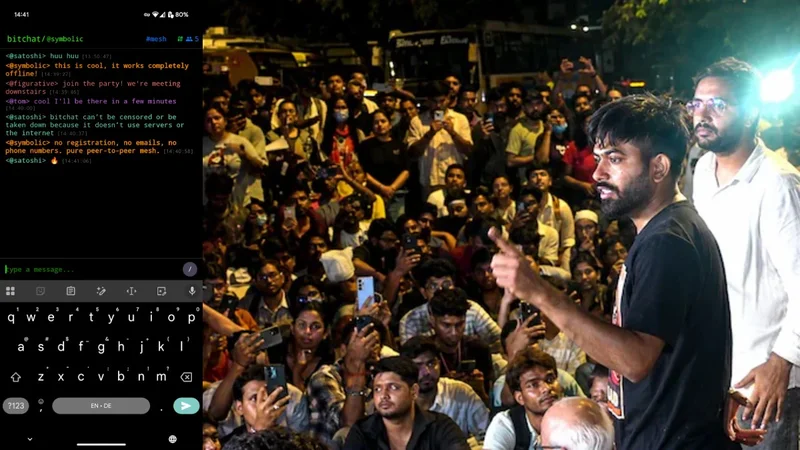
Delhi cops are seemingly investigating whether protesters, currently assembled in Central Delhi in areas like Connaught Place and Jantar Mantar, are using offline messaging apps. The protesters, who call themselves Cockroaches and who are part of Cockroach Janta Party (CJP) protests, are reportedly fighting off internet blocking and mobile network ban through certain specialised apps that use Bluetooth to create a local network. This local network can then be used to send messages even if there is no 4G, 5G or WiFi in an area.
According to a report by the TOI, cops suspect that some protestors may have relied on Bluetooth-based communication apps to stay connected even after mobile internet services were shut down in parts of central Delhi.
While police have not confirmed that such apps were definitely used, the investigation has brought attention to a little-known technology that allows smartphones to exchange messages without relying on mobile data, Wi-Fi or cellular networks.
How do these apps work without mobile services
Unlike WhatsApp, Signal, and Telegram that rely on mobile data or Wi-Fi, the offline messaging apps use Bluetooth Low Energy (BLE), a wireless technology built into almost every modern smartphone. There are a number of such apps, some local and some more widely available.
One of the most well-known offline messaging apps is Bitchat. It was launched by Twitter founder Jack Dorsey in July 2025. The app has over one million downloads on the Google Play Store and it allows users to exchange messages over Bluetooth without creating an account, using a phone number or connecting to central servers. Other similar offline messaging apps are also available on Android.
Bitchat and other apps like this use Bluetooth, which is part of not just phones but also earbuds and other smart devices, to enable offline communication between nearby phones.
When a user sends a message using an app like Bitchat, it does not travel through a mobile tower, Wi-Fi router or central server. Instead, the phone sends the encrypted message via Bluetooth to nearby devices running the same app. Those devices automatically forward the message to other nearby phones, creating a mesh network. In this setup, every smartphone acts as a relay, allowing messages to "hop" from one device to another until they reach the intended recipient.
When more people using the app are present in the same area, the network becomes larger and the communication range increases. Since the messages move directly between devices instead of passing through the internet, these apps can continue working even during internet shutdowns or when there is no cellular coverage. However, they work best over short distances and in areas where enough users are connected to the same mesh network.
Why is Delhi Police looking into these apps?
The report says Delhi Police plans to write to the service providers of such apps to seek information about users as part of its investigation. Although for now no specific apps have been named. Authorities are also examining internet protocol device records (IPDRs), analysing CCTV footage and using facial recognition technology to identify protesters.
It is worth noting that this is not the first time — if indeed such apps have been used in Central Delhi — that protesters have relied on offline messaging apps to communicate and coordinate. It has been seen that many protests across the world, most notably in Hong Kong, Ukraine, and Nepal, similar apps were used by protesters.
These apps are also sometimes used for communication in case of natural disasters when there is a disruption in wired or cellular networks.
- Ends
Published By:
Ankita Garg
Published On:
Jul 22, 2026 13:18 IST